
The melancholy tones of July
1.My uncle, a soldier who returned from the war with one leg and one eye left behind on the battlefield, was constantly being cared for by my aunt whenever the weather changed. But, as if by magic, every July, when he returned home, he would meet his old comrades, participate in the journey back to the old battlefields, and light incense for his fallen comrades. He seemed to recover completely. He was no longer the old man with the amputated leg, limping with pain and fatigue that I used to see. Instead, he was a man full of enthusiasm and passion. My uncle said, "There are people who have given me the chance to live their lives."
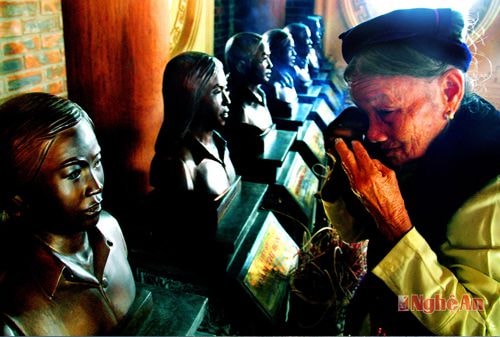 |
| Mother of Martyr Le Thi Em at the Truong Bon Historical Site. Photo: Tran Canh Yen |
I was also fortunate enough to accompany my uncle on a journey, standing silently before a vast expanse of graves. My uncle and his comrades, their hair already gray in the breezy afternoon, their eyes welling up with tears, touched each name on the tombstone: “Thu, Ai, Tam… we’ve come to visit you. Our hair is all gray now, only yours remains forever green…” Among the crowd standing in the cemetery that afternoon was an uncle from Thai Binh. My uncle recounted that visiting his home made him realize just how brutal the war truly was. Of six children, she only managed to raise four. When my uncle and others visited, all four of his children were crawling on the floor, their minds blank. Agent Orange had shattered the hopes of him and his wife. He said his wife couldn’t sleep many nights, clinging tightly to the bed to hide her sobs. He only said to his wife: “At least I’ve returned, and at least we still have hope…” That's right, the soldiers returning from the brutal bombings and shelling had resolved that they must live for the lives of their fallen comrades...
2.I remember, during a conversation, journalist Le Ba Duong, a native of Nghe An province – famous for the poem inscribed on a stone monument on the banks of the Thach Han River, who brought the idea of lighting candles and releasing flowers to honor fallen comrades on this very riverbank to fruition – told me about his unending longing and sorrow. This July, opening his personal Facebook page, I came across newly written lines of poetry: “Every year July rushes back / To the long nights amidst the smoke of incense / Late nights leaning towards the battlefield / Meals choked with longing for friends / Where are you, my friend, who haven't returned yet? / Leaving July white with the smoke of incense all around.” I once asked him: In such fierce warfare, where life and death were separated by a hair's breadth, how many of his comrades died without their graves found? If he could choose again, would he choose the same path he chose: at 15, he lied about his age to... enlist and fight on the most brutal battlefields? He said nothing, only looked at me with surprise. That look made me feel incredibly foolish. Why didn't I understand? War is a tragedy, but fighting for national independence is the purpose of every life!
3.Both my father and uncle often recount the day they left for military service. My grandmother saw them off on the village road. I asked my father, "What did you say to Grandma then?" He replied, "Just like everyone else says to their mother: 'Stay safe and sound, Mom. I'll be back when we've defeated the enemy!'"
Later, my father told me about a fellow villager who fought alongside him that year and had been killed in action. Years had passed since the death notice arrived, but his mother still couldn't believe her son had fallen on the battlefield. She believed in his promise: "When we defeat the enemy, I will return..." She would often sit by the door, gazing out at the deserted village road. To this day, his family and comrades haven't found his remains. My father said that later, when he visited cemeteries, before the graves marked "Unknown Martyr," he felt as if he could see the face of his friend's mother, her eyes filled with longing and anticipation, behind each tombstone.
I often wonder if there's anywhere else in the world with as many strange farewells as in my country? Farewells without specifying a return date, only a firm belief, a promise: when victory is achieved, when the enemy is completely gone, I (he/she) will return. Is there anywhere else, like my country, where so many mothers long for their sons, so many wives wait for their husbands? Waiting until their hair turns gray, waiting until they turn to stone... And I also believed that those soldiers, they weren't lost, they just hadn't returned yet...
TV


