
Things to do during the Kitchen God worship ceremony.
(Baonghean.vn) - Ông Công Ông Táo (the Kitchen God) is a deity who is the chief figure in determining the fortune and misfortune of each family, so worship and rituals dedicated to him were highly valued by people in the past.
1. Clean the altar in preparation for the Kitchen God ceremony.
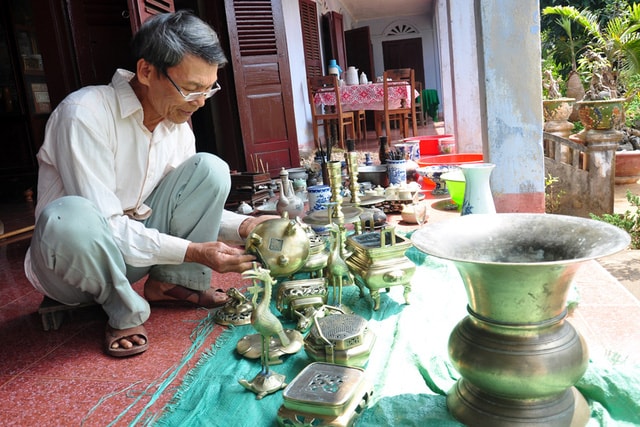 |
| Cleaning the altar in preparation for sending the Kitchen God back to heaven. |
Before cleaning the altar, prepare a plate of fruit to place on it, then light an incense stick to inform the ancestors and deities that the altar will be cleaned today, inviting them to temporarily move aside so that the descendants can carry out the task.
Next, prepare a table covered with red cloth or paper to place the ancestral tablets. If the altar contains both ancestral tablets and tablets of deities, they must be placed in two separate areas and not mixed together. Wait until the incense has completely burned out before beginning the work.
When cleaning ancestral tablets, use warm water, not cold water. When cleaning, if there are tablets of deities or Buddhas, clean them first, then pour fresh water to clean the ancestral tablets; absolutely do not clean the ancestral tablets first.
Next comes cleaning the incense burner. Nowadays, most people pull out the incense sticks and then empty the ashes from the incense burner. According to the old saying, this can easily lead to "losing wealth." Therefore, people use a small spoon to scoop out the ashes little by little before washing the incense burner clean and setting it aside.
When the incense burner is dry, if it's for worshipping gods and Buddhas, use seven gold paper bills; if it's for ancestors, use three gold paper bills. Burn them around the burner until they're half-burned, then put them inside. Wait until the gold paper bills are completely burned, then pour the ashes in all at once. This is called "small outflow, large inflow," meaning "money flows out in small drops, money flows in like a waterfall." If you pour everything out at first and then scoop in small amounts, it's called "small inflow, large outflow," meaning "money flows out a lot, money flows in little."
Burn seven more sheets of gold paper to cleanse the area where you want to place the statue/altar of the deity and the incense burner, then place the objects in their designated positions. After placing them, light 12 incense sticks and insert them in order according to the direction of time:
- The first stick is placed at the 1 o'clock position, and when placing it, one recites "nian nian shi hao nian," meaning every year is a good year.
- The second stick is placed at the 2 o'clock position, and when placing it, one recites "Nguyệt nguyệt thị hảo nguyệt," meaning every month is a good month.
- The third stick is placed at the 3 o'clock position, and when placing it, one should say, "Every day is a good day."
- The fourth stick is placed at the 4 o'clock position, and when placing it, one should recite "times are good times," meaning every hour is an auspicious hour.
Continue this process sequentially until the 12 o'clock position. The positions of the ancestral tablets and incense burners for the ancestors and female ancestors are also arranged in the same way.
2. Arranging the altar for worshipping the Kitchen God.
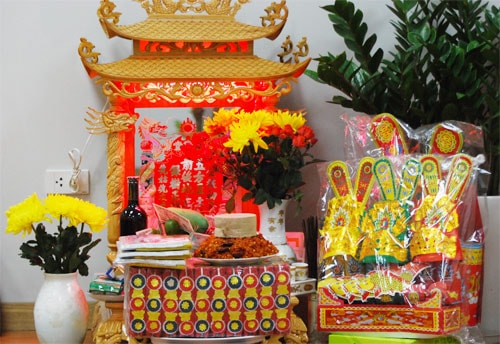 |
| In feng shui, placing an altar for the Kitchen God and Goddess is not something to be done haphazardly. If you want your family to have good fortune in the new year, you should know how to properly place the altar to avoid bad luck. |
The altar dedicated to the Earth God is usually placed in the side rooms, away from the ancestral altar. If a household does not have an ancestral altar, the Earth God altar can be placed in the central room of the house.
The altar for the Earth God is very simple, consisting only of an altar table placed against the back wall. On the altar table is a small table or shelf holding three wine vessels. Behind this small altar is the Earth God's tablet, which is placed high up. Sometimes, instead of a tablet, the homeowner uses three hats. These hats consist of one woman's hat in the middle and two men's hats on either side. The men's hats have dragonfly wings, while the women's hats do not. Sometimes, due to the limited space of the altar, the homeowner only places one hat.
In front of the small shelf is placed an incense burner or censer. On either side of the incense burner are a pair of candles or oil lamps. A pair of incense holders can also be placed.
The altar dedicated to Ông Công and Ông Táo (Kitchen Gods) is not just for one deity, but for three deities with three different titles. The altar tablet displays the titles of all three deities. Each deity oversees a specific task: Thổ Công (Kitchen God) oversees the kitchen, Thổ Địa (Household God) oversees household affairs, and Thổ Kỳ (Market God) oversees women's shopping or the reproduction of plants in the garden.
According to traditional beliefs, each family has its own Earth God (Thổ Công). This Earth God is replaced annually on the 23rd day of the 12th lunar month. In Vietnam, this day is called the day the Kitchen God ascends to heaven or the Tet Ong Cong Ong Tao (Kitchen God Festival). On this day, families prepare offerings and burn the old altar tablet, replacing it with a new one.
3. Prepare the offerings for the Kitchen God ceremony.
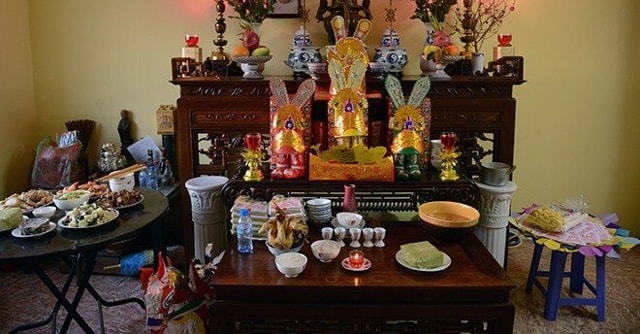 |
| A complete offering tray for the Kitchen God. |
The most important ceremony for worshipping the Kitchen Gods is the Kitchen God Festival on the 23rd day of the 12th lunar month. During this ceremony, after the offerings are made, the Kitchen God ascends to the Supreme Being to report everything he has seen and heard in the mortal world that he has recorded.
In the past, to prepare for the Kitchen God's ascent to heaven, families would burn votive paper, hats, clothes, and shoes from the previous year and release a carp to serve as a "horse" for the Kitchen God to ride. It was believed that after the offering, the live fish along with the ashes of the votive paper, hats, and clothes were thrown into a river or pond, where the Kitchen God would receive them. The released fish would transform into a dragon to carry the Kitchen God to heaven. Nowadays, many families don't keep the hats and clothes for the whole year; they buy them only for the Kitchen God's festival and burn them immediately after the offering.
Because of the significance of the ceremony, to prepare offerings for the Kitchen God, one must first buy hats, robes, and shoes. There must be three hats for the Earth God: one for a woman and two for men. The men's hats have dragonfly wings, while the women's hats do not. The color of the hats depends on the elemental nature of the year. For example, if the year is associated with the Wood element, choose green; with the Metal element, white; with the Fire element, red; with the Earth element, yellow; and with the Water element, black.
In some places, there is a custom of burning paper horses as offerings to the Kitchen God, and the color of the horse can be chosen according to the five elements. After the hat and robe, another common item is a live carp placed in a basin of water, which will be released into a pond or lake after the ceremony.
Regarding offerings to the Kitchen God, the family can offer either vegetarian or non-vegetarian dishes. Vegetarian offerings include gold and silver paper, banknotes, betel nuts, water, and fruit. If the family wishes to offer non-vegetarian dishes, they can offer pork sausage, pork trotters, sticky rice, and other traditional dishes. However, there are some types of meat that are avoided in offerings. For example, dishes made from duck, bird, goose, buffalo, cow, goat, and dog. In general, the most common offerings are made from pork and chicken.
4. At what time should we offer sacrifices to the Kitchen God and the Stove God?
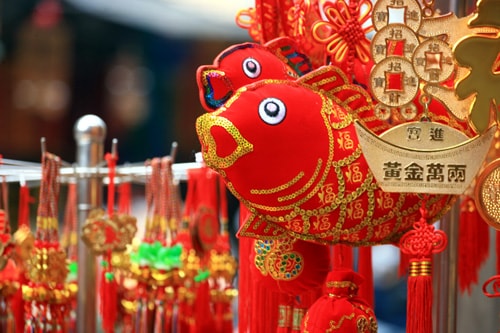 |
| What time should one offer sacrifices to the Kitchen God and the Stove God on the 23rd day of the 12th lunar month? |
The ritual of worshipping the Kitchen God and the Stove God is usually performed on the 23rd day of the 12th lunar month. So, what is the best time to worship the Kitchen God and the Stove God?
On the 23rd day of the 12th lunar month each year, families typically prepare offerings to bid farewell to the Kitchen Gods (Ông Công and Ông Táo) as they ascend to heaven. According to folk beliefs, Ông Công is the god who governs the land, while Táo Quân (consisting of two male gods and one female god) oversees the kitchen in the household. On the 23rd day of the 12th lunar month each year, these deities fly to heaven to report to the Jade Emperor about everything that happened in the family during the past year.
On the 23rd day of the 12th lunar month, the hour of the Horse (from 11 am to 1 pm) is considered a sacred time, suitable for sending the Kitchen God and the Stove God to heaven.
However, in reality, many people are busy with work and cannot perform the ritual of offering sacrifices and releasing fish at this time, so it is not necessary to offer sacrifices to the Kitchen God at midday. Some other opinions suggest that the ceremony of sending the Kitchen God back to Heaven should be performed on the evening of the 22nd or early morning of the 23rd of the 12th lunar month.
If the homeowner is busy with important work, they should complete the offering to the Kitchen God and the Stove God before 12 noon on the 23rd day of the 12th lunar month, because otherwise, they will not have enough time for the gods to ascend to heaven.
Peace
(Synthetic)
| RELATED NEWS |
|---|


