
Values derived from practice
(Baonghean) - Land consolidation and exchange, encouraging land accumulation, is a practical necessity and a long-term solution aimed at developing commodity production, increasing people's income, promoting sustainable agricultural development, and contributing to the construction of new rural areas. After more than a year of implementing land consolidation and exchange in accordance with Directive 08-CT/TU of the Provincial Party Committee, it has been shown that this is a correct policy, consistent with reality, and brings about socio-economic benefits. Initial results
(Baonghean) - Land consolidation and exchange, encouraging land accumulation, is a practical necessity and a long-term solution aimed at developing commodity production, increasing people's income, promoting sustainable agricultural development, and contributing to the construction of new rural areas. After more than a year of implementing land consolidation and exchange in accordance with Directive 08-CT/TU of the Provincial Party Committee, it has been shown that this is a correct policy, consistent with reality, and brings about socio-economic benefits.
Initial results
The achievements after 10 years of implementing land conversion, in accordance with Directive No. 02-CT/TU dated April 5, 2001, of the Provincial Party Committee, are of paramount importance in the development of agriculture and rural areas in the province. The land conversion process has resulted in larger land plots than before; upgraded the internal irrigation and transportation systems; gradually transformed the structure of crops and livestock, increasing economic efficiency per unit area; and contributed to poverty reduction. However, the size of land plots after conversion remains small; the average number of plots per household is still high (over 5 plots per household), plots are not contiguous, and large, economically efficient specialized farming areas have not yet been formed.
In response to this situation, the Provincial Party Standing Committee issued Directive 08-CT/TU on May 8, 2012, to promote the consolidation of land plots among farmers and encourage land accumulation for large-scale agricultural production. After more than a year of implementation, 91 communes have completed land consolidation, with nearly 100,000 households participating on over 24,000 hectares of agricultural land. After the conversion, the average plot size ranges from 800 to 1,600 m2; the average number of plots per household is from 1 to 3; and the average number of farming areas per household is from 1 to 3.
Mr. Nguyen Manh Toan, Deputy Head of the Land Management Department (Department of Natural Resources and Environment), assessed: In general, the results of land consolidation and exchange in the field are basically consistent with the purpose and progress of the approved land consolidation and exchange plan. Land consolidation and exchange have created conditions for the development of commodity production; specifically, 15 large-scale model fields have been built, bringing high economic and social efficiency, increasing productivity and output by 10-15% compared to conventional methods, increasing farmers' income and contributing to the construction of new rural areas.
Among the 19 districts and towns that organized land consolidation and exchange, Anh Son, Yen Thanh, Thanh Chuong, and Quynh Luu were assessed as having performed well. These districts had implemented land consolidation and exchange before the Provincial Party Committee's Directive 08 was issued. However, many localities still achieved low results. The approval of various planning documents at the commune level in districts such as Con Cuong, Que Phong, Quy Chau, Thai Hoa, etc., is still slow, and in some places, it has not been implemented at all. Even some pilot communes, which were planned to be completed before 2013, have not yet finished.
Good experience
Tuong Son is a mountainous commune in Anh Son district that still faces many difficulties. After completing land conversion according to Directive No. 02-CT/TU of the Provincial Party Committee in 2001, the farmland in Tuong Son remained fragmented and small. On average, each household still used 4-7 plots of land, or 3-5 different fields. After the issuance of Directive 08 of the Provincial Party Committee, the commune continued to supplement and refine its plan to ensure it met the provincial criteria. After more than a year of conversion, Mr. Nguyen Van Linh, Vice Chairman of the Commune People's Committee, breathed a sigh of relief: To date, the commune has completed land conversion on the entire cultivated area of 12 villages. After conversion, the average is 1.97 plots per household (of which, rice land is 1 plot/household and other cultivated land is 1 plot/household). The entire commune has repaired and built 11,675 meters of internal field roads and 11,736 meters of irrigation canals. The fragmentation and small-scale nature of land ownership have been eliminated, and public land is planned according to management zones and used effectively.
According to Mr. Linh and the members of the commune's Steering Committee, the success was due to their reliance on the people's strength and their support. Initially, when implementing the plan and soliciting public opinion, the commune faced some opposition from a segment of the population. However, the commune's officials determined that while policies are issued from the top down, implementation must come from the bottom up. Accordingly, the Tuong Son commune's Steering Committee persistently carried out mobilization and propaganda work among the people, using methods such as organizing dialogue meetings and face-to-face discussions.
Mr. Linh shared: "To ensure the people understood and participated, Tuong Son commune had to organize 180 meetings, both large and small, from the commune level to the hamlet level. Specifically, in Hamlet 5, initially, some households did not fully understand the purpose and positive meaning of land consolidation and reallocation, so they did not participate. I went directly to the hamlet with the hamlet's leadership committee to organize a meeting with the people using a dialogue method. The people's questions were answered immediately, without beating around the bush, and in the end, the people understood and implemented it very well."
To increase democracy and stay grounded in reality, the commune required each hamlet to develop a land consolidation plan based on the actual situation of its agricultural land. In Hamlet 5, the fields were fragmented, with as many as nine different plots, including narrow, uneven areas and ravines. At one point, both the district and the commune determined that Hamlet 5 would not be able to consolidate and exchange land plots. With a spirit of democracy, fairness, and transparency, the residents of the hamlet ultimately supported and enthusiastically participated. After the plan was finalized, the commune proceeded with surveying and mapping all the plots.
Mr. Tran Ngoc Long, head of Hamlet 5, said: "To ensure fairness, the hamlet divided the rice fields into plots located near the embankment to make it convenient for people to cultivate. Difficult areas are cultivated first, followed by easier ones." Sharing his experiences, Mr. Long openly stated: "Cadres and Party members must set a good example and not act for personal gain. During implementation, we must ensure that each step is done thoroughly and effectively, then the people will agree."
Unlike Tuong Son commune, Tao Son commune (Anh Son district) chose a different approach that still ensured democracy and transparency, relying primarily on the people's participation in the land consolidation and exchange campaign. Immediately after the District Party Committee's Resolution 03 on land consolidation and exchange was issued, the commune solicited opinions from the people and compiled them into a draft plan for the entire district. The commune then incorporated and revised the plan to create its own specific plan tailored to the local characteristics and production situation. The goal was for each household to receive 1-2 plots of rice land and 1 plot of arable land (compared to an average of 6 plots per household before the conversion), linked to the planning of internal field transportation and the construction of new rural areas.
Mr. Hoang Dinh Son, Chairman of the People's Committee of the commune, said: Initially, some people disagreed and wanted to receive 4 plots per household. Faced with this situation, the commune organized 8 meetings from the commune level down to the hamlets to persuade the people, with the principle: The minority must submit to the majority, and the Party leads, the government implements. The area of agricultural land allocated to the people according to Decree 64 will remain unchanged and must be completed in 2012.
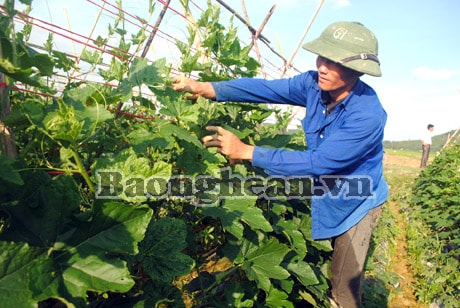
The family of Mr. Dao Van Tu, Hamlet 5, Tao Son Commune (Anh Son District), has converted their rice paddy land to pumpkin cultivation, yielding high economic returns.
The approach taken by Tao Son commune demonstrates the strong determination of local government leaders, with a focus on high consistency from top to bottom. After agreeing on the proposed plan, the commune directed a meeting of residents from all 12 hamlets to implement it overnight. The land consolidation and exchange plan was developed in 10 steps, implemented from top to bottom. From propaganda, planning, data collection... to the actual allocation of land to people for production, everything was thoroughly understood and agreed upon with a high level of focus. Therefore, the results of land consolidation and exchange in Tao Son after the conversion have met the set targets. The average area of one plot is 1,200 m2; the average is 2.7 plots/household (of which: average rice land is 1.7 plots/household; average cultivated land is 1 plot/household); the average is 2.5 farming areas/household.
Phuc Thanh commune (Yen Thanh district) is considered one of the bright spots in land consolidation and exchange in the entire province. Before the conversion, Phuc Thanh's farmland was fragmented and scattered, with each household owning an average of 3 or more plots, and irrigation and transportation infrastructure was inadequate. To overcome this situation, the Party Committee and People's Council of the commune issued a Resolution on the land consolidation plan, facilitating the introduction of mechanization into the fields and the construction of new rural areas. The commune developed a land consolidation plan and guided each hamlet to develop its own consolidation plan. Within just 3 months, the commune completed the process and proceeded with the land allocation to the people. Each household or group of families now owns only 1-2 plots of land in each farming area.
Thanks to these results, Phuc Thanh was chosen as a destination for many localities throughout the province to visit and learn from. Sharing the lessons learned, Mr. Dinh Van Duong, Chairman of the People's Committee of the commune, said: During the implementation process, the commune linked the planning of rice fields with the planning of new rural construction. This served as both a basis and a prerequisite, as well as a measure for the commune to mobilize contributions from the people and external financial resources. To gain high levels of public support, it is necessary to ensure benefits and convenience in production. Therefore, when developing the conversion plan, the commune planned each rice field area close to the residential area of that hamlet. It encouraged fathers and sons, siblings, or family groups to gather in one concentrated area. These are the prerequisites for the commune to plan large areas where households share the same farming practices and seed sources, thus building large-scale model fields for high income.
Value from practice
It's easy to see the positive changes after localities basically completed land consolidation and reallocation on the ground. Standing in the middle of a vast field of over 20 hectares in Hamlet 5, Tuong Son Commune, the entire scene resembles a painting with neat, straight square plots. The internal field road system, built with a mixture of paddy field and hill soil, is 5 meters wide, with 1-meter-wide irrigation ditches on both sides. Cars can now reach every field and plot without any obstacles. Mr. Nguyen Van Linh, Vice Chairman of the Commune People's Committee, said: Thanks to the large-scale planning, Tuong Son Commune has been able to build 4 model fields (2 hybrid corn models and 2 rice models) with an area of 40 hectares/model. At the end of the model, the rice and corn yields of the commune increased 1.5 times. In the 2013 winter-spring crop season alone, the total rice and corn production of the commune reached 6,300 tons, exceeding the planned annual target of 7,135 tons, achieving 84.4%.
Thanks to land consolidation and reallocation, the commune has boldly transformed its crop structure to improve economic efficiency. Many high-quality corn and rice varieties have been introduced into production. This year is the first year the commune has implemented summer-autumn corn cultivation on alluvial land, and it is developing well. Currently, the commune has planned a 25-hectare sugarcane cultivation area in the Coconut field region. This area is high-lying land, where corn cultivation yielded low returns. Recently, people harvested sugarcane for 1.8 billion VND, 1.5 times higher than corn cultivation. The commune has also planned a 5-hectare area to build a model with the hope that people will learn from and follow it.
The family of Mr. Dang Thanh Hien (Hamlet 5) owned 5 sao (approximately 0.5 hectares) of land, but it was divided into 7 plots across 5 different fields. After land consolidation, his family now only has 2 plots for both rice and other crops. With the land consolidated into a larger plot, his family hired a bulldozer to level the fields and invested in intensive farming, resulting in a significant increase in rice yield from 6 quintals to 9 quintals per season. “Before, the rice was only enough for 7 people to eat, but now we have enough to sell. During the off-season, I work as a construction laborer, earning 170,000 dong a day, so our family's life has improved considerably,” Mr. Hien shared.
Turning to Tao Son, a model commune for new rural development in Anh Son district, the mindset and production thinking of the people have changed significantly after the land conversion. Currently, the entire commune has 10 multi-functional plows, and each household has one hand-held combine harvester, something that was nonexistent before the land conversion. Along with introducing high-yield, high-quality rice and corn varieties into production, Tao Son is encouraging people to promote the transformation of crop structure to increase productivity and create a breakthrough in agricultural production. The future direction is to designate an area to build a large-scale model field of 50 hectares, applying the method of slow-release granular fertilizer to improve rice yield. These are important conditions for the commune to build a new rural area, with two key criteria being income and labor structure transformation.
Identifying cassava and pumpkin as key crops, the commune encouraged residents to convert land previously used for watermelon cultivation to intercropping cassava and pumpkins on dry, hilly land. Mr. Dao Van Tu, from Hamlet 5, happily stated that since the land consolidation and exchange program was implemented, residents in the commune have felt reassured and confident in the commune's policies. On his 2.5 sao (approximately 2500 square meters) plot, he switched from rice cultivation to pumpkin farming. On average, his family earns about 20 million VND per sao per crop.
The most noticeable change after land consolidation and reallocation is in Phuc Thanh commune (Yen Thanh district). Before the consolidation, the commune had 86 multi-functional plows; after the consolidation, the number increased to 327. The people in the commune also invested in two combine harvesters, each costing over 500 million VND, and more than 100 hand-held harvesters. Previously, it took the commune nearly 20 days to sow, plant, and harvest. Now, the time has been reduced by half. Thanks to the large-scale land consolidation, the commune has built a large-scale model rice field for F1 hybrid rice production under a competitive project, covering 35 hectares. The total value of the model reaches 140 million VND/hectare/year.
The commune has also established a 100-hectare field for producing Khang Dan rice seeds, with an average income of 80-90 million VND/hectare/year. Currently, Phuc Thanh commune has achieved 16 out of 19 criteria of the New Rural Development program. In particular, the income criterion has reached an average of 22 million VND/person/year. Mr. Ngo Tri Truong, head of Xuan Son hamlet, said: "When implementing land consolidation and exchange, everyone in the hamlet supported and participated enthusiastically. As a result, the number of plots has been reduced, averaging 2 plots per household, per field. Labor costs have decreased, productivity has increased, so everyone is happy. People in the hamlet are participating in a model field for hybrid rice production and it promises to yield high productivity."
The above facts confirm that the State's policy of land consolidation and exchange, specifically in the province as concretized by Directive 08-CT/TU of the Provincial Party Committee, is extremely correct, appropriate, and is bringing practical results and values to rural and agricultural development. However, this work still has a long way to go, requiring all levels, sectors, localities, and the people to work together to create unity and strength to strive to achieve the set plan. One difficulty arising after land consolidation and exchange is that the conversion of crop structures to suit and effectively work in many localities is still confusing and lacks direction. Therefore, the agricultural sector needs to demonstrate its role, promptly guiding localities to find suitable directions to achieve the highest efficiency, helping farmers feel secure in their land, improving economic efficiency, and contributing to the construction of new rural areas.
Cong Sang - Pham Bang


