
Thirsty lands...
(Baonghean) - For the people of Pu Duoc and Pu Khon in Dong Van commune (Que Phong district) and Yen Luom, Diem Bay, and Chau Quang in Quy Hop district, water is more precious than gold. They live with this dark gray water source every day...
We arrived at Pu Duoc village, Dong Van commune (Que Phong district) in the pouring rain, the muddy roads forcing the rickshaw driver to slow down. The first thing I noticed was that every house had a long row of basins and pots lined up in front of it. The Thai rickshaw driver from Pu Duoc village said: "The villagers collect rainwater for drinking. Water is very scarce here, and it doesn't rain heavily, just a constant drizzle like this. It takes several days to gather enough water for one bucket. In the highlands, when it's sunny, it's very hot, the streams dry up, and there's no spring water to use!"
Since moving to the new village, where he hasn't been allocated any land for farming, Village Head Pao bought a Chinese-made motorbike. In his free time, he sits at the Đồng Văn commune's crossroads waiting for customers, earning a few tens of thousands of dong a day. His main occupation is digging for ginseng and raising fish in the lake. Speaking about the villagers' water supply in Pù Duộc, Village Head Pao sadly recounted: "For the past few months, the water reservoir built by the Hủa Na Hydropower Project to serve the two villages of Pù Duộc and Pù Khón has deteriorated severely. The villagers have to take turns collecting clay to fix the problem so they can have water to drink."
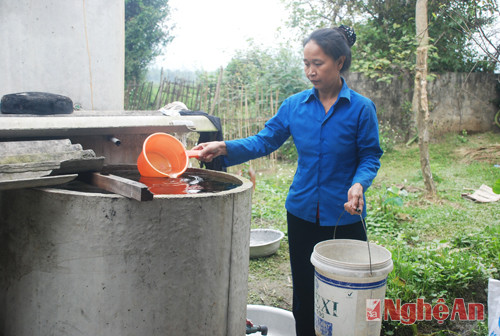 |
| The people of Yen Luom village filter water for daily use. |
I followed the village chief, Pao, to the water reservoir. Some groups were carrying soil on their backs, others were kneading it; it looked very hard work. Mr. Lang Van Cau was returning with soil on his back, sweat streaming down his face and shirt. He said, "Three times a week, the villagers take turns carrying soil here. We have to go all the way to the foot of the hill inside the Pieng Van reservoir (almost 2 kilometers away) to get the clay; the soil there is finer. Many times, the villagers have made suggestions to the Hua Na Hydropower Project Management Board, but they haven't done anything yet. The reservoir is broken, and the water pipes are also broken. Families who can't afford plastic pipes to bring water from the reservoir have to go down to the distant stream to bathe and wash clothes, then carry water back for drinking and cooking." On the way back from Pu Duoc, I encountered a group of dirty elementary school students with embroidered schoolbags slung over their shoulders and water containers on their backs.
During our day in Pù Duộc and Pù Khón, we not only witnessed the villagers' yearning for water but also saw the clear danger of poverty. Since moving to the new village, the people have not had land to cultivate, forcing them to dig for ginseng and gather wild plants to survive. Many families go without food, eating only one meal a day. Everyone was eagerly anticipating the cassava plants, newly planted in their yards, as they awaited the day the tubers would ripen.
Leaving Pù Duộc as evening approached, we continued on to another drought-stricken area. Mế Hủn Chương (63 years old), from Yên Luốm village, Châu Quang commune (Quỳ Hợp district), was barefoot, carrying water back to her village. Following her were several children, aged 9 or 10, along with adults pushing the water, their steps weary. Mế Chương said: "We don't have water at home, so we have to go all the way to the riverside hamlet to beg for water. They've only just dug wells there; even with a drill, we can't find water in our village. Each time we go to beg for water, it's nearly 2 kilometers. We have to leave very early; if we leave late, many people will come asking for water, and we'll have to wait a long time."
We arrived at the house of the village head of Yen Luom, Nguyen Van Thanh, just as he was returning from fetching water. His bicycle was loaded with four buckets of water, and sweat dripped from his forehead and back. He spoke breathlessly: "It's not just Yen Luom village that has to live without wells, with heavily polluted streams. Many families in Chau Quang commune share this same situation. Yen Luom has over 100 households, and more than 80 of them don't have wells. The 20 households with wells are those living in the floodplains. Even the nearest wells are more than half a kilometer away, and the furthest are about one to two kilometers. These 20 wells don't provide enough water for the whole village in the summer. In the summer, we mainly fetch water for cooking and drinking; we wash clothes in the stream. Many days, after bathing, we get itchy skin and red rashes, but if we don't bathe, we still have to wash our clothes, and they itch terribly when we wear them..."
Village head Thanh also said: Before 1975, the Yen Luom stream had crystal-clear water, allowing you to see schools of fish and shrimp swimming freely in the deep water. The villagers often reminded each other to keep the water clean and not throw garbage into the stream. Once a week, the villagers would bring their garbage up the hill, dig a hole, and burn it, treating the water as if it were their own lifeline. Over time, the stream became increasingly murky, so the villagers started digging wells. When the wells didn't yield water, they had to ask for water from the riverside hamlet.
When speaking about the water supply in Yen Luom, Vice Chairman of Chau Quang Commune People's Committee Hun Vi Thay's voice was no different from that of Village Head Thanh and the villagers. He said sadly, "The most challenging water situation is concentrated in Diem Bay and Yen Luom. It's impossible to dig wells, and the villagers are living in a state of severe water shortage. The Yen Luom stream is heavily polluted, with a grayish-black color, lots of waste, and occasionally animal carcasses floating in it. In 2011, Chau Quang commune benefited from a clean water project from the Quy Hop district water plant to Yen Luom village, but there were no pipes leading to each household. At the end of 2011, Chau Quang commune allocated over 200 million VND from the local budget to install water pipes to each household in Yen Luom village. The joy was short-lived; in August 2013, a flood washed away almost all the pipes, forcing the villagers to revert to using stream water and continue begging for water..."
Summer is approaching, and the heat will be prolonged. Will the people of Pù Duộc and Pù Khón villages in Đồng Văn commune be able to withstand it? Will the 20 wells in the riverside area provide enough water for Yên Luốm and some households in Diềm Bày village during the hot season?
Text and photos:Thu Huong


