
Models that need to be replicated.
(Baonghean) - Economic models such as forest protection and conservation, farm-based livestock breeding, and the cultivation of corn, ginger, and cassava on hillsides as a substitute for upland rice are taking root in Ky Son, bringing practical results in poverty reduction and being widely implemented by the local people. By selecting crops and livestock suitable to the natural conditions, the people's efforts to overcome difficulties, and the correct policies of the local government, Ky Son is gradually achieving sustainable poverty reduction.
Visiting Mr. Le Thanh Binh's pig farming model in Khe Nhan village, Chieu Luu commune, everyone praised him. Despite his small plot of land, Mr. Binh has created a closed-loop livestock farm model, applying scientific and technical methods to reduce costs and improve economic efficiency. With a pig population consistently exceeding 50, he raises three batches per year, producing 10-12 tons of pork and generating nearly 150 million VND in revenue. By utilizing readily available local feed sources such as corn, cassava, and distillery waste, his profit margin reaches 50%. Two years ago, with support from Project VIE 028's agricultural extension program, Mr. Binh built a biogas digester, ensuring environmental protection in the farming area while also providing fuel, saving him over 20 million VND annually. Mr. Binh said: "Based on the successful livestock farming model, I am currently guiding several households to follow suit, thereby gradually contributing to the formation of a cluster of livestock farms in the commune with a sufficient number of pigs to regularly supply the market inside and outside Ky Son district with the specialty of traditionally raised pork."
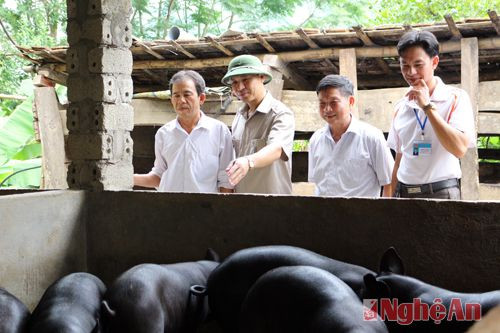 |
| Mr. Le Thanh Binh's model of raising pigs for meat has proven to be highly economically effective in Khe Nhan village, Chieu Luu commune. |
Visiting the natural forest conservation model of Mr. Luong Ngoc Xuan's family in Khe Ty village, Huu Kiem commune, was truly surprising. The area, previously barren, is now covered in lush greenery. Large, sturdy trees, requiring 1-2 people to encircle them, stand tall on the hillside. Under the forest canopy, Mr. Xuan cultivates medicinal plants and raises honeybees. According to calculations by forestry officials accompanying the delegation, thanks to effective conservation efforts, not only is the natural ecosystem of the headwaters protected, but when the harvesting cycle arrives, Mr. Luong Ngoc Xuan's conserved forest area could generate hundreds of millions of dong in income.
Visiting Khanh Thanh village, Nam Can commune, we went to see the cattle and chicken farm of Mr. Moong Pho Ngoc, Vice Chairman of the People's Committee of Nam Can commune. At this time, the farm has more than 60 cows grazing and hundreds of chickens and ducks raised for breeding and meat. Mr. Moong Pho Ngoc said: "On the contracted area of over 24 hectares, I focus on raising commercial cattle and poultry under the forest canopy. Initially, I only had 5 cows, but thanks to good veterinary and disease prevention work, no outbreaks occurred, so the total herd has rapidly increased. Each year, the farm sells two batches, each batch with more than 10 cows, generating an income of over 200 million VND." Not only is he skilled in farm economics, but Mr. Ngoc has also pioneered the model of growing hybrid corn and bananas for commercial purposes, which the villagers have followed, earning nearly 100 million VND annually from these two crops.
It can be said that the pig farming models of Mr. Binh, the forest protection and conservation model of Mr. Xuan, and the local cattle farming model of Mr. Ngoc are three of many effective practices that have been published in the mass media for villagers to learn from and follow. These include the turtle farming, bamboo shoot cultivation, and fish farming models of Mr. Lo Khac Loi in Na village, Huu Lap commune; the agroforestry model of Mr. Lo Van Dung in Hoa Son village, Ta Ca commune; and the ginger cultivation and cattle fattening models of the Mong people in the highland communes. These effective models have become valuable experiences for people to learn from and apply to the specific conditions of each household. Thanks to this, Ky Son now has 405 effective economic models, including 109 integrated economic models, 295 livestock farming models, 9 small-scale handicraft models, and 1 crop farming model... Comrade Le Cong Tam, Head of the Ky Son Agricultural Extension Station, said: "Based on a thorough understanding of the actual conditions of each locality and the existing models, the station advises the District People's Committee to support the replication of these models, and at the same time supports the application of scientific and technical advancements to improve efficiency for the people."
It can be said that during this term, the agricultural and forestry sector in Ky Son has proven effective and suitable to the local soil conditions. For the Mong people in the communes of Na Ngoi, Nam Can, Tay Son, Muong Tip, etc., the district's policy is to promote ginger cultivation, stabilizing the area at 350-400 hectares, along with the sustainable development of Shan snow tea and fattening cattle in households. For areas with medium altitude and low mountains, hybrid corn cultivation will be maintained on over 3,000 hectares in communes along National Highway 7 and the border ring road. In low-lying areas, with a proactive approach to irrigation, the district plans to stabilize the area of 300 hectares of two-crop rice and 1,100 hectares of one-crop rice. Thus, despite the challenging terrain, implementing the Resolution of the 21st Party Congress of Ky Son District, term 2010-2015, Ky Son has clearly established a system of specialty crops and livestock in each sub-region, from the highlands to the lowlands. Thanks to positive changes in the agricultural, forestry, and fisheries sectors, Ky Son has a foundation to accelerate poverty reduction. At the beginning of the term, the poverty rate was over 84%, but it has now decreased to over 52%, and average per capita income has increased from 4.8 million VND to 15 million VND. Comrade Bui Tram, Chairman of the District People's Committee, stated: Based on the proven effectiveness of some crops and livestock, the district will stabilize the area according to the plan, and at the same time invite investors to invest in processing plants such as ginger processing and Shan Tuyet tea processing. Simultaneously, the district will plan locations for collecting and purchasing corn and rice... This is the basis for Ky Son to achieve the target of reducing the poverty rate by 6% each year, aiming for sustainable poverty alleviation.
Hong Son


