
Models that need to be replicated.
(Baonghean)Waste collection and treatment, and improving the rural environment are among the important criteria in the current national criteria for building new rural areas. However, in many localities, waste is becoming a serious problem, directly affecting the environment, lives, and health of the people... While many rural communes in the province are struggling with the issue of waste and waste collection, some communes have adopted innovative and effective approaches that should be replicated…
| RELATED NEWS |
|---|
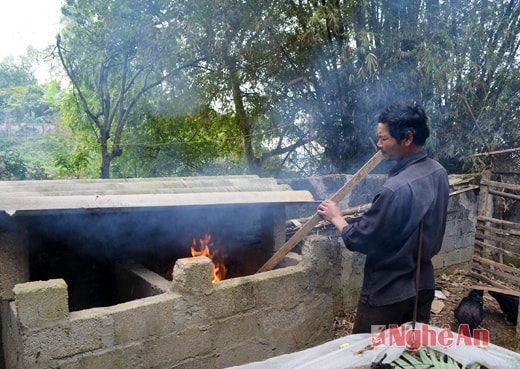 |
| A model of a household waste disposal pit in Thanh Lien commune (Thanh Chuong district). |
The house is clean, but I haven't gone out yet...
As people's living standards improve and their consumer demand increases, so does the amount of household waste generated in communities. Without public waste collection points, roads, ditches, vacant lots, and fields become ideal dumping grounds. Therefore, it's not uncommon to see garbage overflowing everywhere in many rural areas of the province. A clear example is along Provincial Road 8B, in the communes of Hung My, Hung Tien, and Hung Thang (Hung Nguyen district), where all kinds of waste are dumped haphazardly and piled up along the roadside, resembling a large garbage dump.
They not only spoil the aesthetics but also pose a potential risk of toxicity and environmental pollution. Similarly, along dike 42 passing through Hong Long and Xuan Lam communes (Nam Dan district), waste is piled up in heaps, accumulating day after day, emitting foul odors. According to Ms. Tran Thi Hoa from Hamlet 7, Hong Long commune: "This section of road has become a common garbage dump for many years. Not only people from our commune but also people from other communes dump their garbage here. They take advantage of the late night hours to throw their trash, making it difficult to remind them. Many people just throw their trash on the road and speed away. Everyone only cares about keeping their own homes clean, while few people pay attention to the area outside. Over time, it becomes a habit, accumulating a little each day until the waste starts to smell, and then they complain about environmental pollution."
Environmental protection is one of the 19 criteria of the National Criteria Set for Building New Rural Areas, with the overall goal of protecting the environment and ecosystem, and improving and enhancing the quality of the rural environment. However, in Nam Cuong commune (Nam Dan district), fulfilling the environmental criterion is not simple, especially the target of collecting and treating waste in accordance with regulations. After more than two years of implementing the National Target Program for Building New Rural Areas, the commune has seen many positive changes in various fields and achieved 10 out of 19 criteria. However, the environment remains the most challenging and difficult criterion to implement.
Mr. Thai Hong Son, Chairman of the People's Committee of Nam Cuong commune, said: "Nam Cuong commune has a relatively large area, with 1,235 households distributed across 11 hamlets, and a large amount of household waste is released into the environment every day. Currently, the commune only has one planned waste collection and treatment point in Bai Say area, Tan Xuan, serving hamlets 1, 2, 3, and 4, and one point in the Cau Treo area, mainly serving hamlet 5. In the remaining 6 hamlets, households have to handle their own waste. This situation of people handling waste in their own ways has led to the formation of 'mobile' garbage dumps in many places in the commune, because many people still have the mindset of 'clean my house, don't worry about the neighbors'.
And the two proposed locations for waste collection and treatment are also not feasible, because Nam Cuong is a low-lying commune located outside the dike, and annually suffers from 3-4 floods lasting 2 months. This is because waste cannot be burned in time when floodwaters carry waste from the collection sites into fields and residential areas. Currently, the commune has two options for mobilizing people to collect and treat waste: building a mini incinerator in each hamlet, with a person assigned to collect and treat waste receiving 500,000 VND/month, or building incinerators at home. For the mini incinerators, the commune will support 2/3 of the construction costs, and for home incinerators, it will support 50% of the construction costs. However, the timeline for achieving the environmental standards is still uncertain. This is a very difficult criterion to achieve without funding and the cooperation of the people…”
Every day, a considerable amount of waste is generated in rural areas. Although the amount of waste from each household may not be much, the combined waste from the entire village or commune constitutes a significant burden on environmental protection in these areas. Because there are no specific guidelines or regulations on waste disposal from local authorities, each household handles its waste in its own way. The most common and thorough method is to simply throw it wherever possible. Seeing others dumping waste, people follow suit, resulting in the formation of small, scattered garbage dumps throughout the villages and hamlets.
Effective models
While many rural communes in the province are struggling with waste management and collection, some have adopted innovative and effective approaches. A prime example is Thanh Lien commune (Thanh Chuong district). Previously, waste disposal was a major problem due to residents' habit of indiscriminately dumping garbage along canals, fields, and ponds, causing unsightly scenes and environmental pollution. To address this, the commune implemented a household waste incinerator model, spearheaded by the Women's Union and the Veterans' Association. After nearly a year of implementation, the model has resulted in a greener, cleaner, and more beautiful environment for the locality.
Ms. Pham Thi Sam, Chairwoman of the Women's Association of Thanh Lien commune, said: "Since the beginning of April 2013, implementing the policy of the Thanh Chuong District People's Committee on building household waste disposal pits to reduce indiscriminate waste dumping and alleviate the burden on centralized landfills, the commune has launched a movement encouraging people to actively build waste incinerators. To motivate and encourage this spirit, the commune has allocated budget to support 50,000 VND per incinerator. The incinerators are built according to the district's design standards, with surrounding walls, a roof, measuring 60-80 cm wide, 1.5 m long, and 70 cm high, divided into two compartments: one for solid waste and one for waste that can be incinerated by fire. Inside the pit, there is a raised iron grate about 30 cm above the ground to filter and prevent waste from falling in, hindering the combustion of fuels below."
The exemplary conduct of officials and Party members has contributed to encouraging the people to follow suit. To date, 967 out of 1,216 households in the commune have built incinerators for household waste, with leading hamlets such as Lien Tan (107 out of 140 households), Lien Minh (95 out of 139 households), and Lien Dong (79 out of 199 households)... Currently, the commune is continuing to support and encourage people to build more household incinerators. The plan for 2014 is to build public waste pits in the fields to collect agricultural waste, contributing to the early completion of environmental criteria and accelerating the progress of building new rural areas.”
The waste collection and treatment model in Nam Xuan commune (Nam Dan district) is considered highly effective. In 2012, the commune invested in building concrete waste bins along the internal roads throughout all 12 hamlets to facilitate residents in disposing of used bottles and pesticide containers from agricultural production. The bins are constructed like cement pipes, approximately 1.5m high and 80cm in diameter; the average cost per bin is 230,000 VND.
Each field has one waste pit located in a central position. The commune provides over 200,000 VND per pit, and residents contribute 18,000 VND per person per year, equivalent to 1,500 VND per month. In addition, the commune has supported the construction of 1,532 new two-compartment waste pits for households (accounting for 95% of households). To transport non-combustible household waste and chemical waste from the fields, the commune has planned a centralized waste disposal site with a scale of 1,500m².2In the Lum Bang field area (formerly planned for manual brick kilns), with a total investment of 134 million VND, of which the district budget contributed 40 million VND, the rest came from the local budget and people's contributions. To date, the entire Nam Xuan commune has built 166 waste pits in the fields and 100 waste pits at home (mainly concentrated in hamlets 7 and 10). Notably, when the centralized waste disposal site was completed and put into operation, it contributed to reducing the amount of waste, giving the commune a new look, with clean and tidy village roads and alleys…
Waste collection and treatment in rural areas would not be too difficult if local authorities quickly intervened and implemented positive and synchronized policies and solutions. To find a reasonable solution to the rural waste problem, it is essential to first ensure three "necessary" and "sufficient" factors: planning the scale and location of centralized treatment facilities; the organizational model for collection, transportation, and treatment; and the application of treatment technologies suitable to practical conditions, oriented towards long-term sustainability. Among the 19 criteria for building new rural areas, many rely on the people's efforts, including the environmental criterion. Therefore, fulfilling this criterion is not easy for local authorities. When people's self-awareness is not high, environmental sanitation remains a major obstacle in building new rural areas in many localities.
Ngoc Anh


