
The sick
(Baonghean) - Neither moving up nor down, he just kept going down in the final years of his civil service career. The reasons given by his superiors—downsizing, merging departments, or, more vaguely, job requirements—didn't convince him. If it were due to poor performance, disciplinary action, or health problems, that would be understandable, but his criteria were all excellent. So he became angry, lost his appetite, couldn't sleep, and suppressed his frustration, which would erupt at any opportunity. And then, he freed himself by requesting early retirement.
He thought that being away from the hustle and bustle would bring peace; but no, the frustrations of the office still followed him home. Worse still, in the solitude, with only his wife and children, the melancholy intensified. A pessimistic outlook, a heart full of guilt, and self-torment as he reflected on past losses were characteristic of him in the days immediately following his retirement. For him, retirement meant a decline in his life, so he often pondered the uncertain end point of his life. He developed a new habit of counting and comparing ages. When sitting with people his age, he would observe their hair and complexion, guess their birth year, and inquire about their health to subtly compare it to his own. He would pause for a moment when reading obituaries in the newspaper or hearing news of the deaths of close friends and contemporaries. Then, a vague sadness would creep in, causing him to sit silently, contemplating the end of his own life.
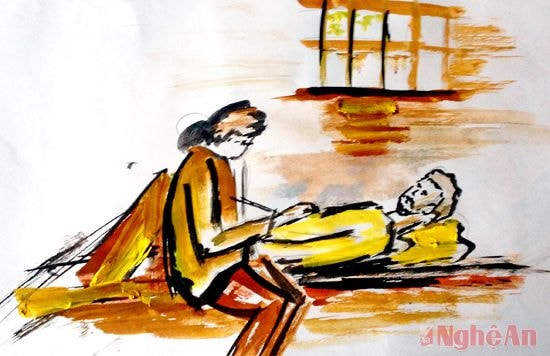 |
| Illustration: Hong Toai |
After retiring, he fell seriously ill. Before, that hateful thing wouldn't dare show its face to torment him, but now it was plotting an attack. He had to do the unpleasant task of taking medicine every day and frequently going to the hospital, a place many people dislike. Illness constantly plagued him, preventing him from doing anything, and forcing him to put many plans on hold. Even the restoration of the church and the renovation of his ancestors' graves in his hometown, which he had planned for a long time, couldn't be carried out.
His old age and ailments even affected his wife and children, who had to endure his erratic irritability. When his wife asked what color to repaint the fence and gate, or what kind of refrigerator to replace, he nonchalantly replied, "You figure it out yourself, what's there to ask about?!" But when she called a plumber to replace some light bulbs and lubricate the ceiling fan that was whirring like a windmill, he became visibly annoyed. As soon as the guests turned their backs, he questioned his wife in an irritated tone, "Why didn't you let me do that?" Hearing his wife's explanation, and seeing how some elderly people carelessly climbed high and fell, landing in a soft heap, he misinterpreted it negatively: "You said I'm very old?" She smiled conciliatorily, "Don't nitpick." Having run out of reasons to argue, he sat motionless, his voice distant and sad, "It turns out I really am useless!" His wife sensed the onset of old age when she saw him suddenly become sulky and easily moved to tears. The man who was once so strong was now quick to weep. Watching a heartbreaking scene on TV or reminiscing about poverty over drinks would bring tears to his eyes. Furthermore, even a casual, harsh gesture or a few careless words from his wife could easily anger him.
His preferences have changed, becoming more introverted instead of sociable as before. Even when invited to parties, he tells his wife to go. Even slightly loud TV volume or the boisterous laughter of the neighbors chatting makes him frown and shake his head. In the past, family frustrations seemed to dissipate and disappear when he went to work. Now, petty annoyances feel frozen, with no way out, making him uncomfortable.
When he was hospitalized, the lingering patriarchal tendencies from his time as a boss made him a patient who attracted a lot of attention. His anxiety about his illness made him even more difficult to please. Even simple matters like food caused arguments. Instead of simply saying what he wanted to eat, he kept whining, "Anything will do," making things awkward for his wife. She felt humiliated when he rudely refused the delicious dishes she had prepared: "How can I eat this?!"; "Just put it away!"… His grumpy words and frowning expression made her both annoyed and embarrassed in front of others. The other patients in the room stared at him; some whispered to her, trying to comfort her: "Everyone gets sick like this, don't blame them." She juggled household chores with rushing to the hospital to care for him, but she didn't feel as tired as she did during his kidney stone treatment. At times, she tried to suppress her feelings, pretending to be cheerful so her husband wouldn't be upset or pessimistic.
She suggested he go out to eat, order whatever he liked, and have it hot. Her underlying intention was to give him some time away from the hospital room to relax. He enthusiastically agreed. She thought it wasn't just about eating; simply walking around and admiring the scenery would make him feel better. After eating at a few restaurants, he changed his mind, reluctant to cross the street amidst the endless stream of cars and people. So he sought out the charitable meals distributed by Buddhist nuns in the hospital courtyard.
It had become a routine: around six in the morning, eleven in the morning, and five in the afternoon, the volunteer group would bring free meals to the patients. At the appointed time, patients or their family members would arrive with bowls or containers to receive their portions of rice or porridge. He joined the crowd, eagerly waiting for his turn, feeling a sense of joy. An elderly woman, dressed in the familiar blue attire of a Buddhist devotee, handed him a bowl of porridge along with words of encouragement: "Please try to finish it!" Those kind words warmed his heart. After a while of bustling around the crowd, the woman stopped, slowly making her way to a nearby stone bench. She placed her feet on the bench, rubbed her knees, massaged her calves, and stretched them repeatedly. After a while, seemingly relieved of the pain, she hobbled back to the steaming pot of porridge, picked up a ladle, and performed her familiar actions. Her clothes were soaked with sweat, but she remained polite to the impatient crowd. Once, seeing her massaging her legs, he approached and asked, "It seems you have sciatica?" She looked up at him, giving a wry smile, "I don't know what it is, but standing for a long time or walking a long distance makes the pain unbearable!" With that, she hurried off to get some porridge for the patient.
About six months later, during a hospital visit, he met the woman again in the same ward. The women's ward was full, so she was temporarily moved to a men's ward. In just a few months, she looked terribly haggard; her head was bald and white, her skin pale and sickly, and she was as thin as a reed. “Almost ten years ago, my wife had cancer, but luckily it was detected early. The whole family advised her to rest and recuperate, but she refused, insisting on doing charity work because she felt her time was running out. While sitting with you in the hallway, her husband sadly shared, ‘Now the disease has relapsed, I think she won’t make it!’” The narrator’s voice trailed off and faded, choked with tears, making him feel a pang in his heart.
The woman braced herself, enduring the pain without a single cry or outburst of anger. Whenever her son's illness temporarily subsided, she would confide in her husband and children about her plans and worries for her final days. Her greatest worry was that no one would care for her husband. She told her daughter that he was an only son, spoiled since childhood, and therefore clumsy in the kitchen; she wondered who would cook his favorite dishes. Hearing her granddaughter read online about a foreign woman who, knowing she was about to die, tried to prepare as much food as possible for her husband to use for the rest of his life, she pressed him, "How did she preserve it?" Hearing that their refrigeration system must be excellent, she sighed helplessly, "Then we're doomed!" She also worried about her daughter-in-law, who was about to give birth but had no one to look after the baby. She meticulously instructed her daughter-in-law on what to remember during her confinement and caring for the newborn. She spoke hastily, blurting out whatever came to mind, as if sensing she didn't have much time left to think about her loved ones.
When her youngest sister came to visit, he and the other patients in the room witnessed another touching scene. Listening to their conversation, he learned that her youngest sister was not yet fifty, her husband had passed away long ago, and her children were all grown up. After a brief, casual conversation, she asked her sister to help her sit up; she gestured for her husband and children to pull chairs closer. She hesitated, her lips trembling, unable to speak for a long time, while her relatives waited in silence. Despite the difficulty, she finally managed to entrust her sister with the task: "Later… please help me take care of him."
Her younger sister quickly interrupted, "Just focus on your treatment, don't worry." She gripped her sister's hand tightly, struggling to sit upright; after a moment of heavy breathing, she clearly stated her thoughts: "I want you to take my place, to share the burden of caring for him day and night." Her sister gasped, "Why do you say that?" Her voice faltered with rapid breaths: "I don't have much time left... If you don't agree, I won't be able to rest easy..." She collapsed, exhaling sharply, her eyes wide and fixed on her sister, waiting. After a moment of hesitation, her sister nodded slightly, her shoulders trembling with sobs; her husband and two children bent down, wiping away tears; she managed a heart-wrenching smile, her eyes welling up with tears.
Seeing that scene, he was deeply moved, speechless, and then felt ashamed as he thought about himself…
Short stories by
Nguyen Trong Hoat


