
Those who are completely devoted to their teammates.
Since 1984, Military Region 4 has successively established six teams to collect the remains of Vietnamese volunteer soldiers and experts who died in the nine provinces of Laos. To date, these teams have searched for, exhumed, and reburied 21,486 sets of remains in martyrs' cemeteries, with the Nghe An team alone having exhumed 10,296 sets.
Since 1984, Military Region 4 has successively established six teams to collect the remains of Vietnamese volunteer soldiers and experts who died in the nine provinces of Laos. To date, these teams have searched for, exhumed, and reburied 21,486 sets of remains in martyrs' cemeteries, with the Nghe An team alone having exhumed 10,296 sets.
Over the past 24 years, to complete this immense and sacred work, the recovery team has had to overcome many difficulties, hardships, and even sacrifices and losses!
|
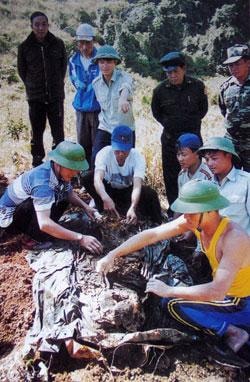
Due to the harsh climate in Laos (six months of torrential rain, six months of intense heat), the soldiers involved in the repatriation effort only have seven months each year to search for graves during the dry season (from November of the previous year to the end of May of the following year). If they don't find a grave during one search, they must mark it so they can return later. Their equipment includes a map of the area, a coordinate measuring device, a compass, a list of fallen soldiers provided by their former combat units, an AK submachine gun, ammunition, dried rations, a water canteen, a pickaxe, a shovel, a hammock, incense, and cloth... All of this weighs about 25kg, fitting neatly on their shoulders, enough for weeks of operation each time they venture deep into the jungle.
Each trip for the team was a long and arduous journey. Most of the martyrs' graves were located in remote, rugged areas. Many areas were still occupied and heavily inhabited by bandits, sometimes requiring the excavation of graves right under their gunfire. Many burial sites were located in former base areas, where many unexploded bombs and mines remained. Moreover, these areas were now completely covered by forest, forcing the recovery team to concentrate all their efforts on burning thousands of square meters of forest, waiting for the dry ground to clear the area before discovering the graves. In some cases, bamboo thickets had grown densely over several dozen square meters, requiring the team to dig tunnels to reach the graves. In addition, the hand-drawn maps and gravestones provided by the units were inaccurate compared to printed maps and the actual geography. Furthermore, very few people knew about the former martyrs' cemeteries, making it difficult for them to guide the team during the search. One of the particular difficulties that the repatriation team often encounters is dealing with the undissolved graves and finding a water source to wash the remains of fallen soldiers after their exhumation.
|
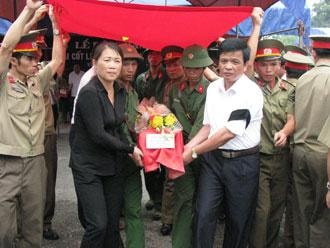
Thus, during each dry season, the officers and soldiers of the repatriation unit have to walk, climb mountains, cross slopes, and wade through streams, covering an average of nearly 2,200 km, eating and sleeping with fallen soldiers for 180 days and nights. Sometimes they have to carry 7-10 sets of remains on their backs, and also carry a comrade suffering from malaria for three days to reach the assembly point. Lieutenant Colonel Ho Trong Binh, the team leader of the Nghe An repatriation unit, said: "If it weren't for the heart and the devotion to those who have fallen, we couldn't be repatriation soldiers. The number one standard for repatriation soldiers is that everyone must be aware: the older generation has sacrificed themselves, and we, as the younger generation, must find them and bring them back to their hometowns!"
To facilitate the successful repatriation of the remains of fallen soldiers, the Provincial Special Task Force organizes two trips annually to work directly with the Laotian side to exchange experiences, sign agreements, and receive the remains. They also coordinate with the Laotian side to organize memorial services according to the customs and traditions of the Laotian tribes before repatriating the remains. Alongside the task of collecting the remains of fallen soldiers, the team members are also assigned the additional task of building a base and mobilizing the local population. The team has consistently implemented the "three together" principle (eating together, living together, and working together) to quickly integrate, gain a deep understanding of, and assist the people of the Laotian tribes in production and political security. These practical actions not only help you maintain stability in your life and develop socio-economic conditions, but also show your people that the search for and recovery of the remains of fallen soldiers is the responsibility of the people of the Lao ethnic groups, and create conditions to help the recovery team carry out their work better.
|
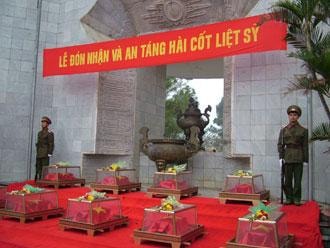
Over the past 24 years, nearly half of the total number of remains of fallen soldiers collected by teams under Military Region 4 speaks volumes about the tireless efforts of the Nghe An Remains Collection Team. The team has been awarded the title of Hero of the Armed Forces in the new era. But few know that in the past 24 years, the team has lost 9 comrades, dozens have been wounded, and many have suffered from serious illnesses such as lung cancer, liver cancer, kidney failure, and blindness. Despite this, driven by a sacred sense of duty and responsibility towards the more than 2,600 comrades still buried in Laos, they continue their journey, enduring the scorching dry seasons in the deep forests to bring the remains of the volunteer soldiers back to their homeland.
Minh Quan


