
Good wives
(Baonghean) - Not only are they skilled at housework, but the women in Nam Cat (Nam Dan) are also capable of plowing and hoeing in the fields, developing the family economy when their husbands are away...
As one of the relatively wealthy families in Nam Cat commune, no one knows how much hardship and struggle Nguyen Thi Hong (Dai Thang hamlet) had to endure to have a spacious house, two academically successful children, thriving fields, fish ponds, and livestock farming. She single-handedly managed all household affairs so her husband could focus on his work in South Korea.
Pouring a cup of green tea for her guest, Ms. Hong confided: "When my husband and I got married, our only assets were six acres of rice paddies. If we didn't have to hire laborers and the weather was good, it was enough to feed ourselves. But if we wanted to buy things, books, and clothes for our children's education, that amount would never be enough. We were both young (I was born in 1976, he in 1974), strong and capable, so we couldn't just stay around the village forever, never knowing when we would be able to make a name for ourselves in front of our neighbors, let alone invest in our two children's education. After much consideration, in 2007, he agreed to let me go to Malaysia for overseas employment. After a year, he also applied to go to South Korea. He said, 'As a man, I have to go out and earn money, and you should come back to take care of the two children and our grandparents...' I thought it made sense and agreed, and he's been gone for over four years now."
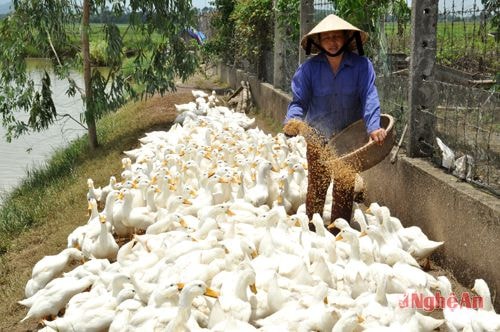 |
| This is the model of a fish pond farm combined with duck egg farming owned by Ms. Hoang Thi Bien in Quy Duc hamlet, Nam Cat commune (Nam Dan district). |
Since her husband went away to work, Hong has been managing the same amount of farmland by herself. During the harvest season, when the three of them can't keep up, she hires extra help. But mostly, the three of them struggle to make ends meet on their own. Her two children are obedient, well-behaved, and good students, which gives her some comfort. Currently, both of Hong's children are in the advanced class at Le Hong Phong High School (Hung Nguyen). Hong says that when her husband was still at home, she never knew what hard work was, but now she can do anything, from repairing water pumps and broken light bulbs to blown fuses… But what makes Hong most happy is that with the money her husband sent home, she has planned and managed to expand her pig farming (four batches a year), then chicken and duck farming, renovated the fish pond… rebuilt a spacious house, and focused on investing in her two children's education.
Just like Ms. Hong, Ms. Hoang Thi Mai (Thuan My hamlet), Ms. Nguyen Thi Thuy (My Thien hamlet)... all have husbands working abroad. At home, they manage the fields, cultivating two crops a year, developing the local economy, and investing in their children's education, ensuring their success. For example, Ms. Thuy now has two children studying at universities in Vinh and Hanoi, and Ms. Mai has a child attending Phan Boi Chau Specialized High School...
However, with men often away from home, women have to shoulder two burdens: farming, livestock raising, raising children, and developing the family's economy, which creates many difficulties for them.
Take the case of Ms. Phan Thi Lan (born in 1976), whose husband has been working abroad for the past three years. She's left alone to care for two young children (the second one is just over three years old), plus six acres of leased farmland. She says: "Since my husband went away to work, I've managed to save a few tens of millions of dong each year, but it's very hard being home alone... Don't think that just because your husband sends money home, you can spend it all. If you don't do anything and just eat, how long will it take to make ends meet? For farming women, whether there's a lot of work or little work depends on you. Like me, after the planting and harvesting season, I even take the time to catch crabs to sell." If she's diligent and hardworking, she can earn an extra 3 million dong each month. That's enough money in the countryside to buy her children extra milk, pay the electricity bill, etc. On rainy days, when the older child is sick and the younger one cries, she thinks: I'll call my husband to come home, we'll eat whatever's available at home, as long as we're close and can rely on each other during times of illness... But then she thinks: When will I ever have any money coming in if I stay home? And when the children grow up, the cost of food and education will increase...
For the past five years, Nam Cat has been one of the communes with the highest rates of overseas labor migration in Nam Dan district. In the Women's Union alone, out of 1,046 members, 70% have husbands working abroad in countries like Angola, South Korea, and Taiwan. This is encouraging because overseas labor migration has helped many families escape poverty, build beautiful houses, provide better care for their children, and provide capital for wives to develop their businesses at home. As living standards improve, women are paying more attention to their health. Each year, the Women's Union organizes four rounds of regular health check-ups, almost achieving 100% of its targets. Thanks to overseas labor migration and economic stability, the Union's initiatives such as the "Fund for Shelters of Love" and mutual assistance programs without interest are actively participated in by the women.
Ms. Nguyen Thi Thanh An, President of the Nam Cat Women's Association, said: "The number of people working abroad has had a positive impact on many aspects of society, raising people's awareness. Income from overseas labor is stable, not only improving family life but also contributing to the construction of welfare projects in the commune and villages, such as supporting the construction of new cultural centers, multi-purpose halls, and paving village roads and alleys with concrete. The rural landscape of Nam Cat has changed significantly compared to other communes: there are many multi-story houses, and the commune's revenue is higher thanks to those working abroad. Almost all women's meetings, from the commune level to the branch level, emphasize promoting the good practices of the women in the commune for other women to learn from." Thanks to this approach, nearly 100% of women whose husbands work abroad have now learned to utilize their capital: some have expanded their livestock farms, others have opened shops, or deposited money in banks... As a result, the percentage of well-off households in Nam Cat is increasing, while the number of poor households has decreased to 43 out of 1,700 households in the entire commune.
Thanh Thuy


