
New Year customs in Nghe An
(Baonghean) - From the plains to the coastal and mountainous regions, the people of Nghe An have unique customs for the beginning of spring...
New Year's Fishing Prayer Ceremony
At the beginning of the new year, fishermen in the coastal districts of Quỳnh Lưu, Hoàng Mai town, Nghi Lộc, Diễn Châu, Cửa Lò town, etc., solemnly organize a fishing prayer ceremony, thanking the gods for protecting their fishing trips throughout the year and praying for a bountiful catch of shrimp and fish in the new year.
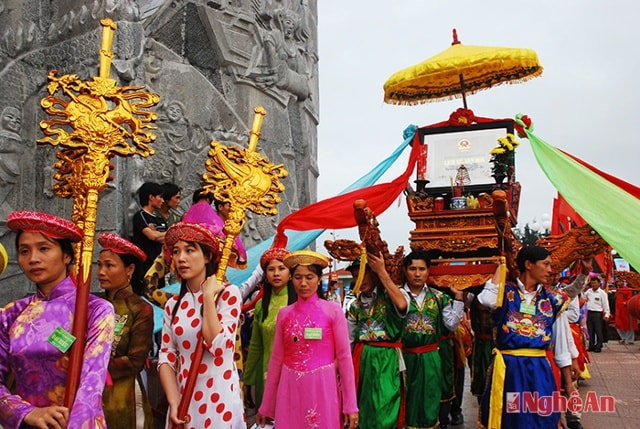 |
| Fishing Festival in Cua Lo Town |
The ceremony is usually held on the fourth day of the Lunar New Year. Local fishermen, dressed in their most formal attire, form a lively procession accompanied by the sound of ceremonial drums, parading through the village streets before heading out to sea. The offerings, including sticky rice, a chicken (or a pig's head), fruit, incense, and flowers, are carried down to the boats by strong, able-bodied fishermen to be offered to the river and sea gods.
In addition to individual ceremonies on each boat, fishermen also participate in a communal fishing prayer ceremony organized by the local authorities. This ceremony adds to the joyful atmosphere of the Lunar New Year celebrations, motivating fishermen to continue venturing out to sea and maintaining their livelihoods.
The carrying pole evokes memories of our roots.
For the people of Yen Thanh district, Tet (Lunar New Year) is a sacred day, signifying family reunion, remembering the gratitude owed to ancestors, and preserving family traditions. On the afternoon of the last day of the year, families in this rice-growing region gather together to perform a ceremony inviting their ancestors and deceased relatives to celebrate Tet with their descendants. The offering must include a bowl of new rice and a banh chung (traditional rice cake) placed in two baskets, each carried on a carrying pole, placed next to the ancestral altar. These carrying poles are also used to carry the offerings for the family on the first day of the new year...
On the first morning of the new year, all family members wake up early, prepare the feast, and arrange the offerings in two baskets. The women are responsible for carrying the offerings to the ancestral temple.
The carrying poles are present during Tet (Lunar New Year) as a symbol of the spirit of "drinking water, remembering the source," teaching and reminding children and grandchildren, and showing gratitude for traditional values.
First writing of the spring season
The traditional New Year's calligraphy ceremony in Quynh Doi (Quynh Luu district) has long been a beautiful custom, preserved and promoted by the local government and people. Every year on the morning of the third day of Tet (Lunar New Year), the most educated or highest-ranking member of the family performs this ceremony. It has become a sacred ritual.
Today, the traditional New Year's calligraphy ceremony in Quynh Doi has undergone many changes and developed into a vibrant movement throughout the commune.
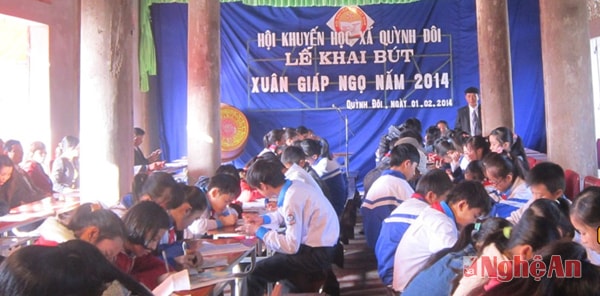 |
| The first writing ceremony of the spring season in Quynh Doi (Quynh Luu). |
Immediately after midnight on New Year's Eve, the local education promotion association encouraged each family to guide their school-aged children in performing the first writing of the year. On the morning of the second day of Tet (Lunar New Year), a large number of people gathered at the village communal house to participate in the writing ceremony. Everyone was welcome to participate. Paper and pens were provided, and the assignment was given by the organizers, usually a short prose piece or poem praising the beauty of the homeland and country in the Vietnamese Quốc ngữ script. After writing, the work was submitted to the organizers, who then judged it based on "good writing and calligraphy" and awarded prizes.
The custom of tracing the "footprints of fairies".
In the days leading up to Tet (Lunar New Year), people from Dien Phu commune, Dien Chau district, often flock to Mao Son Temple to queue up and place their feet on the "fairy's footprint" on a rock, praying for good luck in the new year. It's a rock about 10 square meters in size, located at the foot of the mountain. On the rock is imprinted the image of a right foot in the center, the size of an adult's foot, with all five toes clearly visible. Ancient legends say that the footprint on the rock must be the "footprint of a fairy" because the rock is so hard that no ordinary person could leave a footprint on it.
They place their feet on the "fairy's footprint" on the rock, hoping to receive good fortune at the beginning of the year, wishing to follow in the fairy's footsteps to receive intelligence, academic success, and good health.
The Hmong people's Hap Ky ceremony
In the Hmong New Year customs, a prominent feature is the Hap Ky ceremony (a ritual to call back the spirits) for the elderly, similar to the longevity celebration in the lowlands. The ceremony requires a pair of chickens (one rooster and one hen) and a pig. After slaughtering the rooster and offering it as a sacrifice, the legs and head of the chicken are examined by elders or shamans to predict future good or bad fortune. The Hap Ky ceremony is a beautiful custom of the Hmong people in Nghe An province, demonstrating filial piety and respect for the elderly in the family.
Bathing in the stream for good health.
This is a traditional custom of the Tho ethnic group, performed after midnight on New Year's Eve. All family members, from the elderly to young adults and children, rush to the stream to bathe. It's not necessary to bathe the whole body; simply touching the stream water in the first moments of the new year is sufficient. The Tho people believe this is when the water is purest, and even the fairies from heaven come down to bathe. Therefore, bathing at this time brings good luck and health throughout the year. Currently, due to many changes in socio-economic life, the houses of the Tho people are gradually moving further away from rivers and streams, and this custom is no longer practiced by many, remaining only in the memories of the elderly.
The ritual of summoning spirits and consecrating souls.
The Thai people have a custom of summoning the spirits of family members on the evenings of the 28th, 29th, or 30th of the Lunar New Year. The homeowner slaughters two chickens: one for the ancestral offering and one for summoning the spirits of everyone in the family. To summon the spirits, the shaman takes a shirt from each person, ties the two ends together, and drapes it over his shoulder. Holding a burning piece of wood, he goes to the edge of the village and summons the spirits two or three times, then returns to the bottom of the stairs and summons them once more. After the ritual, the shaman personally ties a black thread around each family member's wrist to ward off evil spirits. The thread must break on its own; if it breaks, the person is likely to fall ill or encounter misfortune.
Thanh Chung - Phuong Chi
(synthetic)
| RELATED NEWS |
|---|


