
These teachers 'put aside their pens and books to go to war'
(Baonghean) - Nearly 50 years ago, in response to the general mobilization order, thousands of students and teachers from Nghe An "put aside their pens and books" to go south to fight. And for them, even though they had to leave behind the blackboard, chalk, family, and classrooms, they were always proud to be part of those sacred moments of the nation.
Happy to be going to war.
Mr. Hoang Khac Hue – a former student of the Mathematics Faculty at Vinh University, former lecturer at the Military School of the 2nd Army Corps, currently residing in Tan Tien Hamlet, Hung Binh Ward, Vinh City – was one of the four outstanding young people from Thanh Lien Commune, Thanh Chuong District, who were admitted to university.
In the summer of 1971, while in his third year of university, he returned home and received a general mobilization order from his school. One day later, due to the urgent requirement to report to the assembly point in Quynh Thang commune, Quynh Luu district, Hoang Khac Hue's departure was practically unprepared.
He also doesn't remember many of the farewell moments when he enlisted because at that time, "Dad was working at the cooperative, my younger brother was still small, and my mother and siblings would leave after dinner." The most memorable moment was when his mother saw him off at the edge of the village, slipped him a handful of small change, and cried. But, in his early twenties, brimming with enthusiasm and a burning desire to go to war, he didn't know how to hug or even offer a word of comfort. The only promise he made to his mother was, "Don't worry, Mom, I won't die."
Upon enlisting, the mathematics student was assigned to the 66th Infantry Regiment, 304th Division. After nearly two months of basic training, he was transferred to the 2nd Corps Non-Commissioned Officer School in Military Region 4. With the advantage of being a young, enthusiastic, and intelligent student, after four months, he transitioned from a "new recruit" to a trainer and then, along with his comrades, went straight to the Quang Tri battlefield to defend the Citadel. At the end of 1972, he was further sent to study at the Army Officer School to prepare the main force for the Army to fight in the South.
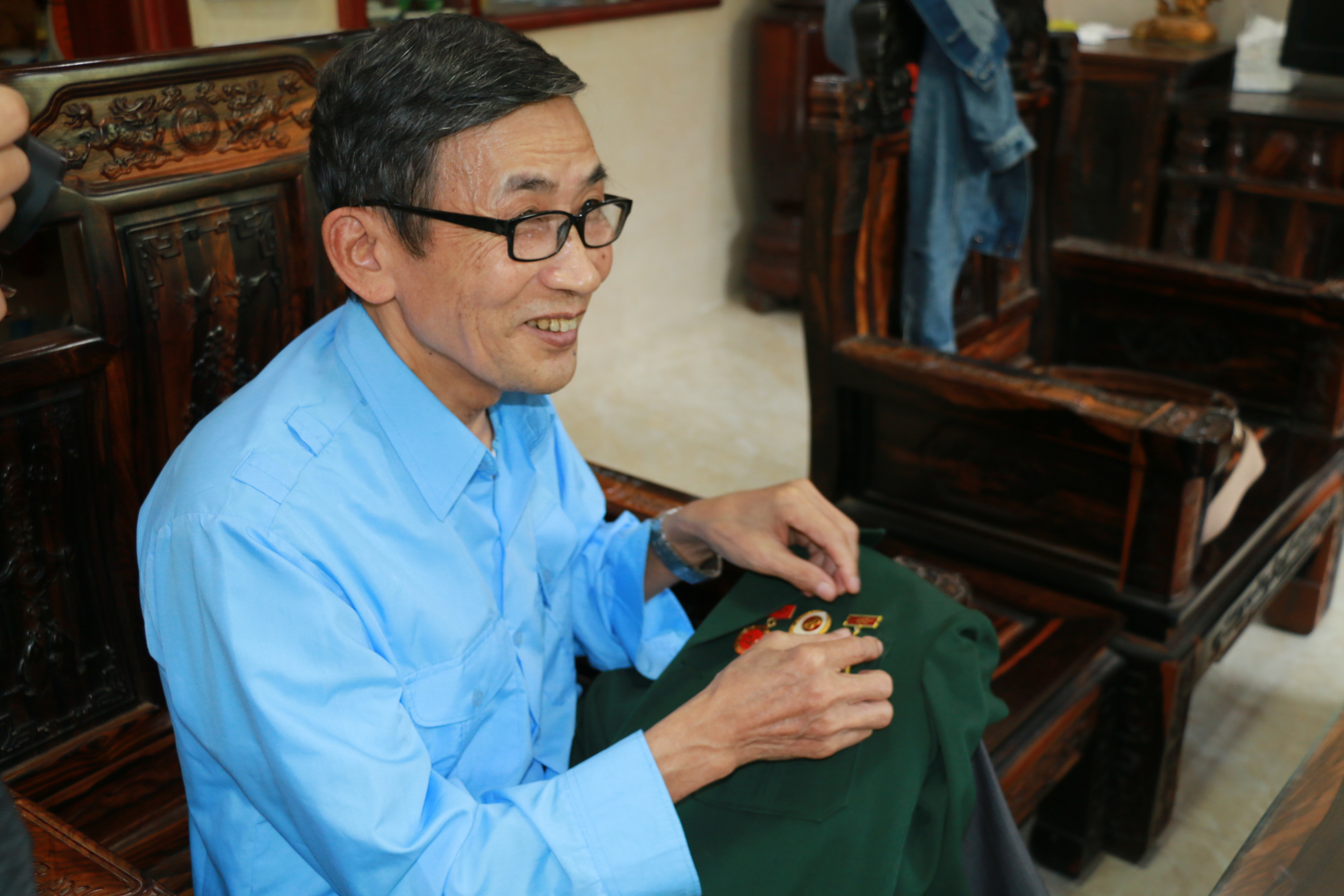 |
| Mr. Hoang Khac Hue and the medals and decorations awarded to him during the resistance war against the US. Photo: My Ha |
From 1974, as an operations assistant in the 66th Regiment, his unit participated in battles along Highway 1 and directly fought to liberate Da Nang, advancing towards Binh Thuan to crush other enemy defensive positions in Phan Rang and Ham Tan. On April 29, 1975, after participating in the capture of the Nuoc Trong – Long Thanh base, his 2nd Corps was ordered to advance into Saigon in the East-Southeast direction.
On April 30th, Huệ's 66th Regiment was the first infantry unit to arrive at the last stronghold, the Independence Palace. It was there that he and his comrades witnessed the historic moments when President Dương Văn Minh of the Saigon government read the surrender statement and the flag of the Provisional Revolutionary Government of the Republic of South Vietnam was hoisted atop the Presidential Palace.
“Before arriving in Saigon, I knew that the Independence Palace was an ‘impregnable’ landmark for the city dwellers. Therefore, the moment we captured the Independence Palace also meant we had achieved complete victory, and that was the happiest moment for a soldier.”
In 1971, the atmosphere in Hanoi was also very tense because the fighting in the South had entered an extremely fierce phase. Therefore, even though he lived in the North, enjoying the peaceful days of a student at Hanoi Pedagogical University, student Nguyen Quoc Phu (later a teacher at Ha Huy Tap High School) volunteered to go to the front lines. At the moment of departure, he most remembered the image of over 600 students from three schools of Hanoi Pedagogical University – the Faculty of Natural Sciences, the Faculty of Social Sciences, and the Faculty of Foreign Languages – eagerly setting off.
To bid farewell to those who remained, the car carrying all the students circled the campus three times, with friends waving incessantly below. “We set off with excited hearts, heading towards our beloved South. Later, when we gathered on the northern bank of the Ben Hai River, some students stayed behind in Quang Tri, while others crossed the Truong Son Mountains to the B2 battlefield in the Southeast region, suffering significant sacrifices and losses. However, having left, we carried with us the belief in the day of victory,” recalled teacher Nguyen Quoc Phu.
No sacrifice of blood or bone.
Due to the impact of the Covid-19 pandemic, the Nghe An Teachers' Association, which served in the South during the war, did not hold its usual annual meeting this year. However, at the small house of teacher Nguyen Quoc Khanh (former teacher at Ha Huy Tap High School) on Hong Bang Street (Vinh City), former colleagues still had a small reunion to reminisce about their time fighting on the battlefield.
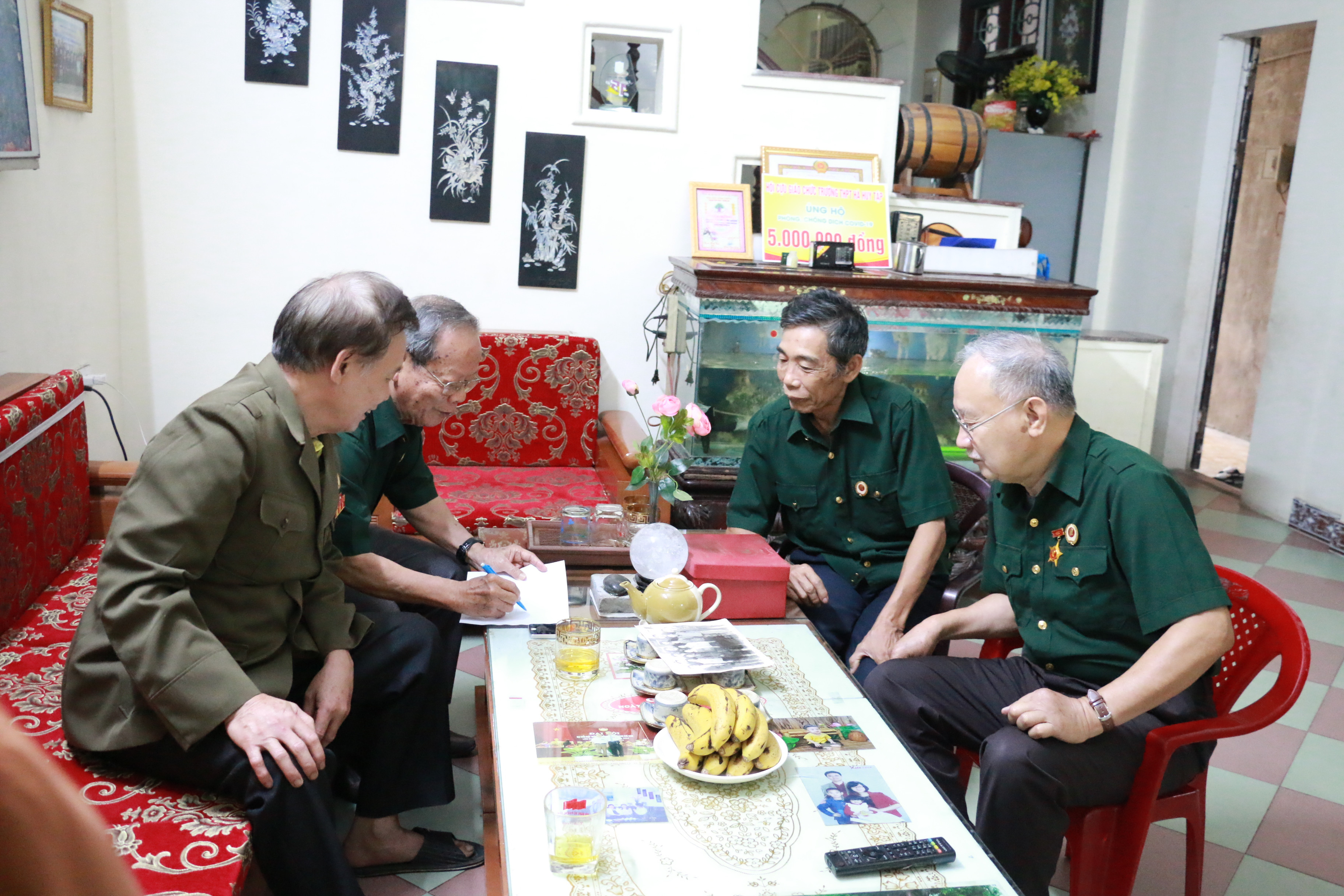 |
| A reunion of teachers who went to the South (Teacher Nguyen Quoc Khanh is on the far right). Photo: My Ha |
In April, once again, teacher Nguyen Quoc Khanh had the opportunity to reread his poem "April Sentiments":My dear! If I ever forget you this April, please don't be angry with me so quickly. In that moment, I think of my comrades, who shared my hardships, who fought alongside me in battles, who turned wild cassava shoots into "delicacies"... April is also the day the whole country rejoiced at the liberation of the South. I am proud to have a part of myself in it. Can you hear the thunderous cheers? What joy could compare to the reunification of the country?
Forty-eight years ago, 150 teachers from the Nghe An Department of Education were ordered to enlist in the army. At Tan Ky High School, teacher Nguyen Quoc Khanh, teacher Pham Quy Hung (former Deputy Director of the Department of Education and Training), and four other colleagues were among the first to put down their pens and chalk, bidding farewell to the classroom to go to the front lines and reinforce the forces in the Southern battlefield.
On the day of departure, each person carried their own burden, because for Teacher Khanh's family, he had a younger sibling and a difficult family situation. Teacher Nguyen Quy Hung was even more special because he was one of the new recruits who was over 30, burdened with a wife and two young children, the second child only 1.5 months old.
Before setting off, Mr. Hung was the Party Branch Secretary, the Vice Principal of the school, and had a permit to study abroad. However, answering the sacred call of the Fatherland, the teachers were ready to leave "without any self-interest, without regretting their blood and bones."
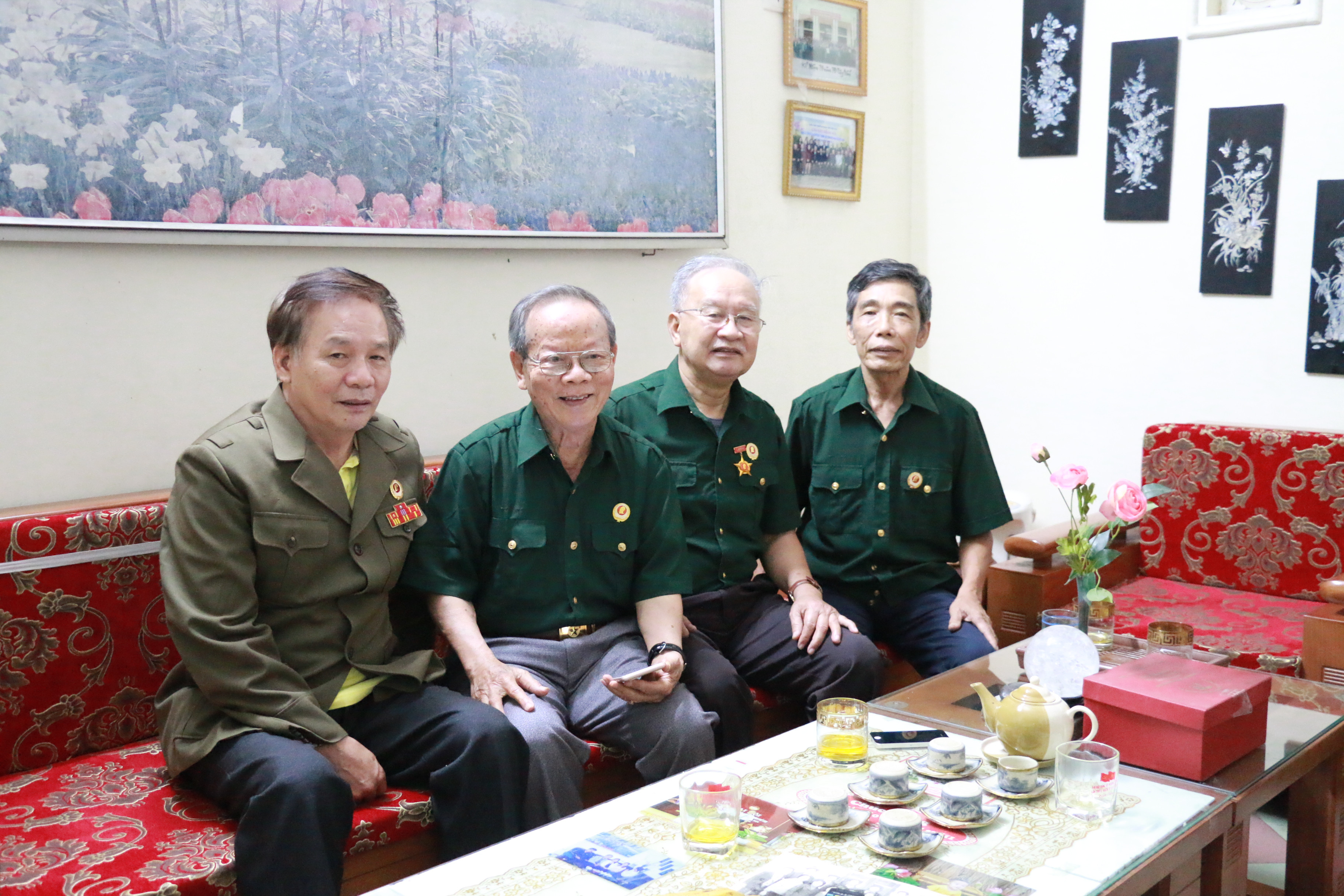 |
| Every year on April 30th, the anniversary of the complete liberation of Southern Vietnam and the reunification of the country, teachers who once "put aside their pens and went to war" gather together to reminisce about the past. Photo: My Ha |
Nearly half a decade has passed, but the memories of those days fighting in the war have never faded, and the happiest moment remains the moment of complete victory for our nation.
The teacher recounted: "At 1:30 PM on April 30th, we arrived in Saigon. The moment we reunited, the joy was overwhelming, beyond words; we could only communicate through our eyes, smiles, and tears of pure happiness."
Teacher Pham Quy Hung said: “We were much luckier than many of our comrades because we returned unharmed and continued to contribute to the education sector. The days on the battlefield are unforgettable, and we were trained, molded, and matured thanks to those arduous but heroic days.”


