
Initial advantages
It took nine years for Quan Ho folk singing of Bac Ninh and six years for the Ho Dynasty Citadel to be recognized as World Cultural Heritage sites by the United Nations Educational, Scientific and Cultural Organization (UNESCO). For Nghe Tinh folk songs and Vi Dam, the dossier submitted to UNESCO was completed in early April 2013. But that was only the first step…
(Baonghean)It took nine years for Quan Ho folk singing of Bac Ninh and six years for the Ho Dynasty Citadel to be recognized as World Cultural Heritage sites by the United Nations Educational, Scientific and Cultural Organization (UNESCO). For Nghe Tinh folk songs and Vi Dam, the dossier submitted to UNESCO was completed in early April 2013. But that was only the first step…
After numerous preparatory steps, in early April this year, the dossier for the Nghe Tinh folk songs (Vi and Dam) as a “Representative Intangible Cultural Heritage of Humanity” was completed and submitted to UNESCO for consideration as a World Cultural Heritage. Having completed phase 1, we are now preparing for phase 2, the assessment and completion of the dossier according to UNESCO's requirements (if any). There is still much work to be done. This can also be considered the most difficult phase, and it is difficult to predict the completion time. Most importantly, we must demonstrate that the Nghe Tinh folk songs are a product of the community, created by the community, and deeply rooted in the local identity.
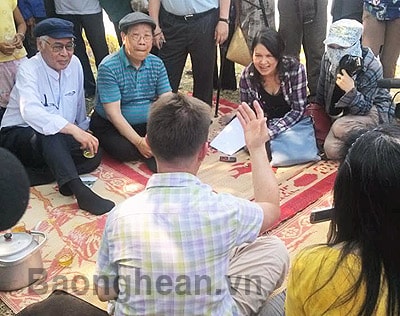
A delegation of experts from UNESCO and the Vietnam Institute of Culture and Arts held discussions with members of the Folk Music and Singing Club in Boi Son commune.
To assess the above content, in early June 2013, a delegation comprising professors and leading experts from UNESCO and the Vietnam Institute of Culture and Arts visited and exchanged views on the artistic value and significance of the Nghe Tinh folk songs (Vi Dam) in Nghe An and Ha Tinh provinces. The delegation included Professor, Dr. Tran Quang Hai, who has many years of research, collection, performance, and dissemination of Vietnamese folk music, Professor, Dr. Nguyen Chi Ben – Director of the Vietnam Institute of Culture and Arts, and many foreign experts such as Professor Barley Norton (Goldsmiths University, London), Yoshihito Tokumaru (Seitoku University), Oshio Satomi (Miyagi University of Education, Japan), and Tvrtko Zebec (Croatian Institute for Cull Folk and Ethnic Studies).
With a serious and responsible work ethic, the delegation went directly to Boi Son commune (Do Luong district) to listen to members of the commune's folk singing and playing club perform call-and-response songs on the Lam River. On this outdoor stage, amateur performers recreated the cultural and artistic atmosphere commonly seen in Nghe An's folk songs. The unique aspect here is that during the work process, people can engage in call-and-response singing, both spontaneous and practical, helping them forget the fatigue and hardship of labor. In Ngoc Son commune (Thanh Chuong district), the delegation attended a session and learned about folk songs from artisans at the Ngoc Son Folk Song Club. Following that, the delegation watched performances by artists from the Center for Preservation and Promotion of Nghe An's Folk Song Heritage.
During this survey, the expert team did not offer any conclusions or assessments, but the members' enthusiasm was evident as they listened attentively and excitedly to the melodies of the Nghe An folk songs. Professor Barley Norton (Goldsmiths University, London) commented: "Listening to the folk songs on the river, the best part is the feeling of listening to a choir." Previously, Professor Tran Quang Hai also used his prestige and influence to promote this unique folk music form of Central Vietnam on international media by giving interviews on Radio France International (RFI) and Voice of America (VOA) about the beauty and uniqueness of the folk songs.
Also at the request of the Institute of Culture and Arts and with the aim of promoting Nghe An folk songs to a wider audience of people and tourists worldwide, many performances of Nghe An folk songs were organized within the framework of the 5th Quang Nam Heritage Festival, commemorating the 10th anniversary of the UNESCO Convention on the Protection of Intangible Cultural Heritage. In one week, from June 19-26, 2013, artists from the Center for Preservation and Promotion of Nghe An Folk Song Heritage held nearly 20 performances in the An Hoi Sculpture Garden and the grounds of ancient houses along the Hoai River. With unique and elaborately staged performances such as folk songs performed in the rice fields, the Ly Phuong Vai folk songs, and call-and-response love songs, the Nghe An folk song performances received enthusiastic and enjoyable responses from numerous guests and visitors.
According to Professor Nguyen Chi Ben, Director of the Institute of Culture and Arts, "Currently, to have Nghe An's Vi Dam folk songs recognized by UNESCO as a heritage, we have only completed 1/8 of the journey and there will still be many difficulties." However, through practical and meaningful activities, we have proven that Nghe An's folk songs are an invaluable heritage. More importantly, from these successes, experts and professionals will have an objective view of Nghe An's Vi Dam folk songs and clearly see the awareness of preserving, maintaining, and developing folk songs and the love for folk songs of the people of Nghe An.
Text and photos: My Ha


