
The final footage of President Ho Chi Minh's life.
(Baonghean.vn) - The cameraman himself had to wait 20 years to see the footage he recorded of President Ho Chi Minh's final moments.
Nearly 50 years have passed, but Major Nguyen Thanh Xuan (Lien Son 1 hamlet, Kim Lien commune, Nam Dan district) still feels nostalgic when recalling those old film clips. These were films about President Ho Chi Minh's life that he made while working at the Army's film studio and archives.
Special mission
That was the assignment he received in the final weeks of August 1969. At that time, he had been a cameraman at the Army Film Studio's archives for four years. The order from the General Political Department was simple: assign two cameramen to a special mission.
During wartime, sudden deployments were not uncommon. But a mission that was kept secret even from the leadership inevitably caused anxiety. After several days of apprehension, one night at midnight, they received orders to leave immediately. Their equipment consisted of two of the most modern cameras of the time: a Soviet Convat and a Chinese HP camera.
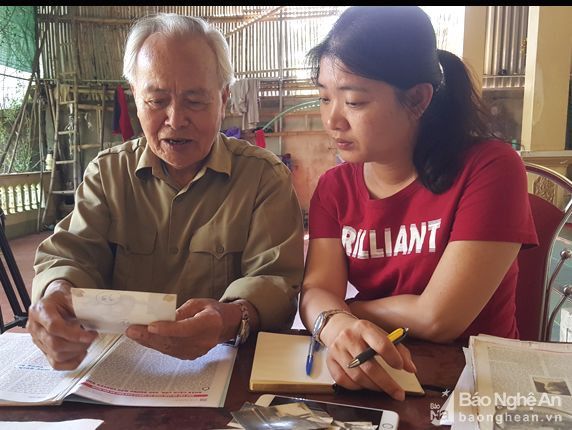 |
| Major Nguyen Thanh Xuan stands beside old photographs from his time working at the Army film studio. Photo: SH |
Surprisingly, the group's destination that day was the Presidential Palace. Upon arrival, he, along with cameraman Tran Van Tra and driver Hoang Hai (who was also in charge of lighting), were taken to a house near President Ho's stilt house.
In the first few days, seeing so many people coming and going, the officers had a feeling something bad was about to happen, but they didn't know what it was. One day, Comrade Vu Ky, Ho Chi Minh's secretary, came in person and said: "The President's health is unstable, and the Politburo has requested the Army film crew to record his final images."
Upon receiving this news, the entire film crew couldn't hide their disappointment. However, hope still flickered each day because there was news that President Ho Chi Minh would appear before the entire nation on National Day, September 2nd.
After nearly a week of anxiety, on August 30th they were ordered to enter the stilt house because "Uncle Ho's health had improved." On the first day, both of them worked but were not allowed to get close to Uncle Ho's bed, so they could only film from the outside.
By September 1st, the task was still being carried out diligently, and everyone thought Uncle Ho would be feeling better. A special chair had also been prepared for him on September 2nd.
However, the situation took a turn for the worse on September 2nd. "When Comrade Vu Ky told us that because the room was small, only two cameramen were allowed in, we were shocked. When we arrived, I saw Comrades Pham Van Dong, Tran Quoc Hoan, Vo Nguyen Giap, and many other high-ranking leaders already standing beside President Ho's coffin."
No one could hold back their tears. My own eyes were also welling up, I couldn't see anything through the lens anymore, I could only use the wide-angle lens to film..."
20 years of waiting
Later, under those extraordinary circumstances, cinematographer Nguyen Thanh Xuan often doubted the quality of his footage. However, because the initial purpose was to film "documentary," all the footage shot during the last days of President Ho Chi Minh and during his funeral was recorded and kept secret. President Ho Chi Minh's passing was a special day, National Day, September 2nd. Therefore, for a long time, information about the date of his death was kept secret for the sake of national liberation.
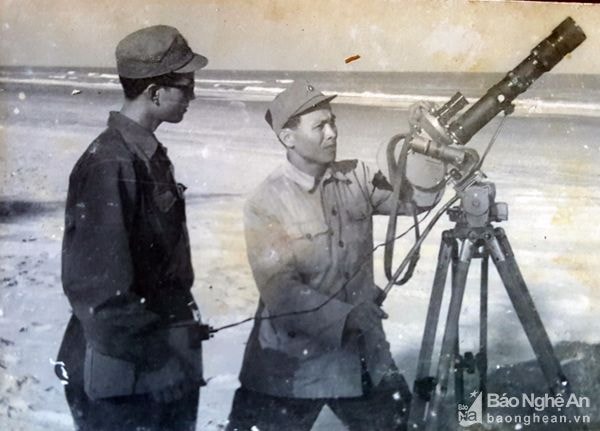 |
| Major Nguyen Thanh Xuan (holding the camera) while on assignment. Photo: archives. |
"Live to keep it to yourself until you die," for a full 20 years, it wasn't until 1989, after the film "The Last Moments of President Ho Chi Minh's Life," directed by Pham Quoc Vinh of the Army Film Studio, was released, that cinematographer Nguyen Thanh Xuan – then retired – was able to see his footage for the first time. On the day of the premiere, he was invited to Hanoi by the Central Committee and the film studio to review the old images.
Sitting in the auditorium, looking at the familiar images of Uncle Ho, looking back at the old stilt house, looking back at the rubber sandals, the walking stick, looking at his comrades and fellow soldiers, and looking at the lines of people standing silently along the long stretch from the Grand Theatre to the Trang Tien intersection as Uncle Ho's coffin passed by… he couldn't hold back his tears.
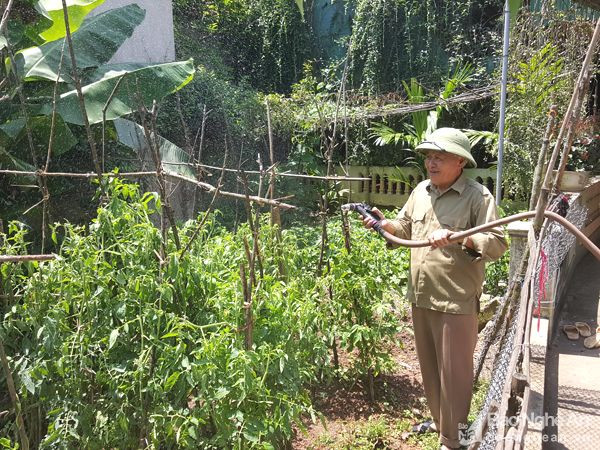 |
| Everyday life photos of cinematographer Nguyen Thanh Xuan after his retirement in his hometown. Photo: SH |
Nearly 50 years after President Ho Chi Minh's passing, Major Nguyen Thanh Xuan is now over 85 years old. Throughout his military career, enduring bombs and bullets, his footprints have left their mark on many battlefields, from Dien Bien Phu and the ancient citadel of Quang Tri to the Southern battlefields, with many valuable documentary films.
Among them, mention must be made of many famous documentaries such as "The Victory at Ham Rong", "Aim Straight at the Enemy and Shoot", "Under the Banner of Victory", and "Da Lat in Spring". Besides that, he is also the author of many other valuable films about President Ho Chi Minh, which he made during the period from 1965 to 1969.
Speaking about his years as a war correspondent, during which he had many opportunities to be close to President Ho Chi Minh, he said: "Many international reporters asked me if I was 'privileged' because I was from the same hometown as President Ho. This is completely untrue. For me, being from the same hometown as President Ho, being known as a descendant of President Ho, meant that no matter what task I was assigned, no matter how difficult, I had to complete it. Perhaps that's why, even though I was an outsider, having grown up amidst the 'smoke and fire,' I was always trusted by my superiors and given special assignments."
My Ha


