
Features of car tire treads
(Baonghean.vn) - Car tire treads come in many different patterns, resulting in varying levels of grip, water drainage, and noise, to meet different road conditions and vehicle types.
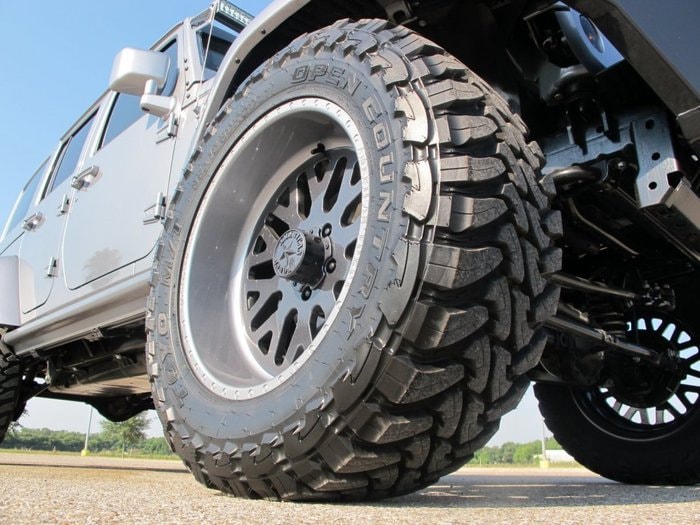 |
Tire treads are made up of grooves of various shapes and depths. These grooves function to ensure contact between the tire and the road surface. The deeper the grooves (the higher the tread), the better the grip.In conditions where the road is waterlogged, vehicles can experience "hydroplaning." This occurs when water doesn't drain quickly enough from the grooves, preventing the tires from making full contact with the road surface, easily leading to loss of control.
With advancements in technology, modern tires are manufactured with tread patterns designed for rapid water drainage. Below is a guide to distinguishing some types of tire treads currently available on the market and their effects on vehicle performance.
How does tire tread affect a vehicle's performance?
Depending on the type of tread pattern and design, the performance of the vehicle will be affected to varying degrees. Experienced automotive experts share the following insights:
- Rib shape:Ribbed tread patterns have grooves running along the tire surface (often called longitudinal treads), with the advantage of low drag, good stability and steering control due to high lateral grip, suitable for high-speed driving because they generate less heat.
However, this tread pattern has the disadvantage of poor braking and acceleration on paved roads, so it is suitable for vehicles traveling on asphalt roads, for use on the front wheels of trucks or buses.
- Lug shape:Worm-shaped treads have grooves running across the tire surface (often called transverse treads), offering good steering and braking capabilities, and excellent grip. These are typically the types of tires used on trucks and off-road vehicles for dirt roads and muddy terrain.
With its large lugs, this type is unsuitable for high-speed driving due to noise and high drag. This type is suitable for vehicles on dirt roads, for the rear wheels of buses and trucks.
- Block shape:Tires with block-shaped treads and interwoven grooves are ideal for driving on snow and wet roads due to their stability, excellent steering, and optimal water drainage.
However, because the tread blocks are smaller and closer together, this type of tire wears out faster than others. Therefore, they are suitable for winter tires, or all-season tires on passenger cars, and can be used as rear tires for radial tires on regular cars.
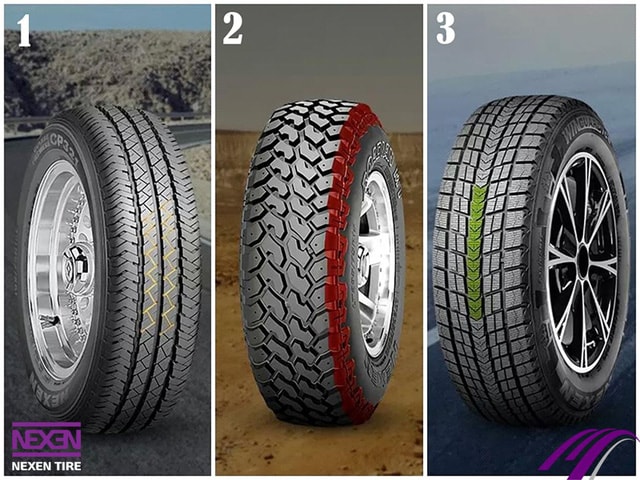 |
| From left to right: rib-shaped, worm-shaped, block-shaped |
- Asymmetric form:Asymmetrical tread patterns are commonly found on high-performance or sports car tires because they offer superior cornering capabilities due to their large contact area, reducing wear on the outer surface of the tire.
However, because the tread pattern differs on each side of the tire, it's important to install the tire with the outer and inner sides facing each other correctly. Use high-performance or sports car tires.
- Rib-Lug shape:A type of tire tread suitable for both paved and unpaved roads, for both front and rear wheels, commonly found on SUVs, with grooves running lengthwise and crosswise across the tire surface (longitudinal and transverse treads). Rib-like patterns in the center provide good steering, while worm-like patterns on the shoulder enhance braking and handling.
This type of tire is suitable for both paved and unpaved roads; it can be used for both the front and rear wheels of trucks and buses.
- Directional orientation:The directional tread pattern has horizontal grooves on both sides of the tire that point in the same direction. The advantages of this type include good handling and braking, excellent water drainage resulting in stability on wet roads, and suitability for high speeds.
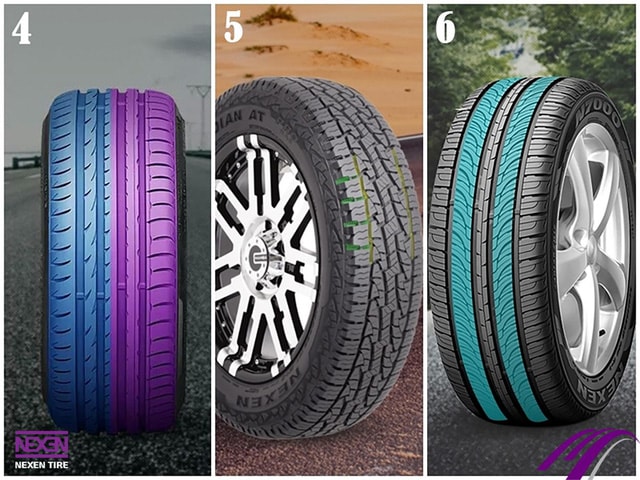 |
| From left to right: asymmetrical form, worm and rib form, oriented form. |
Does tire tread affect tire lifespan?
Tire tread significantly affects tire lifespan, but it's not the only factor. According to automotive maintenance engineers, tire lifespan is often impacted by the following factors:
- Tire quality: This is the first factor determining the durability of a tire. The quality of a tire is reflected in the rubber material, the metal cords, the cord structure and number of cords; whether it's a tubeless tire or a tire with an inner tube, etc.
- Tire pressure: Pressure greatly affects tire lifespan, as evidenced by tire wear.
- Load capacity: Each type of tire has a different load capacity rating; exceeding this rating is a major cause of premature tire failure.
- Tire rotation: Rotating car tires will correct uneven tire wear, thereby increasing tire lifespan. Car owners can rotate their tires themselves by knowing the steps involved in rotating car tires.
- Road conditions, weather...
To ensure the longevity of tires, in addition to regular maintenance, checking tire pressure and contact with the road surface every 20,000 km, it is also necessary to rotate the tires (approximately every 60,000 km) as part of the scheduled maintenance. When the tire tread wears down to the specified limit, the tires must be replaced to ensure safe vehicle operation.
Ngoc Anh
(Synthetic)
| RELATED NEWS |
|---|


