
Issues that need to be addressed
Nghe An is a large province with a large population (area of 16,490 km2, population of 2.92 million people), with nearly 172,000 Party members. The Provincial Party Committee has 28 subordinate Party committees, including 20 district, city, and town Party committees with 1,563 grassroots Party organizations, and 480 commune, ward, and town Party committees.
(Baonghean)Nghe An is a large province with a large population (area of 16,490 km2, population of 2.92 million people), with nearly 172,000 Party members. The Provincial Party Committee has 28 subordinate Party committees, including 20 district, city, and town Party committees with 1,563 grassroots Party organizations, and 480 commune, ward, and town Party committees.
In implementing the conclusions of the 9th Conference of the Central Committee of the Party (10th term), which included the pilot model of the Party Committee Secretary also serving as the Chairman of the People's Committee at the commune level, the Provincial Party Committee organized study sessions to disseminate the policy and raise awareness, creating consensus among cadres and Party members.
Based on field surveys from communes where the Party Secretary also serves as the Chairman of the People's Committee, the Provincial Party Standing Committee developed Plan No. 43-KH/TU dated May 5, 2009, on piloting this model in 2-3% of the communes throughout the province. This aims to further research and develop a model for innovating the Party's leadership methods; creating uniformity and consistency in leadership, direction, and administration at the local level; contributing to enhancing the Party's leadership role, the effectiveness of State management, and emphasizing the personal responsibility of the head of each locality.
Prior to the Politburo's directive, due to personnel organization requirements, the arrangement of having the Party Secretary also serve as the Chairman of the People's Committee had been implemented in 5 communes and towns. Based on the proposal of the grassroots Party committees, on September 21, 2009, the Provincial Party Standing Committee issued Conclusion No. 25-KL/TU selecting and implementing this pilot model in 19 units, including: 15 communes (79%), 2 wards (10.5%), 2 towns (10.5%); 10 mountainous units (52.6%), 5 midland units (26.3%), and 4 lowland units (21.1%). In addition to the 5 units that implemented the policy before the Politburo's directive, 5 units implemented it after the Central Organization Committee's Guidance No. 25-HD/BTCTU but before the grassroots Party congresses took place, and 9 units implemented it concurrently with the grassroots Party congresses for the 2010-2015 term.
Implementing the model where the Party Secretary also serves as the Chairman of the People's Committee at the commune level has initially yielded several advantages: it has fundamentally created unity in leadership, direction, and task implementation among local Party committees; ensured consistency between the leadership of the Party committee and the management and operation of the government; limited instances of the Party committee overstepping its authority, taking over, encroaching on, or neglecting the leadership of the Party committee over the grassroots government; enabled the head to demonstrate dynamism and creativity in leadership, direction, and operation; and contributed to the implementation of administrative reform and streamlining of the organizational structure at the grassroots level. This policy has initially reformed the Party's leadership methods within the political system; it has promptly received and processed information and feedback from the people, reduced stagnation and shirking of responsibility, thereby providing solutions to improve ideological work, adjust the content and methods of work, and create a favorable environment to attract investment and promote socio-economic development.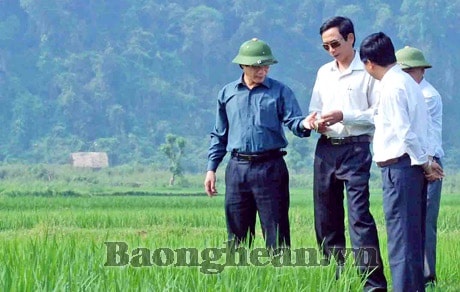
Inspecting rice crops for pests and diseases in Chau Ly (Quy Hop).
However, by April 2013, several changes had occurred throughout the province. Six units requested to withdraw from the model: Bac Ly, Ta Ca (Ky Son), Quynh Doi (Quynh Luu), Yen Tinh (Tuong Duong), Nghi Hoa ward (Cua Lo), and Hung Khanh (Hung Nguyen); two pilot units were transferred: Vinh City (Quang Trung ward, transferred to Hung Hoa commune), and Quy Hop district (Chau Cuong commune, transferred to Tho Hop commune); and personnel changes were made in one unit: Que Phong district (Kim Son town). During the implementation of this pilot program, the following shortcomings and obstacles emerged:
1. Preparations for the pilot program were not entirely complete, resulting in delays in implementation in some localities, or significant difficulties and confusion during implementation.
2. Some officials do not meet the requirements in terms of character, competence, and professional qualifications. Meanwhile, the workload of the Party Secretary who is also the Chairman of the People's Committee of the commune, ward, or town is very high, and they have not received training or professional development, leading to awkward handling of work, easily giving rise to authoritarianism, abuse of power, and a lack of democracy. In some cases, disciplinary action has had to be taken against officials.
3. The system of guiding documents has not been timely, so in the process of implementing the amendments and revisions to the operating regulations, some places have found them incomplete and inconsistent.
4. During implementation, difficulties were encountered in selecting and appointing young cadres, female cadres, and cadres from ethnic minorities to the position of Party Secretary and concurrently Chairman of the People's Committee at the commune level.
5. The majority of new pilot projects were implemented after the Party Congress and are concentrated in localities with many favorable factors; there is close attention and guidance from all levels and sectors to build these pilot projects, therefore the results of the pilot projects have not been fully and comprehensively evaluated.
Because of the constant turnover of officials, many localities are requesting the Central Government to promptly conduct a review of practical experiences, properly assess strengths and weaknesses; and accurately evaluate the current state of the quality of officials at the commune, ward, and town levels in order to provide appropriate guidance. Specifically for mountainous communes, with many unfavorable factors, the model of the Party Secretary also serving as the Chairman of the People's Committee at the commune level should not be implemented yet.
Ngo Dinh Vien (Provincial Party Committee's Organization Department)


