
Billionaires plant forests at the foot of Mong Ga Mountain.
(Baonghean) - From a poor hamlet where people toiled year-round but still struggled to make ends meet, with many families even forced to leave the village, the lives of the people in that mountain hamlet are now not only comfortable but also prosperous. These changes are thanks to the people's commitment to the profession of planting timber forests…
 |
| Forests of timber trees blanket the Mong Ga mountain range. Photo: Huu Nghia |
From a poor oasis…
We arrived at Hamlet 10, Lang Thanh Commune, Yen Thanh District in the last days of May, under the scorching sun. Looking at the well-developed hamlet nestled among the hills and mountainsides, covered in lush greenery, everyone was delighted by the transformation. This land, once known as a poor, isolated oasis, has now become a key reforestation area of the district.
In the spacious wooden house of village head Nguyen Ba Nghia, the sturdy, dark-skinned local men shared stories of their lives intertwined with this isolated piece of land amidst the undulating mountains. Taking a sip of green tea, Party branch secretary Tran Nguyen Hao recalled that before the 1960s, their village was quite densely populated, but later, due to the harsh natural conditions and difficult living conditions, the villagers left.
 |
| People in Lang Thanh commune (Yen Thanh district) are planting forests for timber production. Photo: HN |
Continuing the story, village head Nguyen Ba Nghia said that for a long time, the lives of dozens of households had been filled with hardship. The dirt roads were muddy in the rainy season and dusty in the dry season, making travel extremely difficult. The village was only about 13 km from the commune center, but it was like two worlds in many ways. They only had 50 hectares of rice paddies, and could only cultivate one crop per year. At that time, everyone relied solely on the forests of the Mong Ga mountain range for sustenance.
But "eating from the forest brings tears to the eyes," a prosperous life remained a distant dream… All the changes only came when the people of the mountain village were given land and forest. With the means of production—tens of hectares of land allocated to each family—the hardworking, diligent, and dynamic farmers began to develop their economy. The hillsides were covered with pineapples, the sugarcane fields stretched as far as the eye could see, and the strong eucalyptus plantations gradually conquered the barren land. But the color of prosperity and abundance still eluded them, as the recurring cycle of "good harvest, low prices; high prices, poor harvest" repeatedly plunged the farmers into hardship. And change only came when acacia trees, the raw material for timber, took root in this land.
...to the billionaire neighborhood
Recalling the story of planting acacia trees after numerous failures with other crops, Secretary Hao's eyes lit up with pride. Having spent almost his entire life on this land, he spent decades as a village official, from cooperative team leader during the subsidy era to village head, and then as Secretary of the Party Branch of Hamlet 10. He was the first person to introduce acacia trees to the land allocated to his family for production.
Having done it himself, he actively encouraged the villagers to follow suit. Now, the entire Hamlet 10 has 2,000 hectares of acacia forest. After more than two harvesting cycles, the economic value of acacia trees has been confirmed. The family of Party Secretary Hao alone owns over 60 hectares of forest land planted with acacia, and the family of Hamlet Head Nghia also has over 35 hectares. Leading us to visit his two-story house under construction, Party Secretary Hao excitedly said: “Since the beginning of the year, my family has sold 20 hectares of acacia trees and earned about 1.2 billion dong in profit. This house is being built with the money from selling the acacia. Before, I never dared to dream of having a house like this.”
Thanks to acacia cultivation, not only the family of Party Secretary Hao but also the vast majority of the 187 households with 678 people in Hamlet 10 have become financially secure. Seventeen families in the hamlet have even bought cars to facilitate transportation and the delivery of raw acacia wood. Mr. Nguyen Hong Thai's family is one of them. With only 10 hectares of acacia trees, after the first harvest yielded some capital, he boldly invested in a truck worth over 400 million VND. Having the truck not only allows him to proactively transport his family's raw acacia wood during harvest but also regularly transports acacia wood from Hamlet 10 to the factory. Mr. Thai stated: "The model of forest planting and transportation services has been truly effective, creating a stable and consistent income for my family."
Walking around the small village, nestled beneath the mountains and the verdant slopes of the forest, the old dilapidated houses have given way to sturdy, spacious homes neatly situated along the newly completed main concrete road. “This road was built with the government's support of 60 tons of cement, and the villagers also contributed 300,000 VND per person to the construction.”
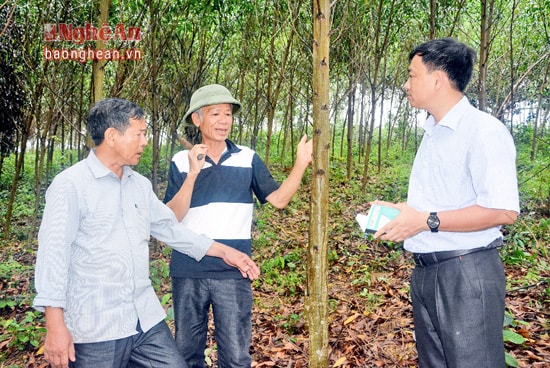 |
| Residents of Hamlet 10, Lang Thanh Commune (Yen Thanh District) discuss planting forests for raw materials. Photo: HN |
"The total length completed is over 1.3 km. Currently, in terms of transportation system, our hamlet is considered the best in the commune. The Party branch resolution is already in place, the goal is to complete the construction of 4 km of concrete roads within the hamlet by 2020," Mr. Nghia said excitedly. In addition, due to the remote location from the commune center, the people in the hamlet have also contributed 200 million VND to buy a three-room house to serve as a medical facility for the hamlet. This is something only the people of Hamlet 10 could do.
As evening approached, a sudden, heavy downpour of rain fell on the mountain village. Gathered around a cup of tea, village head Nghia and Party secretary Hao couldn't hide their joy as they showed us photos of their children studying information technology in Japan… Outside, trucks carrying acacia wood rumbled in and out, bringing a lush green landscape to the people of this mountain village. The story of these millionaire farmers in the western Yen Thanh mountain village is a vibrant testament to the effectiveness of forestry.
It is the hardworking farmers of Hamlet 10, Lang Thanh Commune, who have contributed to unlocking the potential of this vast but challenging region of the Western Mekong Delta, with its complex terrain and harsh climate. The effectiveness of planting timber forests has transformed the lives of the mountain hamlet over several seasons, and this effectiveness will only increase. The value derived from forest land will be fully realized once the villagers adopt and apply advanced planting and care techniques, selecting standard varieties and implementing a closed-loop planting-care-harvesting process. And Mong Ga Mountain will become a "treasure chest" in a sustainable green color, literally fulfilling the saying familiar to every rice-growing villager: "In front is a granary, behind is a treasure chest."
| Mr. Nguyen Cong Vinh, General Director of Thang Nam Forestry Joint Stock Company, stated: For areas and localities within the raw material development plan for the Nghe An MDF wood processing plant, as approved by the Provincial People's Committee, such as Hamlet 10 in Lang Thanh commune, the company will conduct specific surveys, coordinate with local authorities, and provide support policies to exemplary forest-planting households to develop high-tech forest planting models. Accordingly, the company will provide interest-free support for seedlings, fertilizers, termite control, and planting and care techniques throughout the raw material growth cycle, and commits to purchasing all raw materials until harvest. |
Nghia Duy


