
Points to note in spring crop production 2015
(Baonghean) - According to forecasts, the 2015 spring crop faces many difficulties and challenges such as drought and the potential for pest and disease outbreaks... To provide farmers with relevant information on technical measures and production protection, Baonghean newspaper conducted an interview with Mr. Nguyen Van Lap - Deputy Director of the Department of Agriculture and Rural Development.
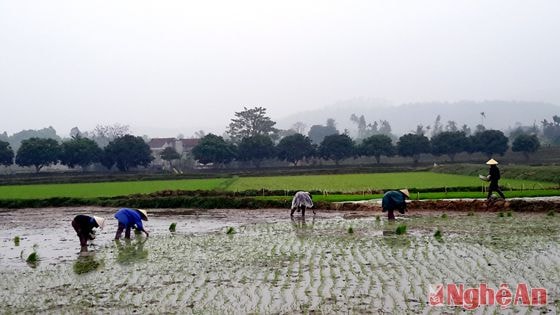 |
| Farmers in Long Thanh commune (Yen Thanh district) are heading to the fields to sow and plant spring rice. Photo: Phu Huong. |
PV:Could you please tell us about the progress of spring crop production in Nghe An province up to this point?
Mr. Nguyen Van Lap:To date, Nghe An province's spring crop has achieved the following results: For rice, the entire province has sown and planted 76,000 out of 86,000 hectares (over 90%), for peanuts, 10,000 out of 17,000 hectares (approximately 60%), and for corn, 10,000 out of 17,000 hectares (approximately 60%). It can be said that, in terms of planting season, it is expected to reach...13/2/2015(25/1 AL) The entire spring rice crop area in Nghe An is fully planted. As for peanuts, some areas in Nghi Loc and some in low-lying areas may be planted until the beginning of the first lunar month due to high humidity. Thus, we have arranged all crops in the planting season to ensure they are planted according to the set schedule.
PV:According to forecasts from meteorological and hydrological units, widespread drought may occur during the spring crop season of 2015. So, what are the agricultural sector's assessments of the difficulties and advantages for this year's spring crop season?
Mr. Nguyen Van Lap:
Regarding advantages: This year's weather has not been as harsh as in previous years, being warmer with fewer periods of intense cold. In spring crop production, localities are competing to focus on directing efforts to celebrate the Party congresses at all levels, therefore the atmosphere for spring planting and cultivation is very positive.
Supplies such as fertilizers, seeds, and pesticides for the 2014 spring crop were adequately provided to meet the needs of farmers. This year, the entire rice crop was planted before Tet (Lunar New Year), so we didn't have to rush.
Regarding difficulties: This year, the biggest challenge for the spring crop is the drought. Currently, the water level in reservoirs is insufficient, while the amount of additional rainfall in early spring is very limited.
Due to the warm weather, pests and diseases are developing more rapidly, thus affecting crops. Warm temperatures also shorten the growth period of crops; therefore, without proper intensive farming practices, yields may not meet expectations.
PV:Given this situation, what advice does the Department of Agriculture and Rural Development recommend to farmers to ensure productivity in the 2015 spring crop?
Mr. Nguyen Van Lap:Given the difficulties mentioned above, we suggest that you take note of the following:
It is crucial to strictly adhere to the planting schedule, as this year's weather forecast predicts warm temperatures. If planting is done too early, the results will be unsatisfactory. Drawing on experience from previous seasons, including the spring and summer crops, the solutions provided by the relevant departments and districts are very accurate. Therefore, we urge farmers to strictly follow the guidance provided by specialized agencies. Only then can we ensure a high-yield and high-quality spring crop.
PV:In some areas, the agricultural sector recommends transplanting, but farmers have gained experience and success from direct seeding in previous years, so they are still using direct seeding this year. What recommendations does the sector have to ensure high yields in those areas?
Mr. Nguyen Van Lap:Direct sowing is a technological advancement. However, in Nghe An province, the Department of Agriculture and Rural Development advises farmers against direct sowing, the reason being that it coincides with extremely cold weather. This period is cold every year, and if sowing seedlings, measures such as covering are necessary to ensure warmth and prevent the seedlings from dying. Direct sowing is fine in normal years, but in years with unfavorable natural disasters, even a single severe cold spell coinciding with the sowing date could result in the complete loss of the seeds. Therefore, the Department of Agriculture recommends that farmers avoid direct sowing during the spring planting season.
However, at this time, in Nghe An province, there are still over 10,000 hectares of direct-seeded rice in many localities such as Do Luong, Nam Dan, Hung Nguyen… Once farmers have directly sown the rice, they need guidance to prevent the seedlings from dying. We can offer some solutions, such as regularly monitoring and regulating water levels, and not letting the fields dry out, because cold combined with dryness can easily kill the seedlings. If direct sowing has been done, thinning and replanting must be done according to the correct principles. In many areas, farmers sow direct-seeded rice too densely, leading to very low yields.
For areas where rice is sown directly, it is very difficult to manage diseases, especially rice planthoppers and blast disease, right from the seedling stage. Therefore, in these areas, farmers must pay special attention to pest and disease management, especially blast disease and brown planthoppers, which may appear in large numbers in the spring crop of 2015.
PV: Given these production situations, how has the Department of Agriculture assigned personnel to support farmers in their production in these localities?
Mr. Nguyen Van Lap:Given the discrepancies in spring crop production, the Department of Agriculture and Rural Development recently organized inspection teams. Currently, the department has issued directives and instructed its subordinate units to pay close attention, especially to two departments:
The first component is that irrigation companies and enterprises must have personnel on duty regularly to regulate water levels promptly, even during the Tet holiday, as this year's Tet holiday is extended. Along with the staff of irrigation companies and enterprises, we propose that the People's Committees of the districts direct the communes to assign personnel to draw and regulate water for rice growth during the Tet period.
Currently, almost all rice is sown and transplanted before Tet (Lunar New Year), so after Tet, around the 4th day of the lunar month, it's time to tend to the rice crop. Therefore, during this period, the development of pests and diseases needs to be carefully monitored, especially blast disease on rice varieties that are highly susceptible such as AC5, BC15, etc. Therefore, the Department of Agriculture and Rural Development requires the Plant Protection Sub-Department to direct district plant protection stations to have staff on duty during Tet and to have staff inspect the fields from the 2nd day of Tet onwards to make early assessments of any signs of disease outbreaks. If signs of disease outbreaks are detected, they must immediately advise the Department and the districts to guide farmers in timely control measures. We believe that during this period, two key aspects are crucial: firstly, ensuring sufficient water to combat drought and promote good crop growth; and secondly, effectively managing pests and diseases from the beginning of the season. Ensuring these two factors will help overcome the initial stages of the 2015 spring crop production.
PV: To ensure a successful spring crop in 2015, what message would you like to convey to the farmers?
Mr. Nguyen Van Lap:The spring crop of 2015 was unique because most of the rice and some other crops were sown before Tet (Lunar New Year). The time between sowing, transplanting, and the first round of care was very short, coinciding with the period between Tet and the full moon of the first lunar month. Therefore, we advise farmers to celebrate Tet and enjoy the spring festivities, but still take care of their fields. It is necessary to allocate time appropriately, so that on the fourth day of Tet, farmers can visit their fields to promptly detect diseases and implement timely preventive and care measures to achieve high yields.
Interviewer: Thank you for the information! Wishing you and your family a healthy and joyful New Year!
PV(Perform)


