
Issues of concern to voters and representatives
When will the rural low-voltage power grid be reimbursed?
At this 11th session, provincial People's Council delegates continued to listen to voters' opinions and recommendations regarding the handover of rural electricity grids, the problem of weak electricity making it impossible to cook rice, high electricity prices, and the slow implementation of repayment for electricity grid investments.
It is known that at the 6th session of the Provincial People's Council, the Department of Industry and Trade responded to questions and promised before delegates and voters that it would direct and coordinate with the Electricity sector to take over the entire electricity grid of households of officials, workers, and farmers in the residential areas of agricultural and forestry farms, the General Youth Volunteer Brigades, and residents living interspersed in these areas, in order to reduce electricity bills for these groups because they are currently paying at commercial electricity rates. Regarding this issue, Nghe An Power Company explained that it is "currently" and "will" proceed in June and July 2014.
According to Nghe An Power Company, in order to directly sell electricity to households currently purchasing electricity through substations of Youth Volunteer Brigades, agricultural and forestry farms, etc., it is first necessary to take over the assets for management and operation. For Youth Volunteer Brigades 1 and 2 (Anh Son), the company is currently working with the asset owners on the handover of assets. If an agreement is reached, the company will begin selling electricity directly to households in June 2014. For Youth Volunteer Brigade 4 (Tan Ky), the company is working with the asset owner to take over the assets; if an agreement is reached, electricity sales will begin in July 2014.
Regarding the issue of handing over the rural low-voltage power grid, voters have repeatedly petitioned for its return, which has yet to be reimbursed according to state regulations. Nghe An Power Company stated that it had sent Official Letter No. 1386/PCNA-P2 dated August 14, 2013, and Official Letter No. 1183/PCNA-P2 dated July 11, 2013, to the People's Committees of the districts regarding the acceleration of the process of preparing documents for capital reimbursement. To date, Nghe An Power Company has only received 8 sets of documents and submitted them to the Northern Power Corporation, but due to invalid documents (not original documents), they have not been approved. Furthermore, 35 communes have not yet submitted reimbursement requests. Therefore, there is no basis to proceed with the reimbursement process.
In reality, many communes are unable to obtain all the required documents, as nearly 20 years have passed, spanning numerous terms and changes in cooperative chairmen. However, many property owners have submitted their applications, but the Electricity Department claims they are insufficient. Recently, the Department of Finance issued a directive instructing districts to resubmit documents for re-evaluation, creating difficulties for the communes, as the documents and assets were transferred long ago and are now lost. Thus, the situation remains a vicious cycle: residents demand divestment, the Electricity Company claims the property owners haven't handed over the assets, and the property owners are intimidated by the document and procedural requirements, leaving the people with no choice but to seek help from higher authorities!
Strictly protect rice-growing land.
Voters in several localities in Nghi Loc and Quynh Luu districts have reported that, recently, some individuals and organizations have arbitrarily converted rice paddy land to other uses without permission from competent state agencies, contrary to the provisions of the Land Law, but this has not been definitively resolved. The unauthorized conversion of rice paddy land without proper planning has resulted in economic inefficiency, negative environmental impacts, and instability in security and order.
Voters have suggested that all levels of government should strictly control agricultural land to ensure food security, linking it with new rural planning and other sectors to promote harmonious agricultural and rural development, and accelerate the country's industrialization and modernization. They also emphasized the need to clearly define the responsibilities and rights of all levels of government in managing rice-growing land according to planning. Violations of land management and use laws must be dealt with strictly, fairly, and promptly. Furthermore, to stabilize rice-growing land areas, policies are needed to support rice producers in disadvantaged areas that frequently experience food shortages. Support should be provided based on the planted area to purchase seeds and fertilizers, with specific support levels for each individual and each crop season.
The permanent and irretrievable loss of rice-growing land is the greatest threat to food security. Therefore, the best rice-producing land must be strictly and permanently protected, and not converted to any other use. It is necessary to recognize that double-cropping rice land is the most valuable and significant natural resource in the fight against poverty...
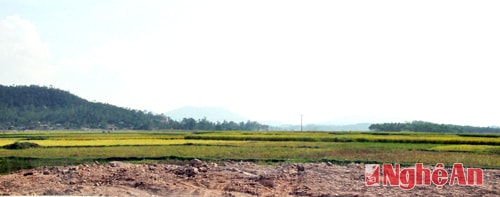 |
| Rice paddy land was illegally transferred and leveled in Hamlet 4, Nghi Dong Commune, Nghi Loc District. |
Government Resolution No. 63/NQ-CP on ensuring national food security clearly states: “The People's Committees of provinces and centrally-administered cities, based on the approved national rice land planning, shall determine the area of rice land to be preserved in their localities, especially double-cropping rice land that needs to be strictly protected, and create rice land use maps down to the commune and household levels.”
Speaking with reporters, Lawyer Trong Hai, Head of Trong Hai and Associates Law Office, said: “In land law relations, acts such as land allocation, land leasing, land use conversion, land encroachment, illegal transfer of land use rights… are violations of the law. Handling violations of land law involves applying forms of legal responsibility to the violators.”
Article 206 of the 2013 Land Law and Decree No. 43/2014/ND-CP detailing the implementation of several articles of the Land Law, which came into effect on July 1, 2014, stipulates very specifically the forms of penalties for land violations: “Persons who violate land law shall, depending on the nature and extent of the violation, be subject to administrative penalties or criminal prosecution in accordance with the law. Persons who violate land law and cause damage to the State or to others, in addition to being punished according to the law, must also compensate the State or the injured party for the actual damage.” The forms and levels of penalties are further specified in the Government Decree on administrative penalties in the field of land.
"Handling violations to prevent land law violations in general, and illegal land use conversion in particular, is necessary to maintain order and discipline and improve the efficiency of land management activities."
Transparency is needed in preschool admissions.
According to statistics from the Vinh City Department of Education and Training, there are currently 15,467 children aged 0 to 2 years old in the city (born in 2014, 2013, and 2012) and 17,166 children aged 3 to 5 years old (born in 2011, 2010, and 2009).
According to the Vinh City's preschool education development plan approved by the Department of Education and Training, for the 2014-2015 school year, Vinh City must enroll 14,694 children of kindergarten age in 434 classes and 3,394 children of nursery age in 166 groups (including 24 kindergarten classes with 632 children and 59 nursery groups with 808 children in 59 family-based preschool facilities).
Excluding family-run preschools, Vinh City currently has 50 preschools (28 public, 5 private, and 17 independent). In the upcoming school year, according to the plan, these schools will have a total of 410 kindergarten classes with 14,062 children and 106 nursery groups with 2,586 children. While these figures do not yet meet the overall requirements of the province (Nghe An's target for the 2014-2015 school year was to enroll 22% to 25% of children in the nursery age group and 88% to 90% of children in the kindergarten age group), they are at least less stressful and less "heated" than in previous years. However, in reality, the enrollment methods of preschools in Vinh City have unnecessarily exacerbated the situation.
Firstly, despite having a plan—a plan specifically assigned to each school (number of class groups, number of children per class, number of children in each age group, etc.)—the schools lack transparency regarding enrollment quotas. Many schools simply announce a round number: 50 children to be enrolled this school year. How can dozens of schools with different conditions and population groups have the same enrollment quota? This has caused public outrage and raised questions: Are the schools deliberately concealing their enrollment quotas for ulterior motives?
Secondly, due to challenging conditions, the enrollment quota for preschool-aged children is too low. Preschools only accept 2-year-olds (born in 2012). Ideally, all 2-year-olds should be eligible to apply, but to reduce the number of applicants, preschools have restricted the birth month of the children. Some schools announce they only accept children born between January and September 2012; some even only accept children born between January and July 2012. By restricting the birth month in this way, these preschools have brazenly deprived children born in October, November, or December (or August, September, October, November, or December, depending on the school) of their right to attend school and receive an education.
Hopefully, the enrollment process for preschools in Vinh City will be conducted in accordance with regulations, openly and transparently, to alleviate the unnecessary stress experienced by many parents every time enrollment season arrives.
Opinions of delegates at the session
DeputyNguyen Chi Nham -Chief Inspector of the Province (Representative of Quynh Luu District)
Enhance the accountability of all levels and sectors in receiving citizens and resolving complaints and petitions.
In the first six months of 2014, state administrative agencies at all levels throughout the province received 2,803 visits from citizens to file complaints and petitions, an increase of 1.2% compared to the same period in 2013. The total number of complaints, petitions, and land disputes arising in the province was 3,461, an increase of 8.8% compared to the same period. Of these, the number of unfounded complaints increased compared to the same period in 2013 and accounted for a higher percentage than in previous periods (unfounded complaints accounted for 76.4%, unfounded accusations accounted for 69.5%).
Besides objective reasons, subjective causes have been identified as the limited legal awareness of some citizens, especially in the areas of land, land clearance, and social policies. In particular, some heads of units and localities have not paid sufficient attention to directing the work of receiving citizens and resolving complaints and denunciations; there is still a situation where leaders are reluctant to receive citizens, engage in dialogue with citizens, and avoid or shirk responsibility in resolving complaints and denunciations. Some members of the Provincial Citizen Reception Council do not fully participate in the monthly citizen reception sessions at the provincial citizen reception office; some officials are sent to participate, resulting in low quality and limited advice on handling issues...
In my opinion, to effectively handle citizen complaints and denunciations in the province, the Provincial People's Committee needs to direct all levels and sectors to properly implement regulations on receiving citizens and resolving complaints and denunciations. Especially, it is necessary to enhance the responsibility of the heads of Party committees, governments, localities, and units in receiving citizens; increase the number and quality of officials working on citizen reception at all levels and sectors; and accurately classify complaints and denunciations to ensure timely and appropriate handling within their authority. Directors of departments and sectors, chairmen of districts and communes, and heads of agencies and units must directly resolve complaints and denunciations within their jurisdiction. They must promptly and decisively resolve newly arising cases at the grassroots level, preventing public dissatisfaction and grievances.
DeputyTruong Hong Phuc- Secretary of the Do Luong District Party Committee
To ensure the policy is implemented effectively.
At this session, the provincial People's Council delegates studied and considered the submissions from the Provincial People's Committee. Through this study, we found that the submissions from the Provincial People's Committee at this session were meticulously prepared and of high quality. In particular, I welcome and appreciate the content of Submission No. 4278 from the Provincial People's Committee on "Amending and supplementing some policies supporting investment in agricultural and rural development in Nghe An province." This policy directly impacts each residential area and locality, both mountainous and lowland, affecting production organizations, individual households, and even farmers. We believe that the introduction of this mechanism will help support people and production organizations overcome current difficulties, encourage investment, and promote production to further shift the economic structure of agriculture and rural areas in the province. It will also be an economic solution contributing to accelerating the implementation of the National Target Program on New Rural Development.
It must be said that this policy, with its specific content and broad scope of beneficiaries, addresses the urgent needs of today. Therefore, I propose that provincial departments and agencies, particularly the Department of Agriculture and Rural Development and the Department of Finance, advise the Provincial People's Committee to issue guiding documents for implementation, organization, and execution, providing specific and transparent procedures, and simplifying the procedures for this support policy. In particular, it is crucial to ensure the necessary resources are available so that this mechanism can reach production organizations and individuals as soon as possible, quickly demonstrating its effectiveness in promoting the agricultural economy and improving the lives of the people.
DeputyLe Van Tri- Mr. Son:
Fulfilling promises to voters.
The question-and-answer session is a topic that attracts significant attention from voters. At this session, the Provincial People's Council selected two issues: outstanding tax debts and the aftermath of the Ban Ve Hydropower Plant resettlement. These are two issues of particular concern to delegates and voters in the province. This demonstrates that the Provincial People's Council has chosen the right questions, addressing the right issues, clearly and specifically, focusing on key areas and reflecting the aspirations and concerns of voters and the general public.
The issue of outstanding tax debts was of great concern to the delegates. The delegates' questions revealed their worry about the high level of outstanding tax debts, and also highlighted shortcomings in the tax sector. Through these questions, the delegates contributed to advising on solutions for the sector. The report and explanations from the Director of the Provincial Tax Department, along with the responses to the delegates' questions, showed that the tax sector had clearly demonstrated its determination to strengthen tax collection measures and reduce the average level of outstanding tax debts. What concerns us delegates and voters is the fulfillment of the tax sector's promises to the voters.
The second item on the agenda for this questioning session concerns the resettlement for the Ban Ve Hydropower Project. This is not a new issue. However, many shortcomings and inadequacies remain that need to be resolved definitively. Representatives suggested that after this questioning session, the Provincial People's Committee should be responsible for overseeing the handling of this matter, as the Provincial People's Committee is the one answering the questions, but the investor is the unit responsible for implementing the solution and must resolve the issue completely.
NPV - C.TV(take note)


