
The issues raised
(Baonghean)After two years of implementing the New Rural Development program, Nam Dan district has achieved many positive results, with land consolidation and exchange initially showing clear effectiveness. However, the large-scale model of model fields – a production organization suitable for the New Rural Development program – still faces many difficulties.
One day in early April, we visited Nam Xuan commune. In the Khuyen field, the villagers were tending to their spring rice crop. With favorable weather conditions, the rice paddies were a vibrant green with young seedlings. Commune officials explained that this was the first production season for the newly consolidated and redistributed land plots. After the second redistribution (the first in 2003), land fragmentation and dispersion had been reduced. Before the 2012 land redistribution, the average number of plots per household in the commune was 4.6; this reduction has decreased to 2.2 plots per household. Accordingly, the field boundaries, irrigation and transportation systems have been replanned for greater convenience in production. More importantly, this land consolidation is a crucial step for the commune to develop many model fields, specialized production areas, and high-income farms.
Nam Dan district has basically completed the land conversion in two communes, Nam Giang and Khanh Son. District leaders stated that in 2013, they will direct the completion of land conversion in the remaining 20 communes. However, the district still has much work to do to achieve the goal of building model fields. Mr. Nguyen Huu Nhuan, Head of the District Agriculture Department, expressed concern: According to Decision No. 09/QD-UBND dated February 4, 2012, of the Provincial People's Committee on supporting investment in agricultural and rural development in the 2012-2015 period, production facilities that build model fields will receive support from the Provincial People's Committee covering 30% of the value of investment materials according to current production processes, as well as funding for workshops, propaganda, and study tours, at a rate of 15 million VND per model field.
In the spring of 2013, Nam Dan district collaborated with three businesses – Nghe An Agricultural Materials Joint Stock Company, Vinh Hoa Limited Company, and Central Seed Joint Stock Company – to implement a large-scale rice cultivation model in three communes: Nam Giang, Nam Thanh, and Nam Loc, with each commune cultivating 50 hectares using AC5, Khang Dan 18, and DT68 rice varieties. However, due to changes in policy mechanisms, participants in the program are no longer receiving the support as previously approved.
The reason the district did not receive provincial support when implementing large-scale model fields is because these models did not have cooperatives and had not undergone land consolidation, even though the area had met the criteria. "Farmers implemented the models before the criteria were established, therefore, they did not receive support, and people suspect that officials did not keep their promises," Mr. Nhuan said.
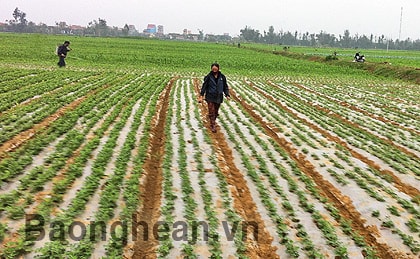
People in Nam Trung (Nam Dan) are tending to their spring peanut crop.
It must be affirmed that Nam Dan is a lowland district with many potential advantages for implementing large-scale field development. These include fertile land with approximately 3000 hectares of alluvial plains along the Lam River suitable for the development of various crops, especially peanuts; many flat fields; and an abundant labor force. However, to date, the district has not fully exploited these potentials.
In Nam Trung commune, which has a large area of riverside land along the Lam River, we met Ms. Nguyen Thi Lien in Hamlet 3, weeding her spring peanut crop. She said: "This season I'm planting 2 sao (approximately 0.2 hectares) of L26 variety. Previously, everyone did things their own way, from seeds to care, mostly based on personal experience. Seed suppliers only know how to sell and collect money immediately, without knowing the yield after harvest. Agricultural supplies have to go through many levels and intermediate stages of distribution, making the cost too high by the time they reach the farmers. Farmers just follow their experience: they arbitrarily save seeds, sow and fertilize, and spray pesticides… Therefore, production is often difficult to avoid the impact of natural disasters and diseases." When asked if she knew about the large-scale production model and if she wanted to participate, she immediately replied: "I've heard a lot about the large-scale production model, how it reduces labor, creates a large volume of goods, and is much more efficient, but I can't do it alone; it requires the participation of a whole group of people and the involvement of businesses. I want to participate, but without someone to 'lead' the implementation, I can't."
Upon visiting the local people, we noted many concerns. Although the land is contiguous and in a single plot, the more important thing is to reorganize production based on linkages between farmers and businesses, consolidating small, scattered plots into a large, common area. This would facilitate the application of new techniques and technologies, and ensure stable output for farmers, but this has not yet been achieved. According to Mr. Tu Trong Kim – Head of the Crop Production Department – Department of Agriculture & Rural Development, to develop the large-scale field consolidation model more quickly and effectively in the context of building new rural areas in Nam Dan, in addition to completing land consolidation, it is necessary to better implement production linkages between farmers, businesses, and scientists, especially between farmers, farmers' organizations (cooperatives, production groups) and businesses involved in processing and consuming products. "Currently, in the province, there are several large-scale rice farming models in Nghi Loc, Dien Chau, Yen Thanh, Do Luong, and in Nam Dan during the spring of 2013. In most of these models, only the factors of area and technique are ensured, while the connection between production and product consumption - the most important aspect of large-scale rice farming - has not yet received sufficient attention and guidance. In reality, most businesses only participate to sell seeds and fertilizers, while very few businesses are able to purchase and process the products, and in some places, there is even price manipulation," Mr. Kim said.
Furthermore, Nam Dan also needs government support for all parties involved in building the value chain, such as providing training to improve the skills of participating farmers; encouraging scientists to actively research and transfer scientific and technological advancements into agricultural production and processing, and to earn a good living from their scientific products...
Text and photos: Thu Huyen


