
Efforts to save rice seedlings and rice crops during the summer-autumn season.
(Baonghean) - The prolonged, extreme heatwave has brought summer-autumn rice production to a near standstill throughout the province. In most downstream and low-lying districts, rice seedlings are at risk of dying from drought, and the planted areas are also at risk of not retaining water.
In Hung Nguyen district, officials from the Southern Department of Agriculture and Irrigation and the local people are working day and night in the fields, carefully collecting every drop of water, pumping and diverting water to save the rice seedlings. Mr. Nguyen Van Hien, Head of the Agriculture Committee of Hung Thang commune, said: “The entire commune has more than 90 hectares of rice seedlings that are severely lacking water. For more than a week now, the commune has tried its best to mobilize pumps from the 9B Hung My canal to regulate irrigation water. But the water source here is not enough in terms of capacity and flow rate to combat the drought for even a few hectares, let alone dozens of hectares that are thirsty like this.”
According to Mr. Hien, some households have taken proactive measures to save their rice seedlings; however, local water sources from ponds and lakes cannot meet the needs of the seedlings that are at risk of dying from drought. It is possible that 60 hectares of rice seedlings in the Cham rice paddy area, which have not yet received irrigation water, will dry up and wither due to the extremely hot weather.
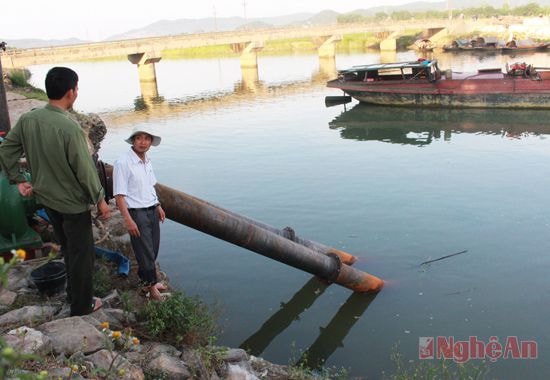 |
| Strengthening the capacity of pumping stations in the downstream areas of Hung Nguyen district. |
In some other areas such as Hung Chau, Hung Loi, Hung Phuc, and Hung Tay communes, 2/3 of the rice seedlings are wilting due to lack of water. Besides drought, these communes also face salinity intrusion due to unstable tidal fluctuations. Mr. Pham Van Linh, an official from the Southern Irrigation Enterprise, said: “Currently, at the Ben Thuy irrigation station, the water reserve level has dropped to 0.1, while 0.5 is already considered the dead water level. However, we are pumping as much water as we can to regulate the water supply for Hung Chau and Hung Phuc communes, which are severely lacking water. We are also making efforts to pump water for Hung Loi commune to irrigate 100 hectares of rice seedlings…” Currently, in the district, outlying communes such as Hung Tay have only 150 hectares out of 750 hectares with water; Hung Yen Nam has 80 hectares out of 225 hectares; Hung Yen Bac has 60 hectares out of 260 hectares; and Hung Trung has 200 hectares out of 420 hectares with water.
On May 27th, the People's Committee of Hung Nguyen district issued an urgent directive instructing communes to implement a rotational pumping schedule. However, by May 28th, the entire canal system leading to the pumping stations was at dead water levels and had to cease operation. Mr. Hoang Duc An, Deputy Head of the Agriculture Department of Hung Nguyen district, said: The communes of Hung Tien, Hung Thang, Hung Chau, and Hung Loi receive water from the old pumping station of Hung Xuan Cooperative (3,000 m3/h), but they can only pump for 12-15 hours each day. The Hung Xuan Bridge pumping station, although always having sufficient water, is not very efficient. With three pumps at a capacity of 3,000 m3/h, the amount of water discharged into the reservoir only reaches about 600-700 m3/h. Thus, as of June 2nd, more than 75% of the district's area still lacks water for production…
Similarly, communes in the floodplains of Nam Dan district are currently unable to prepare the land for production as planned. The entire district has only sown and planted 1,392 hectares out of 6,100 hectares; each commune, with an average of 300 hectares, has only sown and planted 50-70 hectares. Mr. Nguyen Huu Nhuan, Head of the District Agriculture Department, said: “June 20th is the deadline. If water becomes available, we will organize direct sowing with the short-day, high-yield V6 purebred rice variety. Although direct sowing is not the recommended solution…”
In Nghi Loc district, the planned area for summer-autumn rice cultivation is a maximum of 2,600 hectares, 200 hectares less than the 2014 summer-autumn crop. However, the prolonged drought and salinity intrusion have exceeded the district's capacity to manage drought relief efforts, so to date, only 1,800 out of 2,600 hectares have been planted. Meanwhile, if the hot weather continues, drought relief for the remaining 1,800 hectares of planted rice will be very difficult. Nghi Loc is located at the end of the Nam-Hung-Nghi irrigation system but at the beginning of the saline intrusion through Tram Ba to Nghi Quang. The freshwater supply for the entire district's pumping station system depends on the regulation of freshwater through the Nam Dan sluice gate into the Gai canal, heavily dependent on the pumping capacity of Nam Dan, Hung Nguyen districts, and Vinh City. The district has 58 pumping stations and 40 lakes and dams, but these are gradually depleting, and salinity intrusion is becoming increasingly severe.
Currently, Nghi Van commune has 600 hectares of double-cropping rice land that cannot be used for the summer-autumn crop because reservoirs, dams, and streams have completely dried up. After the damming of the Cam River, 670 hectares of double-cropping rice land in Nghi Yen, Nghi Tien, Nghi Quang, and Nghi Thiet communes also cannot be used for production due to salinity intrusion.
In Thanh Chuong, Do Luong, and Dien Chau districts, severe drought conditions are also occurring. For example, Dien Chau has 7,000 hectares of rice fields, with 75% already planted. As of June 5th, nearly 1,000 hectares in Dien Chau remained unplanted, concentrated in 10 communes at the end of the canals and in the high-lying areas. In addition, about 200 hectares of newly planted rice have already begun to dry out. The water level of the Bung River is unprecedentedly low, only 140-150cm, posing a very high risk of saltwater intrusion. Furthermore, many sections of the Nha Le canal have dried up, rendering 30 out of 70 pumping stations inoperable. Faced with this difficult situation, agricultural officials and irrigation enterprise staff are working diligently in the fields, directing efforts to channel water to drought-stricken areas to facilitate planting, while also providing financial support for farmers to mobilize mobile pumps to draw water from ponds, the Bung River, and the Nha Le canal into their fields.
Currently, the province has nearly 59,000 hectares of summer-autumn rice, but only about 34,000 hectares have been planted, reaching 57.5%. However, according to a report from the Department of Agriculture and Rural Development, water levels in reservoirs throughout the province are currently low, only reaching 20% of their designed capacity. River water levels have dropped to -0.4m at the Nam Dan sluice gate and 9.87m/10m at the Do Luong reservoir in recent days. Due to low water levels, pumping stations along the Lam River in Thanh Chuong and Do Luong districts are unable to operate. Currently, only Yen Thanh, Quynh Luu, and Dien Chau districts have achieved over 75% of their planting rate, while other districts have only reached below 50%. Some districts have low planting rates, such as Hung Nguyen (33.3%), Nam Dan (39.6%), and Hoang Mai town (6.9%). Typically, some areas such as Tuong Duong, Quy Chau, Quy Hop, and Nghia Dan are not yet able to carry out planting.
The prolonged and intense heatwave is predicted to continue, meaning that even areas already planted may not achieve the desired growth rate. Given this situation, the Department of Agriculture and Rural Development has issued a directive requiring districts to focus on reviewing and balancing water resources to allocate planting areas for the summer-autumn crop in accordance with local conditions. In addition, a water conservation plan is needed, utilizing all available water sources to care for seedlings and already planted areas. No further planting should be done in areas where irrigation water is insufficient. Mr. Truong Minh Chau, Head of the Crop Production Department of the Department of Agriculture and Rural Development, stated: The department's directive is that localities must do everything possible to save the seedlings. For flood-prone areas, after the rain, mature seedlings should be used; otherwise, very short-duration varieties (under 100 days) should be used for sowing.
Thanh Nga - Chau Giang
(Dien Chau Radio Station)


