
Efforts to address rural employment
(Baonghean) - Solving employment problems, developing production, and increasing people's income are among the important factors that help rural areas develop stably and sustainably.
Son Hai commune is the economic center of the coastal area of Quynh Luu district. Here, the fishing, aquaculture, and fisheries services are thriving, with over 40% of the population earning their living from these occupations. In the economic structure, the fishing industry not only provides many jobs and high incomes for the people but also creates a strong impetus for the commune's development. In recent years, thanks to government policies that facilitate loans for fishermen to build large-capacity vessels, and the formation of cooperative groups within the commune, Son Hai commune has many fishing fleets venturing far out to sea.
Mr. Nguyen Van Hai, from Hamlet 5, said: “In the commune, many households have jointly invested billions of dong to build 420-horsepower fishing vessels, each creating jobs for 12-15 sailors. Because they fish in the Gulf of Tonkin, the economic efficiency is high, and the average salary for each sailor is 4-6 million dong per month.” Hamlet 5 has more than 30 fishing vessels, thus providing many jobs for workers. Along with that, fishing-related services have also developed, creating more jobs and income for the people.
In its socio-economic development and new rural construction orientation, Son Hai commune always prioritizes vocational training and job creation for rural laborers, with a focus on aquaculture and fisheries. It regularly collaborates with relevant agencies to organize training courses to improve the skills of its workforce in the marine sector (currently, there are 1,200 households with over 6,500 workers in aquaculture and fisheries). From 2014 to the present, through vocational training programs, the commune has facilitated employment for 320 workers in industrial garment manufacturing, service industries, seafood harvesting and processing, and supported 60 people in overseas labor export programs.
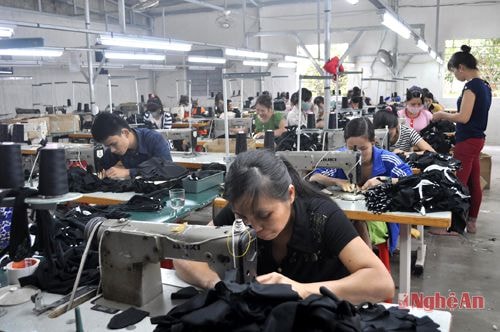 |
| Dung Thuy's industrial garment factory is located in Son Thanh commune (Yen Thanh district). |
The issue of vocational training and job creation for rural laborers is a priority for Quynh Luu district. Along with effectively integrating programs and projects in this field, the district also invests in developing traditional crafts and building small industrial clusters to create "outlets" for vocational training.
Mr. Ho Ngoc Dung, Vice Chairman of the People's Committee of Quynh Luu district, said: "With practical actions in vocational training and job creation for rural laborers, from 2014 to the present, the district has created jobs for more than 2,410 laborers, including 675 who went abroad for work, and has organized 6 vocational training classes for 228 rural laborers."
Dien Hong commune is one of the first localities in Dien Chau to be recognized as having completed the criteria for building new rural areas (in 2014). Thanks to the focus on investing in the development of industries and services, the commune has become a dynamic economic development zone. Job opportunities here extend beyond agricultural production to include small-scale handicrafts and jobs in small factories. Currently, the Dien Hong small industrial park is fully occupied, and the Thap-Hong-Ky industrial cluster has attracted many businesses from Dien Hong.
With its open policies creating favorable conditions for the development of industries and services, the commune has provided significant support for people to learn vocational skills and find employment. Within the commune, there are 10 limited liability industrial production companies, 15 limited liability commercial and service companies, and dozens of construction companies, carpentry workshops, transportation companies, farms, milling businesses, and mechanical plowing and harvesting services. In particular, the substantial capital support from over 500 commune residents living and working abroad has helped many households invest in developing their industries and services. These occupations are a key factor in increasing people's income, creating a foundation for Dien Hong to achieve the New Rural Area (NRA) goal. Dien Chau district also has many other communes that are very dynamic in economic development, thereby creating jobs for local laborers with high incomes, contributing positively to the construction of new rural areas, such as Dien Thap, Dien Ky, Dien Thinh, Dien Hanh, and Dien Hoa communes.
In Que Phong district, the Steering Committee for New Rural Development and the Rural and Mountainous Area Development Board have invested in building 25 economic development models, which have been widely adopted by the local people. These include passion fruit cultivation in Tri Le, Nam Nhoong, and Nam Giai communes; livestock and vegetable farming linked to cooperative economic development in Que Son district; mushroom cultivation in Muong Ngoc commune; cattle farming in Que Son and Hanh Dich communes; and raising local black pigs in Nam Giai commune. The district regularly organizes training courses and transfers techniques in livestock farming, crop cultivation, weaving, bamboo processing, and farm management to households. As a result, people have more jobs and income, which is an important factor contributing to poverty reduction in mountainous areas.
Vocational training, job creation, and the introduction of suitable occupations to local areas have always been pressing issues for Party committees and local governments. Through production development to increase people's income in our province, very positive results have been achieved. From 2011 to the present, the Provincial Agricultural Extension Center has opened 151 vocational training classes in 11 professions (including 93 classes in livestock farming, 46 in crop cultivation, 1 in forestry, and 1 in fisheries...) and trained and certified 4,318 rural workers in agricultural skills. Vocational training also integrates the application of new science and technology into production, providing farmers with information on markets, technology, and input materials.
Mr. Vi Luu Binh, Deputy Director of the Department of Agriculture and Rural Development, said: “In recent years, vocational training for farmers has received appropriate attention and investment. Alongside expanding training in traditional agricultural professions, the training of high-quality labor has been emphasized, helping people meet the requirements of a labor environment demanding high skills and increasing their income. To make vocational training and job creation for farmers even more effective, it is necessary to manage and guide vocational training well, especially training linked to practical application, and to increase funding for this work. In 2014, the New Rural Development Program invested 23.5 billion VND in vocational training for farmers, and in 2015, it is 27 billion VND. With this funding, localities need to use it appropriately and effectively to create jobs for rural laborers.”
Hoang Vinh


