
Efforts to reduce poverty sustainably
(Baonghean) - In recent years, localities in the province have actively promoted many specific programs to help people gradually escape poverty sustainably, contributing to socio-economic development.
The family of Ms. Bui Thi Hien in Dien Tien hamlet, Luu Son commune, Do Luong district, was once a poor household with a child suffering from a serious illness, making their life very difficult. In 2012, her family received a 20 million VND loan from the Social Policy Bank of the district, investing in making rice paper and collecting rice paper from other households in the village, then drying and selling it to districts such as Nam Dan, Hung Nguyen, Yen Thanh, Nghi Loc, and Vinh City. On average, they sold 500-700 pieces per day, earning 200-300 thousand VND per day. Thanks to their hard work and diligence, in 2014, her family escaped poverty and built a beautiful, spacious three-room house.
The family of Ms. Nguyen Thi Chin in Yen The hamlet, Yen Son commune (Do Luong district) was also once a poor household facing difficult circumstances. Her husband died prematurely from a serious illness, leaving her to raise two children alone in a struggling life. In 2013, after being given the opportunity to attend a local poultry farming training course (according to Decision 1956) and through self-study, Ms. Chin developed her poultry farming business on a scale of 300 laying ducks, 200 broiler chickens, and 50 geese. The duck flock alone lays 260 eggs per day, yielding a net profit of 6 million VND per month; the chickens are ready for market every 2.5 months, bringing in a profit of 15 million VND per batch. She raises four batches of chickens annually, and if there are no disease outbreaks, her net profit reaches 60 million VND. In addition, she earns income from her geese and catfish. In 2014, Ms. Chin's family escaped poverty, and their lives gradually stabilized.
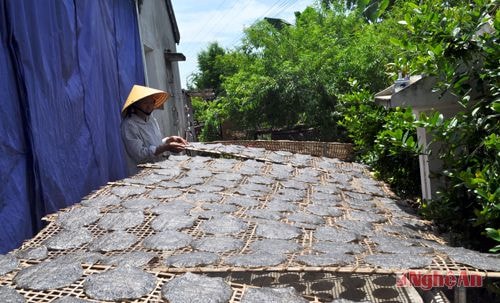 |
| Thanks to loans for poverty alleviation to develop production, the family of Ms. Bui Thi Hien (Luu Son commune, Do Luong district) has escaped poverty. |
The Resolution of the 19th Congress of the Do Luong District Party Committee, term 2010-2015, set targets to reduce the poverty rate by 2% annually; provide vocational training for 2,000 workers; and send 1,000 people abroad for work each year. To achieve these goals, the district established and strengthened steering committees at all levels, assigning specific tasks to each committee member. Simultaneously, it issued specific local policies to support poor and near-poor households, tailored to the actual situation. It also implemented projects to achieve poverty reduction goals, such as the Vocational Training and Labor Export Project for the period 2010-2015. Furthermore, it organized communication activities, policy dialogues with the poor, and capacity-building training for officials at the commune, town, and neighborhood levels. Directing the implementation of poverty reduction policies in the area… With synchronized and close implementation, the poverty rate in the district has decreased rapidly year by year, narrowing the gap between rich and poor in the area. In 2011, the entire district had 7,744 poor households (17.9%), and by 2015, this number had decreased to 3,101 households (5.95%).
Anh Son District has also issued several resolutions and directives on poverty alleviation linked to job creation, such as developing hill and garden economies, planting raw material crops, restructuring crop and livestock production, and investing in essential infrastructure for disadvantaged communes. Annual surveys of the labor force in the district are conducted; coordination with relevant agencies is carried out to recruit workers for domestic employment and overseas labor export to create jobs and increase income for the people.
Mr. Dang Xuan Quang, Vice Chairman of the Anh Son District People's Committee and Head of the District's Poverty Eradication Steering Committee, stated: Currently, the district has several factories in operation, such as the Song Lam Sugar Factory and the Tea Processing Enterprise. More factories will soon be operational, including a cement factory, a clean charcoal export factory, and a cassava starch processing plant. These will attract a large number of local workers, contributing positively to poverty eradication. Furthermore, in line with the principle of vocational training linked to job creation and the development of the rural labor market, the District Vocational Training Center collaborates with the Agricultural Extension Station and partners with vocational schools in the province to provide vocational training for workers. The District People's Committee has assigned the Vocational Training Center to investigate and survey the vocational training needs of rural workers, thereby developing a training plan for industries and professions that meet the needs of both learners and employers. By partnering with vocational schools to open university-level courses in accounting and law, and actively introducing job opportunities for workers, we aim to gradually eradicate poverty and achieve sustainable poverty reduction.
With the attention of all levels, sectors, and organizations, through the "For the Poor" Fund, many farmers have received support in terms of capital and technology, enabling them to improve their production and livestock farming. This has led to the emergence of many effective models and practices, which have been applied and replicated, creating opportunities for the poor to invest in production, such as industrial tea cultivation, watermelon, corn, sugarcane farming, and cattle breeding, all of which yield high economic returns. As a result, the number of poor households has decreased rapidly each year, contributing positively to the socio-economic development goals of the entire district. In 2013, the poverty rate in Anh Son district was nearly 15%; in 2014, it decreased to 11.34%. In addition, implementing the policy of supporting poor households with housing, over the past three years, the entire district has provided support for the repair and construction of 89 houses for households with particularly difficult circumstances. Every year, 100% of poor households are provided with health insurance cards, with a total cost of tens of billions of VND,...
However, to achieve a more sustainable reduction in poverty rates in the coming years, districts need to strengthen vocational training, support job creation, and develop annual poverty reduction programs linked to local socio-economic development plans; promote guidance and technical training in livestock farming and production for poor households to gradually improve their living standards; and regularly inspect, monitor, and evaluate the impact of policies, programs, and projects, as well as the results of poverty alleviation. Most importantly, each poor household must cultivate the will and effort to improve their living standards through labor and production, avoiding the mentality of relying on preferential policies from the State. Only then can poverty alleviation be ensured to be sustainable.
Quynh Lan


