
Efforts to implement national standards for community health care.
(Baonghean) - Currently, Quy Chau district has 6 out of 12 communes and towns that meet the national standards for commune-level health care in the 2011-2020 period. This is a great effort that creates favorable momentum for the locality to strive to achieve the national standard for commune-level health care...
Chau Thuan commune, a remote area in Quy Chau district, is considered to have great potential, but in reality, the lives of the people in its 10 villages remain difficult. However, what reassures the villagers is that when they are sick, they receive attentive care from the local health staff. The commune's health station is quite well-equipped with medicines and medical equipment. The functional rooms are quite spacious and well-built. Treatment and childbirth at the health station are as reassuring as at the district hospital…
We arrived at Chau Thuan Commune Health Station just as Ms. Truong Thi Thuy, the deputy station chief, had finished assisting in a childbirth a few hours earlier. Both mother and baby were healthy and in stable condition. Ms. Thuy said that the station has six staff members, but only two were present today. The station chief, midwife, and other staff were all busy with training... Chau Thuan Commune Health Station is like a miniature hospital with a spacious, clean, and relatively well-equipped functional rooms and equipment: blood glucose meter, electrocardiogram machine, urine analyzer; the examination room and treatment room each have four beds. Such facilities can be considered adequate for a commune with only over 3,100 inhabitants.
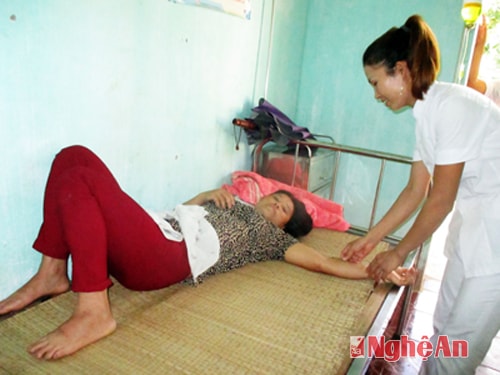 |
| Providing patient care at Chau Thuan Health Station. |
Environmental sanitation has always been a weak point in mountainous areas. However, Chau Thuan commune has received significant attention. Chieng village is one of the residential areas that has done well in environmental sanitation. During village meetings, this issue is frequently discussed and promoted by the village health workers, so recently, the work of maintaining cleanliness in the village roads and alleys has been well-followed by the people. Every day, at 5 a.m., all residents wake up to sweep inside and outside their houses. At the beginning and middle of the month, the village management board mobilizes residents to clean all the main roads in the village. In 2013, thanks to investment from the provincial environmental sanitation and clean water project, Chau Thuan commune received funding to build 100 sanitary toilets. According to Ms. Luong Thi Sen, a health worker in Chieng village, out of 71 households in the village, 55 have built toilets.
Chau Hoi commune achieved national standards for healthcare in the 2011-2020 period in 2013. Thanks to healthcare socialization projects, the commune's health station now has 16 functional rooms, including delivery rooms, postpartum rooms, and treatment rooms, all equipped with basic facilities. The commune's health station has become a reliable destination for women during their childbirth period. Ms. Lu Thi Thuan, head of the Chau Hoi commune health station, said: "With over 6,600 inhabitants, the station receives 40-50 patients for examination and treatment each day. For a health station in a mountainous area, that number is relatively large; however, it also shows that more and more people are trusting and seeking medical care here. Thanks to well-organized public awareness campaigns, most people understand the importance of vaccinating their children. Even in Xon village, which is 25 km away from the commune center via dirt roads, people still bring their children for vaccinations at the appropriate age." Currently, 95% of children under 5 years old in the entire commune have been vaccinated. In the first 6 months of 2014, there were only 3 cases of third births in the entire commune…
Besides the communes with relatively good infrastructure, there are remote areas facing many difficulties, including Chau Nga commune, located 25km from the district center. The health station only has two dilapidated buildings with crumbling walls revealing rows of electrical panels. Patient Vi Van Banh, residing in Tan Tien village, was suffering from a high fever of nearly 39°C but still couldn't hide his anxiety: "I only dare to stay here for treatment when it's sunny; when it rains, I'd rather stay home." Station chief Vi Duc Sinh said: Despite the lack of facilities, the health station receives dozens of patients for examination and treatment on average every day. In addition to the dilapidated infrastructure, environmental sanitation and clean water are also weak points; the main water source for the people in the commune is always polluted. Currently, a new health station in Chau Nga is being urgently constructed; it is expected to be put into use by the end of 2014.
In an interview with us, Ms. Nguyen Thi Dinh, Deputy Director of the Quy Chau District Health Center, stated: "In just two years since 2011, when the national standards for commune-level health care were implemented according to the new criteria, Quy Chau district has had 6 out of 12 communes and towns achieve the new national standards. This achievement is partly due to the significant investment in infrastructure and medical personnel over the past years through social mobilization. The infrastructure has been invested in by many projects, including the multi-sectoral project from Belgium providing computers, electrocardiographs, blood glucose meters, urine testing equipment, etc., the North Central region project, and the province's clean water and sanitation project. In 2014, the RBS project supported the improvement of the quality of medical examination and treatment, the consolidation of reporting and record-keeping, and healthcare for children."
The immediate task for the Quy Chau District Health Department until the end of 2014 is to establish national standards for healthcare in three areas: Tan Lac Town, Chau Hoan Commune, and Dien Lam Commune. For Tan Lac Town, achieving the "standard" is within reach. The remaining two areas, Chau Hoan and Dien Lam Communes, may face difficulties in equipping with necessary machinery as both communes lack access to the national power grid.
Huu Vi


