
The place where the whole village makes rice wine.
(Baonghean.vn) - It takes at least 3 months to produce a jar of Mau Duc rice wine, from making the yeast from Artemisia annua, sugarcane, jackfruit leaves, etc., followed by soaking the rice husks and fermenting it. Therefore, Mau Duc rice wine has a very unique and strong aroma.
Ms. Ngan Thi Thom, who has nearly 30 years of experience in making rice wine in Chom Muong village, said: "Here, every household knows how to make rice wine, and they brew it so that whenever there's a family event or ceremony, they have a jar of wine to offer guests. Now that more people know about it and come to buy it, the women have formed a group to make rice wine to earn extra income."
According to Ms. Thom, making a jar of rice wine requires a lot of effort, starting with the yeast-making process. The quality of the yeast depends on each person's secret of finding the right leaves, which are essential, including Artemisia annua, sugarcane, jackfruit leaves, sweet sugarcane, cinnamon, and more.
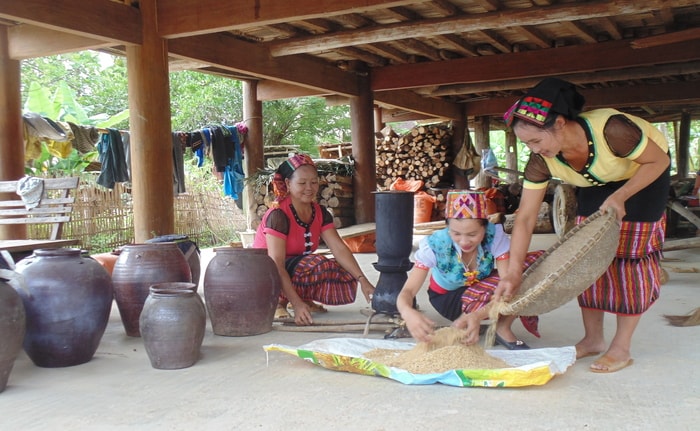 |
| Women in Chòm Muộng village make rice wine. Photo: Tường Vi |
When the leaves are brought home, they are cut, pounded, and steamed to extract the juice. This juice is then mixed with fragrant glutinous rice and rice husks, rolled into large, plate-sized balls, and left under the bed to ferment. Afterwards, they are moved to the attic to dry, both to preserve the yeast and to improve its quality. The fermentation process takes about a month.
High-quality glutinous rice is soaked overnight and mixed with clean rice husks, then roasted (crushing the husks is better than grinding them finely because the fiber in the husks will absorb into the mixture, speeding up fermentation and resulting in sweeter liquor). The mixture is then poured out to cool before being mixed with finely ground yeast. It is then fermented in a plastic bag for about 3-4 days before being transferred to an earthenware jar for further aging. The liquor should be ready to drink after more than 3 months of fermentation, and the longer it ages, the more fragrant and delicious it becomes.
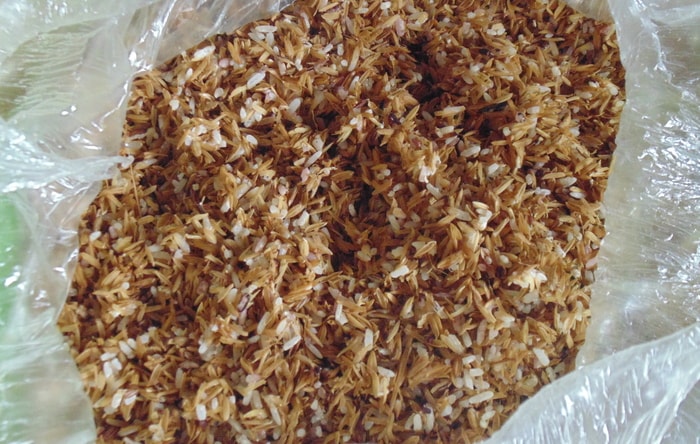 |
| High-quality glutinous rice, soaked overnight, and clean rice husks are mixed together and steamed. After cooling, they are mixed with finely ground yeast and fermented in a plastic bag for about 3-4 days before being transferred to a large earthenware jar for further fermentation. (Photo: Tuong Vi) |
Currently, not only have women's associations in the villages of Kẻ Mẻ, Kẻ Trằng, and Chòm Muộng in Mậu Đức commune established groups to make rice wine, but the Elderly Association has also formed a group since 2011. They are considered the ones who pass on the secrets of making rice wine. Ms. Ngân Thị Viện shared that each household has at least 5-6 earthenware jars for making rice wine, and they must be made of earthenware. When customers come to buy, the wine is transferred from the old jars to new ones for the customers to take home. The villagers then make a new batch using jars that are decades old.
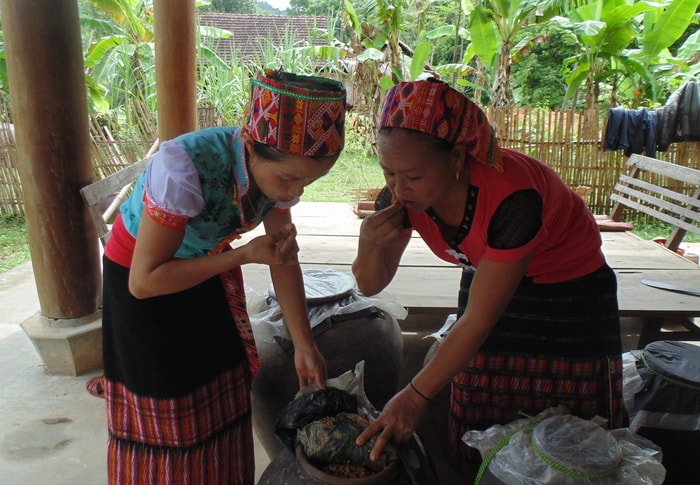 |
| During the fermentation process, the jar must be opened and tasted to check if the wine is ripe and sweet enough; only then is it considered successful. Photo: Tuong Vi |
Mr. Vi Van Vuong, Vice Chairman of the Mau Duc Commune People's Committee, said: "Previously, the people of Mau Duc made rice wine to serve their families during holidays, New Year celebrations, housewarming parties, weddings, etc., but now it has become a marketable product."
The people of Mau Duc are delighted that on May 19, 2017, Chom Muong village was recognized by the People's Committee of Con Cuong district as a traditional craft village. Currently, 45 out of 91 households in the village are engaged in the traditional rice wine making craft, generating revenue of 1.9 billion VND, accounting for 20.17% of the village's total revenue.
Tuong Vi - Thu Trang
| RELATED NEWS |
|---|


