
Concerns about the rainy and stormy season.
Nghe An province has vast fishing grounds, with a fishing fleet of over 4,000 vessels and hundreds of boats from other provinces coming to fish each year. In the context of global climate change, many storms and cyclones occur at sea annually, causing considerable damage to fishermen. Although many storm shelter projects have been built, they still do not meet the needs of boats for mooring...
(Baonghean)Nghe An province has vast fishing grounds, with a fishing fleet of over 4,000 vessels and hundreds of boats from other provinces coming to fish each year. In the context of global climate change, many storms and cyclones occur at sea annually, causing considerable damage to fishermen. Although many storm shelter projects have been built, they still do not meet the needs of boats for mooring...
After several days at sea, fisherman Dau Tran Hung from Quyet Thanh hamlet, Dien Bich commune (Dien Chau district) brought his boat back to Lach Van wharf to anchor. Hung's boat, bearing the registration number NA90270-TC and with a 350CV engine, is fully equipped with safety equipment for venturing out to sea during rough seas, such as lifebuoys, walkie-talkies, and GPS devices. Dau Tran Hung said: "Fishing boats operating at sea year-round face many difficulties and dangers, especially during the rainy and stormy season."
Therefore, when a storm warning is issued, we always strictly follow the directives of all levels and sectors to move our ships to safe harbors. However, due to the crowded mooring area, hundreds of ships of all sizes jostle and push each other. Collisions and damage to ships occur frequently. The biggest difficulty currently is that the channel at the Dong Ky mooring area is too shallow due to siltation, forcing us to wait for the tide to rise before moving further into the harbor. We hope that the State will invest funds to dredge and clear the Van channel, and soon complete phase II of the storm shelter mooring area for ships to ensure the safety of lives and property for fishermen when natural disasters occur."
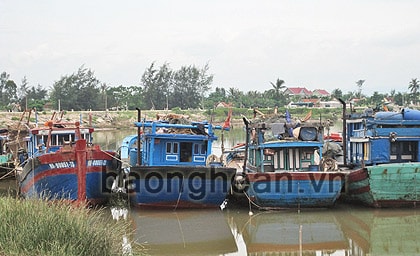
The Dong Ky wharf and Van estuary are crowded, and boats and ships frequently have to jostle and collide with each other when anchoring or seeking shelter from storms.
Mr. Cao Van Thai, Deputy Head of the Agriculture Department of Dien Chau District, said: "Dien Chau currently has 1,400 boats and rafts of all kinds, including 108 boats with engines of 90 horsepower or more. The Van estuary mainly serves boats from Dien Bich and Dien Ngoc communes. At the Van estuary, the second phase of the project to build a storm shelter for boats is being implemented, ensuring that 400 boats can anchor with a total cost of 90 billion VND, including items such as dredging anchorage areas in some sections of the Bung River, building boat anchorage embankments, and constructing 66 concrete anchorage pillars... To date, the project's progress has reached about 50% of the dredging volume and completed 56 concrete pillars. Phase I, which started in 2009, had a total investment of 32 billion VND, with a capacity to accommodate 500 boats, the largest of which is 200." CV.
According to statistics from the Department of Agriculture and Rural Development, as of June 2013, the province had 4,001 vessels of all types, of which 1,060 had a capacity of 90 horsepower or more. According to Decision 1349/QD-TTg of the Prime Minister dated August 9, 2011, adjusting the planning of storm shelter areas for fishing vessels until 2020, with orientation to 2030, Nghe An has 5 planned locations for concentrated storm shelter areas, including: Lach Con (capacity for 400 vessels), Lach Quen (500 vessels), Lach Van (500 vessels), Lach Lo (500 vessels), and Lach Thoi (300 vessels).
The storm shelter areas are designed to be sturdy and safe for vessels with a capacity of 200-600 horsepower, with wide waterways allowing convenient access for boats. Based on the plan approved by the Prime Minister, the province has directed the development and implementation of investment projects for storm shelter areas for fishing vessels in each region. This can be considered good news for fishermen, because when the projects are completed, they will provide a safe and reliable place for boats to gather and take shelter from storms.
To date, the province has had 4 projects approved for investment by the Provincial People's Committee. Of these, the Quèn Canal project, which began construction in 2007 with a total investment of 84 billion VND, is designed to accommodate 500 vessels, the largest of which is 200 horsepower. The Cờn Canal project is designed to accommodate 600 vessels with a total investment of 119 billion VND, funded by the Government. The Vạn Canal project is also divided into two phases: Phase I, with a total investment of 32 billion VND, has completed the construction of the mooring area; Phase II is currently only about 50% complete. The Lò Canal storm shelter project, funded by the World Bank with a total capital of 53 billion VND (12 billion VND in counterpart funding), is expected to begin construction in early 2014. The Lach Thoi project has received approval from the Provincial People's Committee for its establishment and has been appraised. The Ministry of Finance and the Ministry of Planning and Investment have also agreed on funding sources, but due to the implementation of Resolution 11, the project remains on paper and has not yet been implemented...
Thus, currently only the storm shelters at Quèn and Vạn estuaries are basically completed, with each berth capable of accommodating approximately 500 boats. However, in reality, around 700-750 vessels regularly enter and exit these two berths, resulting in constant overcrowding. Furthermore, during storms, boats from provinces such as Thanh Hoá, Hà Tĩnh, Quảng Ngãi, and Quảng Ninh also seek shelter, meaning the capacity for storm shelter is still insufficient to meet demand. Moreover, bridges cross the rivers at the estuaries, making it difficult for large offshore fishing vessels to pass through and navigate deep into the estuaries for shelter, forcing them to anchor only on the outer edges of the estuaries.
According to most fishermen in Tien Thuy commune (Quynh Luu district), the Quen wharf, which serves fishing boats from four communes (Quynh Long, Tien Thuy, Quynh Nghia, and An Hoa) with over 700 vessels regularly entering and exiting to exchange goods, is severely overloaded and its capacity is insufficient to meet the demand of all vessels. Since 2007, despite provincial investment in dredging the channel and constructing a 1.2 km embankment at the wharf entrance, it has only partially met the needs of the fishermen. In addition to the overload, there are two underwater rock formations near the wharf, causing frequent collisions and damage to boats.
The construction of safe anchorages and storm shelters is a matter of concern. These structures contribute to the development of the marine fishing industry; providing fishing vessels with stable and convenient shelter during storms and tropical depressions, minimizing damage caused by natural disasters to fishermen. Simultaneously, they ensure waterway safety, create a foundation for the formation and development of satellite fishing villages and fishing infrastructure; increase the efficiency of investment in offshore fishing development, contribute to the protection of aquatic resources, and strengthen national defense and security in the maritime region.
Text and photos: Ngoc Anh


