
The plight of a teacher in a remote village.
(Baonghean.vn) - Although they are also wives and mothers and long to take care of their families, many female teachers in remote villages in the western part of Nghe An province have to put that dream aside, finding joy in caring for their students to fill the void of homesickness and longing for their children...
"LOOKING UP AT THE SKY REMINDS ME OF MY CHILD"
This is a poem by a teacher from Muong Ai Primary School in Muong Ai commune, Ky Son border district, expressing the longing and affection she has felt throughout her years teaching in this remote mountainous area. Muong Ai Kindergarten has nearly 20 teachers, all female. Muong Ai commune borders Laos, a remote and rugged area. To ensure the children receive care and education, the school has many separate locations in distant villages. Some villages, like Ai Khe, are more than 20km from the center of Muong Ai commune. Because of the remoteness and difficult roads, the people of Ai Khe rarely interact with the outside world, especially the women. Therefore, most of the older women in Ai Khe do not speak Vietnamese.
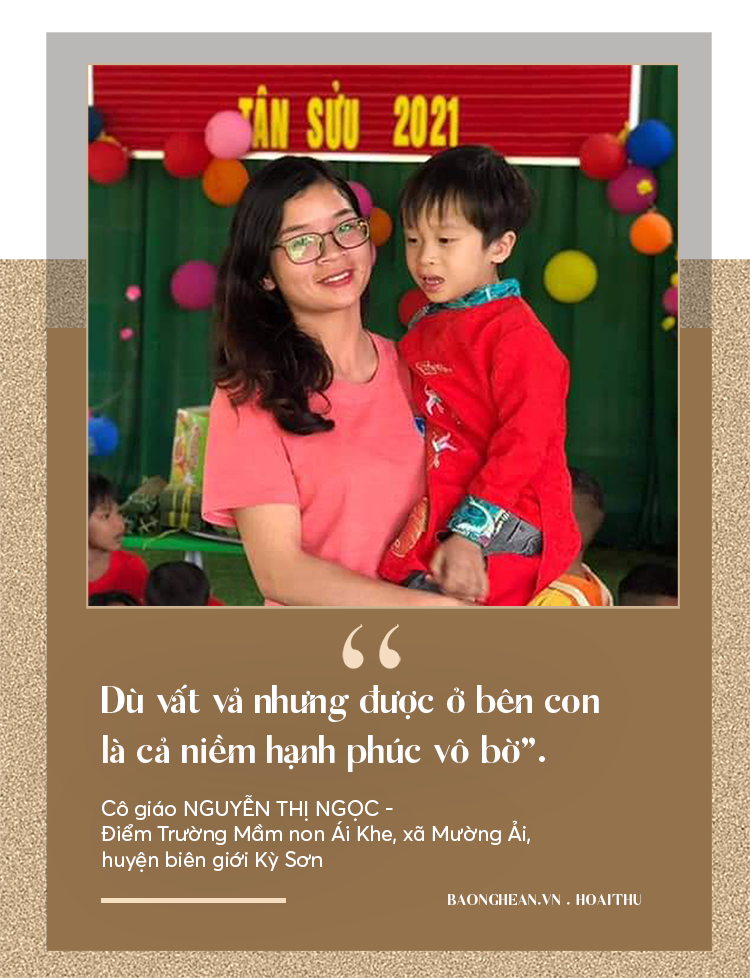 |
| Teacher Nguyen Thi Ngoc and her son. Photo: Hoai Thu |
The Ai Khe Kindergarten is located right next to the main road, with two small classrooms, just enough for a class of about 15 children, and a small corner for the teacher to live, eat, and sleep. Ms. Nguyen Thi Ngoc is one of the teachers who has been dedicated to the Ai Khe kindergarten for many years. Born in 1994, Ngoc gave birth in 2016. Although her child was still young, in this remote border area, she lovingly cared for him. Ngoc said, "Even though it's hard, being with my child is boundless happiness." But the joy of being together didn't last long. Due to work requirements, Ngoc couldn't keep her child in the mountains, and her son, who was just over a year old, needed to study and be raised in a less difficult environment. Therefore, she and her husband decided to send their child to live with his maternal grandparents in Hoa Thanh commune (Yen Thanh district).
It's not just Ms. Ngoc; at Muong Ai Kindergarten, most of the teachers come from districts like Do Luong, Yen Thanh, Con Cuong, Anh Son... and have to leave their children behind in their hometowns, far from their husbands and children. Therefore, the verses, spontaneously born from the longing of mothers, have become a comforting and soothing message for these teachers from remote villages."Looking up at the sky, I miss my child / The wind howls in gusts at night / I curl up to keep warm.".
For Ngoc, besides missing and loving her child, she also constantly worries about her little son. When he was four years old, Ngoc discovered he had a speech delay and showed signs of withdrawal and less interaction with strangers. Tearfully recounting her son's story, Ngoc said, "I think it's because he misses me and is far away from me that he's sad and has become like this." To help her son regain his cheerfulness, for more than six months, his grandmother and little Bin have been taking the bus daily from Hoa Thanh commune to Dien Chau town to attend a communication skills enhancement class. During holidays and Tet (Lunar New Year), Ngoc rushes to catch several buses, traveling nearly 300km from Ky Son to visit her son. Every day, outside of class hours, to ease her longing for her son, Ngoc only looks at his photos on her phone. When the phone signal is stable, she calls to talk to him... At the end of 2020, Ms. Ngoc was transferred to teach at the main school in the center of Muong Ai commune, "the distance to my son has been shortened by dozens of kilometers," Ngoc shared.
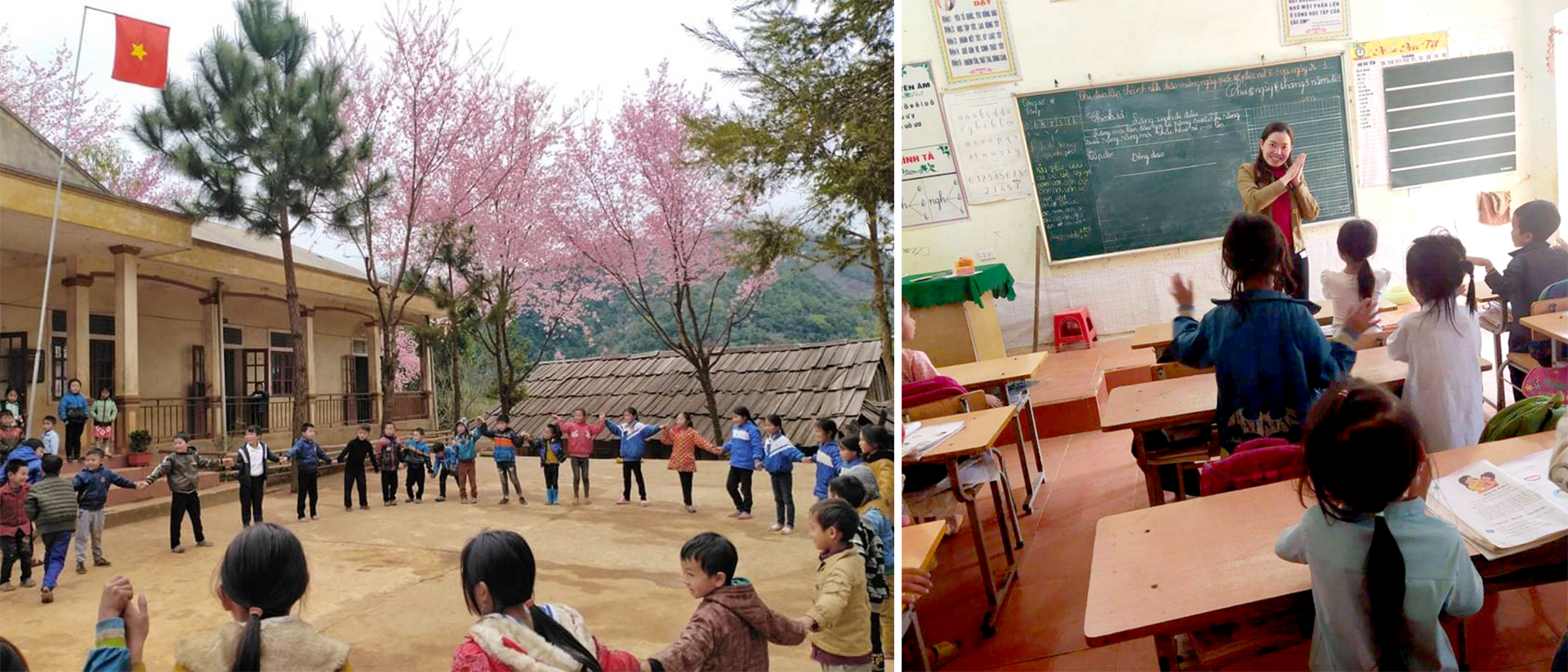 |
| A teacher stationed in a remote village in Muong Tip commune (Ky Son district). Students of Muong Tip Primary School (Ky Son district) participate in outdoor activities. Photo: Hoai Thu |
Adjacent to Muong Ai commune is Muong Tip commune. Teachers and students here are "evenly distributed" across four school locations, three of which are in remote villages such as Pha Noi, 20km from the commune center. The Huoi Khi village school is 14km away from the main school via mountainous roads. The Na Mi village school is closer, at 2.5km from the commune center. According to Mr. Nguyen Quoc Tri, the school principal, all the remote village schools have female teachers stationed there.
At the Pha Noi village school, out of the six teachers stationed there, two are female, in charge of five classes. “Ms. Huong is from Anh Son, and Ms. Anh is from Que Phong. They’ve been teaching here for a long time. They both have families and young children who have to be sent back to their hometowns. The teachers have to live temporarily in makeshift huts made of thatch, bamboo, and wooden planks. In winter, the biting wind blows through the cracks in the doors, and in summer, the sun is scorching. They are far from home, their husbands, and their children, and they face countless hardships,” Mr. Tri explained.
At Huoi Khi school, there is only one combined class for first and second graders, taught solely by teacher Kha Thi On. Ms. On is from Huu Lap commune, Ky Son district. However, she married a man from Con Cuong, and her first child is in kindergarten and lives with his father. She is far from her husband and child, having traveled nearly a hundred kilometers to teach in Muong Tip, rarely getting to go home or take care of her child.
"Taking better care of students than of children"
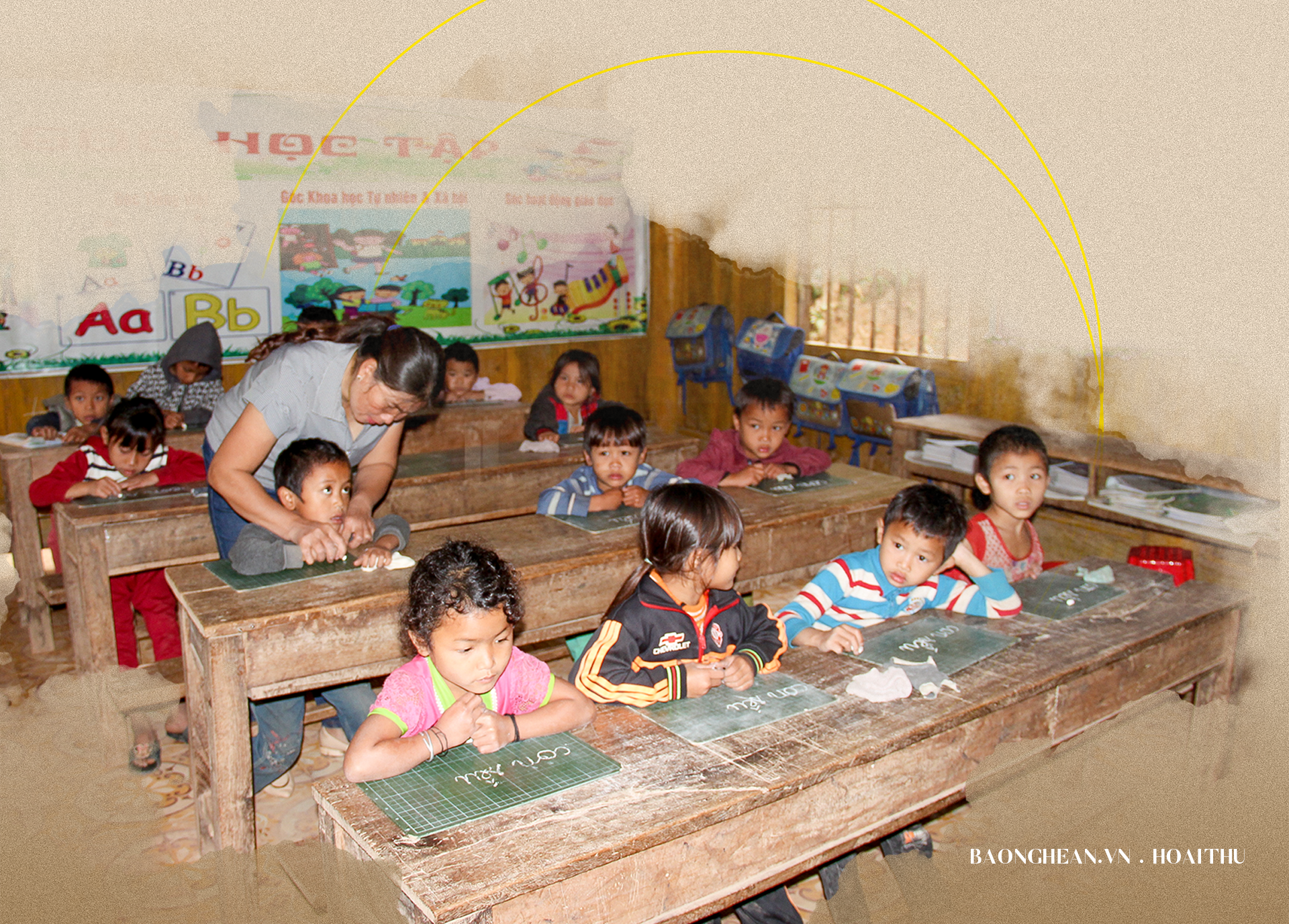 |
| Ms. Vi Thi Quy and her class in Huoi Pun village, My Ly commune (Ky Son district). Photo: Hoai Thu |
Children in border regions and remote villages would forever live in deprivation, especially in terms of education and knowledge, if it weren't for the dedicated teachers who work in these remote areas. During a visit to the classroom of teacher Vi Thi Quy in Huoi Pun village, My Ly commune (Ky Son district), listening to the soft whispers of a first-grade student there, I truly understood the sacrifices and contributions of the teachers who dedicate themselves to teaching in these remote villages.
“The teacher bought notebooks, pens, and books for me to study. She also got me a warm coat to wear. When it rained and the roads were slippery, the teacher came to my house to pick me up for school,” little Cut Thi Vy whispered. After saying this, Vy looked up at Teacher Quy and smiled innocently, her eyes filled with affection. When the teacher gave the signal to begin the lesson, the whole class obediently picked up their chalk and meticulously practiced writing on their small blackboards.
 |
Ms. Vi Thi Quy and her husband are both from Tuong Duong, but they established their careers in Ky Son. After graduating, the couple moved to Ky Son to work. “I’ve been attached to Ky Son for 24 years, teaching in many villages in this border region; I’m used to the hardships,” Ms. Quy confided. Her husband is also a teacher, currently teaching in Muong Long commune. The two work in different locations, hundreds of kilometers apart, so they rarely see each other. Therefore, far from home, her husband, and children, she dedicates all her love to her young students.
"Kỳ Sơn district has 71 schools at all levels, including 126 school branches in remote villages. Of the total 2,196 teachers, more than 1,300 are female. Teachers working in remote villages, especially female teachers, are all people with strong will and a love for their profession. It is because of their dedication to their beloved students that they can stay in these remote areas and excellently fulfill their duties," said Mr. Phan Văn Thiết, Head of the Education and Training Department of Kỳ Sơn district.
“In 2020, when we implemented the new textbooks, each set cost nearly 1 million VND. That amount is too much for the people here. Sometimes, a household's income for half a year is only enough to buy that much, so the people cannot afford to buy enough books for their children. Currently, all the cost of buying books is being temporarily covered by the teachers' own money so that the children can start the new school year on time and have books to study,” said Ms. Vi Thi Quy.
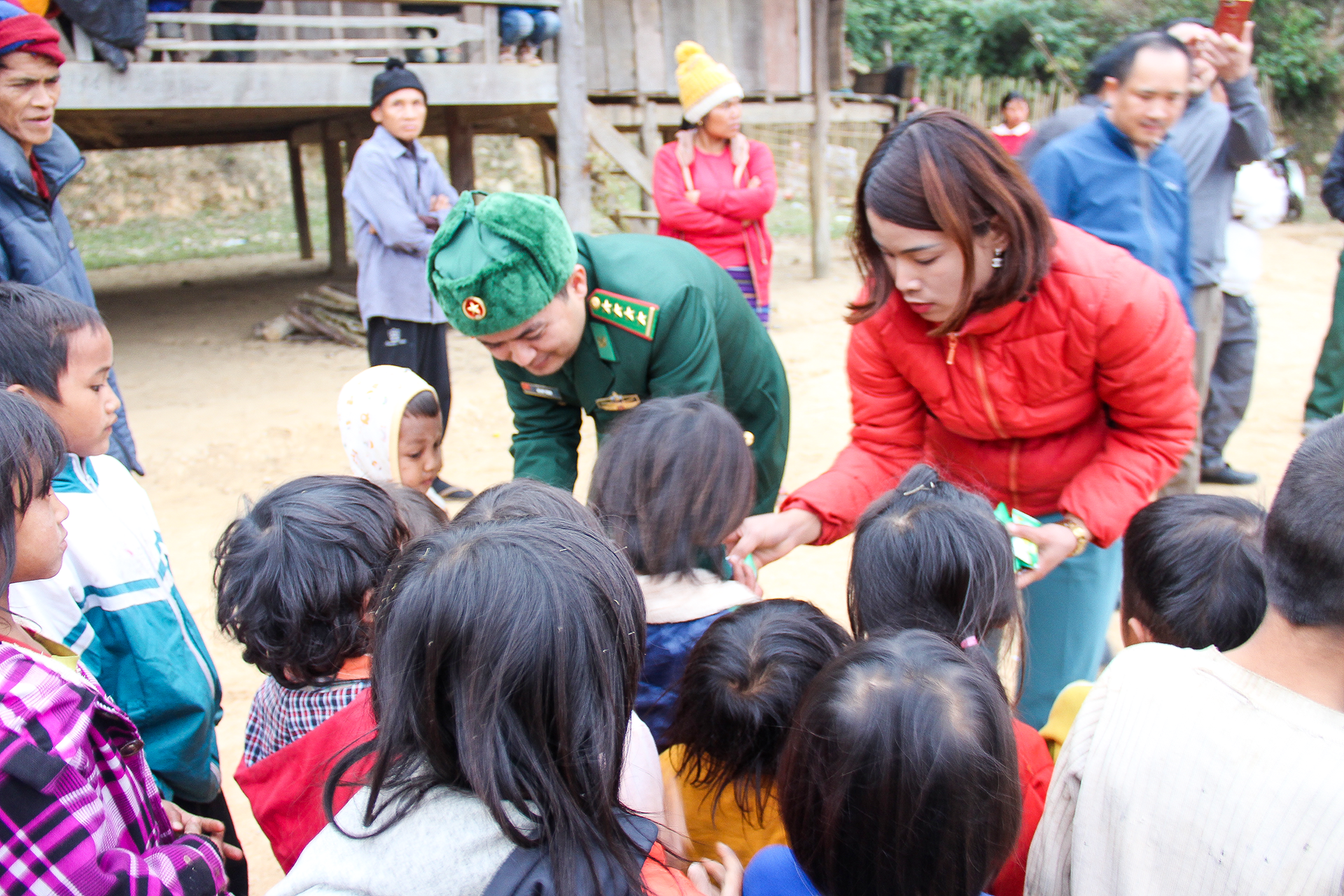 |
| Ms. Lu Thi Dua and officers from the Keng Du Border Guard Station receive gifts from sponsors to distribute to students. Photo: Hoai Thu |
Teachers in remote villages spend more time caring for their students than for their own children, so many treat their students like their own, nurturing them as if they were their own. During cold winters, when temperatures drop below 10 degrees Celsius, students shiver in their thin clothes, so the teachers buy warm jackets or solicit donations to help them cope with the cold. When students fall ill and their parents don't know how to treat them, the teachers go to their homes to take them to the doctor. In some cases of serious illness, the teachers even stay overnight to care for them. For the students here, the teachers are like second mothers, loved and cherished by them. Therefore, the students listen to their teachers' guidance and study diligently.
Like Huồi Pún, which is also home to a large Khơ mú ethnic minority population, we had the opportunity to visit a school in Khe Linh village, Keng Đu commune, Kỳ Sơn district. This is the most remote commune in this border district, located 70 km from Mường Xén town via steep and treacherous mountain roads.
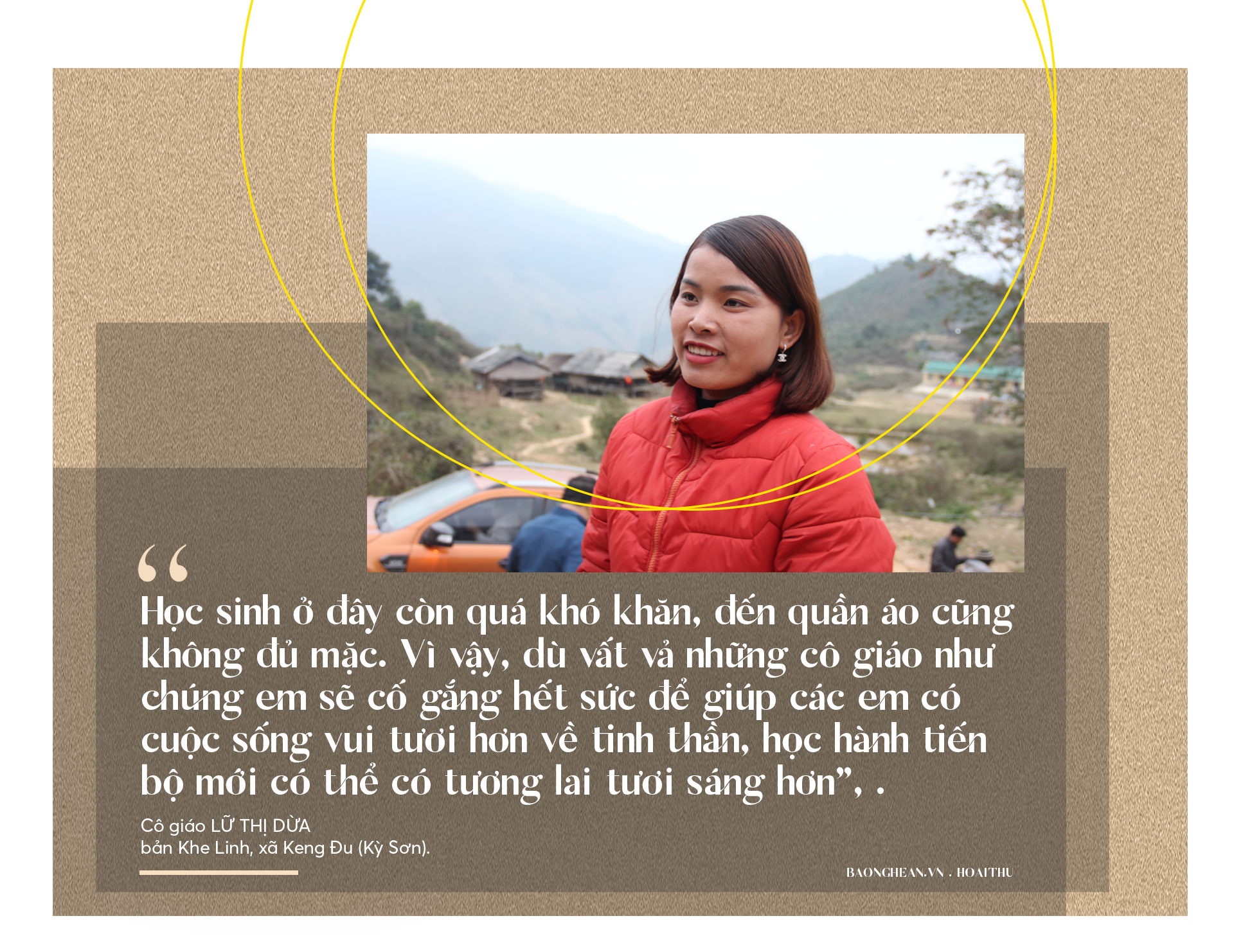 |
| Teacher Lu Thi Dua. Photo: Hoai Thu |
From the center of Keng Du commune, one has to travel 15km along mountainous roads to reach Khe Linh village, where there is a combined kindergarten and primary school. Ms. Lu Thi Dua, not yet thirty years old, originally from Con Cuong district, was transferred from a school in Chieu Luu commune to Khe Linh to teach in this remote village for over a year. Far from her family, Ms. Dua and two other teachers care for and educate 34 kindergarten children and 28 primary school students here. The sturdy, single-story building with 3 classrooms and a teachers' lounge is nestled amidst the surrounding mountains and forests, close to the border with Laos.
With 100% of the population being ethnic Khmu people and nearly 100% of households living in poverty, the students here lack both material and spiritual resources. Village head Lo Van Son of Khe Linh village said that thanks to the teachers, their children are able to read and write much better than their grandparents and parents.
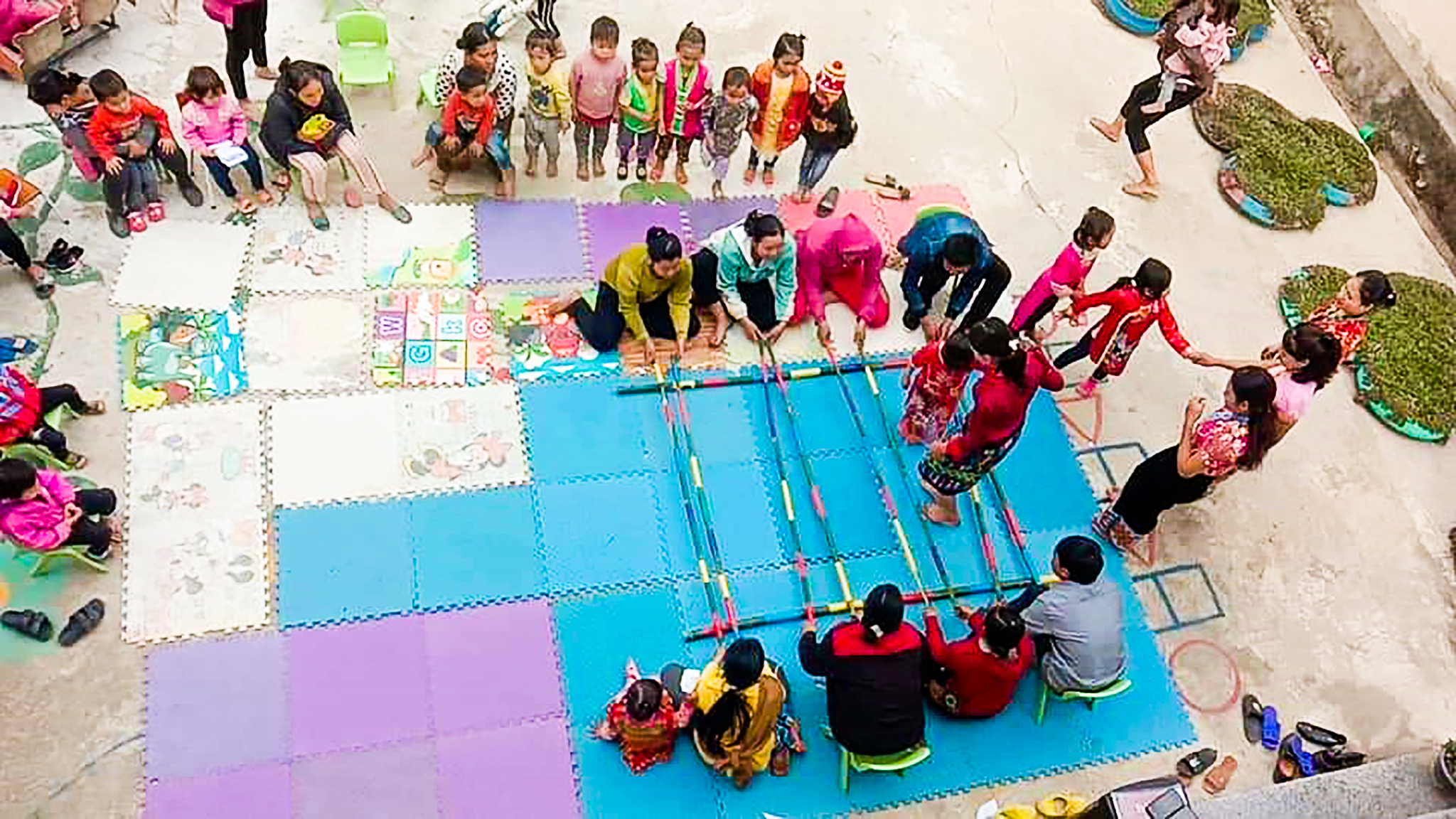 |
| Teachers and students of Muong Ai Kindergarten (Ky Son district) participate in experiential activities. Photo: Hoai Thu |
According to information from the Department of Education and Training, Nghe An province has nearly 42,000 teachers at all levels, of which more than 34,000 are women. In districts classified under Decree 30a, such as Ky Son, Tuong Duong, and Que Phong, there are over 4,100 teachers, with more than 2,900 being women. Among them, thousands have been diligently teaching in remote villages and hamlets. These female teachers in remote areas are not only teachers but also second mothers to their students.
The presence of these women in the mountains and remote villages has brought to generations of children the light of knowledge and love as if they were their own. They accept being far from home and their children and families to nurture the noble cause of educating future generations.


