
Dong Van conical hat
(Baonghean) - For generations, the conical hat has been familiar and close to Vietnamese women, regardless of wealth or social status, from farmers to urban girls. Through time and the changes of life, these conical hats have remained steadfastly with mothers and grandmothers, not only protecting them from rain and sun but also adding charm to women and becoming a unique cultural feature of the nation. Although not as elegant as the poetic conical hats of Hue, the conical hats of Dong Van in Nghe An province – also bright white, durable, and beautiful – embody the simple and gentle charm of the people of Nghe An…
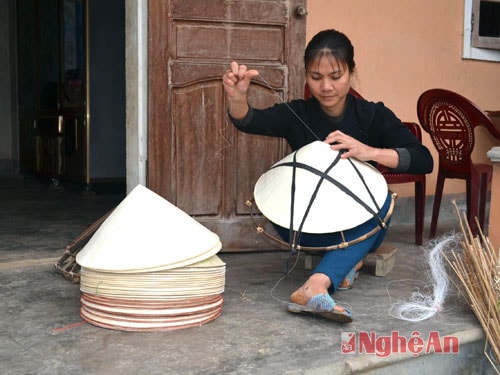 |
| Ms. Hoang Thi Huong, from Thuong Quanh village (Dong Van commune - Thanh Chuong district), is finishing her conical hat. |
From National Highway 46, following the winding dike along the Lam River for about 3 km, we arrived at Thuong Quanh village (Dong Van commune, Thanh Chuong district), famous for its centuries-old hat-making craft. Although not as bustling as other craft villages, it was still lively with buyers and sellers of hat-making materials and stacks of pristine white hats. When asked about the craft, almost all the women in the village knew about it, but few knew exactly when it started or who the founder was. The elders only knew that the craft was once very prosperous; they had seen their mothers and grandmothers diligently making hats since they were children...
For 70 years, Mrs. Nguyen Thi Luu (78 years old) has been dedicated to the bright white leaves and nimble needlework, considered one of the village's artisans preserving the traditional craft. Meticulously working on the hat brim, she confided in us about the bundles of leaves, the hats themselves, and the village of yesteryear. Her voice was gentle, filled with a deep concern for the age-old craft, fearing it would gradually fade away as fewer and fewer young people in the village pursued it, as they disliked the meticulous work and the lack of profit. From the age of 13 until her marriage, her life has been intertwined with bundles of leaves, with the tireless sewing of hats, and the bustling hat-making market days.
When we visited the traditional craft village, Mrs. Luu was very happy. She enthusiastically guided us through the steps of making conical hats. She untied and corrected the clumsy bindings, showing us the most skillful way to do it. For the leaf ironing stage, she taught us the traditional method: placing the leaf under a handful of cloth, using a heated plowshare over a fire, and quickly smoothing it to make the leaf flat and not brittle. Even we young people felt tired in our backs and hands after ironing the leaves for a while. Mrs. Luu still diligently works by the fire every day. She says that on rainy or windy days when there are no dry leaves to make the hat, she misses this corner of the kitchen... "The traditional conical hat looks simple, without fancy patterns, but it's sturdy and durable. When worn on the head, it won't get punctured in the rain or pierced by the sun. The hat-making craft requires meticulousness; you can't finish a hat if you're impatient. Especially the stitching, this step requires carefulness and skill in threading each stitch straight and even from inside to outside. If you're not careful, the leaves will tear. After stitching, you have to apply a thin layer of turpentine oil to prevent mold in humid weather or when going out in the rain and wind," she said softly.
In Thuong Quanh, not only women know how to make conical hats, but even men can help with shaping the brim and assembling the frame. Despite their commitment to preserving the village's traditional craft, the income from hat making is not high; on average, each hat sells for only 40,000-50,000 VND. After deducting expenses, each hat weaver earns about 30,000 VND per day. Recently, the difficulties for the villagers have increased as the price of raw materials (leaves) has continuously risen and become scarce. Ms. Hoang Thi Huong, who has been in the craft for over 20 years, told us, her eyes and hands never leaving the hat: "As farmers, we only have two rice harvests a year. After the harvest, we dedicate all our time to hat weaving."
Although it's only a side job, if you plan ahead and combine farming with hat making, you can earn enough money to raise your children to adulthood. "Once or twice a month, traders come to 'buy goods.' They're familiar with each household's products, so they know whose hats are beautifully made without needing to examine them closely; they just count the quantity and pay." Making a hat requires 12 entirely manual steps, from trimming the rim, attaching the rim, fitting the mold, threading the leaves, stitching, stitching the base, threading the inner lining, and applying oil... According to the women in Thuong Quanh village, to create a beautiful hat, the craftsman must be skilled right from the material selection stage. The leaves, imported from Quang Binh and Ha Tinh, must first be washed in sand and then sun-dried until the green color turns to a silvery white, thin but durable. When the leaves are placed in the hat mold, they must be flattened. This stage requires the craftsman to be very careful, ensuring the temperature is just right so the leaves don't burn or remain undercooked due to insufficient heat. Next comes the frame for bending the rim. The hat rim is made from split bamboo or reed stalks, smoothed into elegant circles of varying sizes, with the largest rim having a diameter of... The first rim is 50 cm, with the subsequent rims gradually decreasing in diameter. Each hat usually has 16 rims, which many people liken to "16 moon rims" - symbolizing the most beautiful age of a young woman. And the most difficult step is spinning the hat, requiring meticulousness and skill from the craftsman because it determines the aesthetic quality of the hat...
Mr. Tran Dinh Tuy, Chairman of the People's Committee of Dong Van commune, shared with us the joys and sorrows of the traditional craft village: "Although the income of those working in the craft is not yet high, thanks to the hat-making craft, the lives of the people have improved significantly. In today's industrialization era, hundreds of thousands of fashionable hat styles have been created, but for farmers, when working in the sun and rain, a conical hat is indispensable. To preserve this traditional craft, the passion and enthusiasm of those who love the craft are not enough. To improve production efficiency, coordination from the district and province is needed to guide brand building, provide financial support for infrastructure investment in the craft village, and ensure market access for the products. Because the development of the craft village not only has economic significance but also contributes to preserving the unique features of national culture."
Currently, the entire commune has three villages: Thuong Quanh, Phuong Dinh, and Tien Kieu, with over 50 households participating in the craft of making conical hats. Over nearly 100 years, Dong Van conical hats have been continuously improved, creating a unique traditional beauty thanks to the skillful hands of the village "artisans." Despite periods of ups and downs, conical hats are never absent from Dung Market, Ro Market, and Dinh Market...
Ngoc Anh


