
Farmers struggle to fight drought and save lemon trees.
(Baonghean) - As a key crop that brings high economic efficiency, lemon trees have played a role in poverty alleviation for many households in Hung Nguyen, Nam Dan, and Nghi Loc districts for many years. The recent prolonged heatwave caused significant damage to lemon orchards, and farmers are now actively restoring and caring for them to ensure a good harvest in the next season.
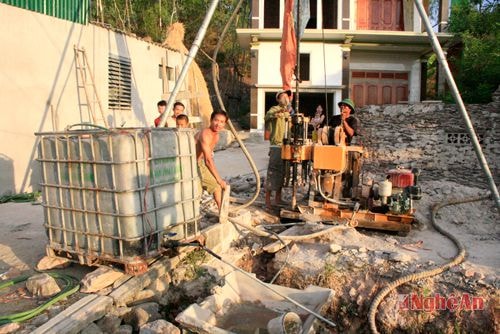 |
| People in Nghi Cong commune (Nghi Loc district) are drilling wells to combat drought for their lemon trees. |
As one of the province's key lemon-growing areas, Nam Kim commune (Nam Dan district) boasts over 170 hectares of lemon trees stretching from Khe Lau and Heo Vong to Dong Trang and Dong Dai... Faced with the prolonged heatwave, lemon growers here have promptly applied various methods to combat drought, so the area of lemon trees that have died so far is only about under 10%. Mr. Le Xuan Lieu, head of Hamlet 7, shared: “The hamlet has 98 households, all considering lemon trees as their main crop. The entire hamlet currently has nearly 20 hectares of lemon trees, with even the smallest growers having over 40 trees. During the peak hot days at the beginning of the season, the villagers promptly covered the base of the trees with straw and undergrowth to retain moisture. At the same time, when fertilizing the lemon trees, they bought gravelly soil to cover the roots with a thickness of about 7-10 cm, helping the lemon roots to develop. Thanks to this, the lemon trees have high resistance to the effects of the weather.”
Currently, 17 out of 22 hamlets in Nam Kim commune, with 1,200 households, have been growing lemons for decades. Besides mulching, farmers also intercrop shade trees like jackfruit trees in their lemon orchards and plantations. In the hamlets of Da Loc, Khe Lau, and Dong Trang, farmers have applied a combination of drought-resistant methods, resulting in a very low mortality rate of less than 7%.
Hamlets 1 and 2 of Nghi Cong commune (Nghi Loc district) have over 200 households growing lemons. Hamlet 1 alone has over 17 hectares of lemon trees. Recently, Khe Thi reservoir, the main irrigation source for the entire area with a capacity of over 4.5 million cubic meters, has been severely depleted. Farmers have been making strenuous efforts to combat the drought and save their lemon trees. Mr. Pham Huu Binh, the owner of a lemon orchard here, shared: “For about a month now, the weather has been extremely harsh, causing 150 out of 400 lemon trees in my family's orchard to die from drought. My family is still trying to save the remaining lemon trees; we are installing a pump and 72 meters of plastic pipe to pump water from Khe Thi reservoir to irrigate the lemon trees. However, if we irrigate heavily for just a few hours, the water only covers the surface and easily evaporates without penetrating deep into the roots. Therefore, in the future, my family will invest 30 million VND to install a drip irrigation system to prepare for future droughts.”
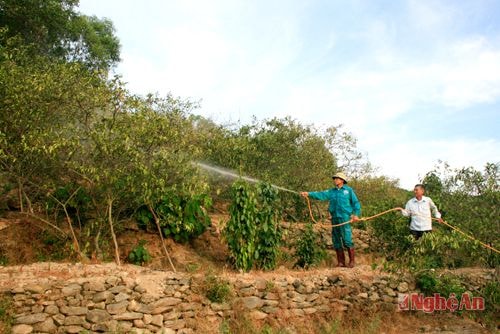 |
| Mr. Pham Huu Binh, residing in Hamlet 1, Nghi Cong Commune (Nghi Loc District), is watering the remaining lemon trees in his plantation. |
Farmers in Hung Yen Nam commune (Hung Nguyen district) are also struggling with the drought affecting their lemon trees, especially after the previous peak heat wave caused significant damage to many lemon orchards. Currently, out of 15 hamlets in the commune, 9 grow lemons. Hamlets 8, 9, and 10 have the most lemon trees. The main lemon growing areas are located in the three regions of Da Den Dam, Truong Long, and Trai Bo. The two water sources for these areas, Thach Tien Dam and Lang Trai stream, are now completely dry. Farmers have had to buy hundreds of meters of plastic pipes and drill wells to irrigate their lemon trees.
In Hamlet 10, known for its lemon orchards in areas like Bai Mo and Khe Mua, there are 67 households growing lemons; most households cultivate over 300 trees, with some even exceeding 1,000. Mr. Nguyen Van Thanh, owner of a 3-hectare farm with over 1,000 lemon trees, shared: “Normally, my family uses water from the Lang Trai stream to irrigate the lemons, but now the stream is dry, leaving no source for pumping water to the farm. Given this situation, my family had to drill a well to save the lemons, drilling to a depth of 20 meters to find water, costing over 10 million dong…”
Mr. Hoang Duc An, Deputy Head of the Agriculture Department of Hung Nguyen District, said: "Drought control for lemons is also related to the lemon crop season, as it is closely linked to the fertilization and irrigation regime. Growing lemons out of season has the advantage of higher profits than the main crop; however, for drought-prone areas, this is a disadvantage. The reason is that for out-of-season lemons, growers will fertilize in January, February to June, when the trees are healthy and bear fruit. The trees have many leaves and store water in the fruit during the hottest period, so if there is not enough water, the trees will inevitably die from drought. Therefore, considering the environmental conditions in the lemon orchard to invest in each season is extremely important to avoid losses. At the same time, planning lemon planting sites also needs to choose locations near water sources to ensure sufficient water supply for the plants..."
Thanh Quynh


