
Off-season agricultural products are mainly from China.
(Baonghean.vn) – Knowing this, consumers still have no other choice because it's the off-season; if they don't eat it, what else can they eat? The flood submerged the whole village. What can they do?!
While busy packing and packing the produce into sacks to supply Hanoi traders, Ms. Khuyen – a wholesaler specializing in gourds and pumpkins for 15 years at Vinh market – said: “These aren’t available in Hanoi, so traders bring tons of them from here. To be honest, the gourds and pumpkins are clean Dak Lak produce, not imported from China, so you can eat them without worry.” When I inquired about other items like onions, potatoes, carrots, and ginger, she said: “We don’t trade those, but they’re all imported and 5-6 times more expensive than ours. They look nice, but they’re not delicious, and they could even be poisonous. Those who import from China bring in tens of tons, but not a single rotten vegetable. That can only be because of chemicals.”
However, the reality is that at Vinh market, most of the fruits and vegetables originating from China, which traders buy and wholesale to district markets, are more expensive and are openly advertised to customers: "These are Chinese goods, all the same, expensive but with nicer packaging."
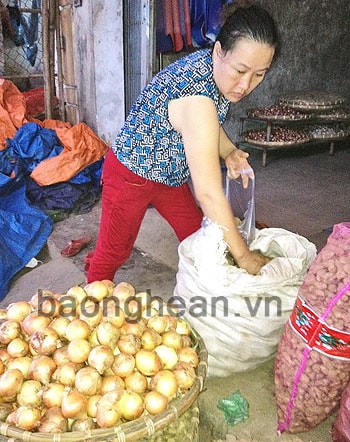
Most agricultural products, originating from China, are sold wholesale at Vinh market.
Next to Ms. Khuyen's stall was Ms. Hai's stall. Sacks of ginger, fresh turmeric, and onions were stacked in towering piles. Posing as a first-time trader at the district market, I inquired about her sourcing methods and suppliers. Ms. Hai said, "We import and sell tens of tons every day, mostly from Mong Cai. When we import, the produce looks so good, we don't add any chemicals. Nowadays, nothing from China is toxic; our people eat it all the time. If we didn't trade in Chinese goods, where would we get the onions, potatoes, and carrots grown domestically this season?"
The woman standing next to me, packing potatoes and carrots to take to the retail market, added: "Every day I buy about 40-50 kilograms of potatoes and carrots, and they sell out so quickly. People know they're from China, but they still buy a lot."
Currently, it's the off-season for many root vegetables, so most of the produce sold at the market is imported from China. Therefore, even though it's imported, the prices aren't cheap. At Vinh market, onions cost 15,000 VND/kg, shallots 25,000 VND/kg, potatoes 13,000 VND/kg, carrots 8,000 VND/kg, and ginger 17,000 VND/kg. However, at retail markets or supermarkets, the prices are 4-5 times higher. Consumers know this, but what else can they eat, since only Chinese-made produce is available out of season?
According to Ms. Khuyen, importing goods by ship is very profitable because importing from the Mong Cai source using her own truck costs only one-third the wholesale price at Vinh Market. At Vinh Market, there are about 30 stalls selling dried agricultural products, but 7 of them source their goods from Mong Cai. All agricultural products in the districts, supermarkets, and neighboring provinces like Ha Tinh, Quang Tri, and Quang Binh are sourced from traders here. Every day, starting at 1 AM, the trucks arrive, and the market is bustling with buyers and sellers.
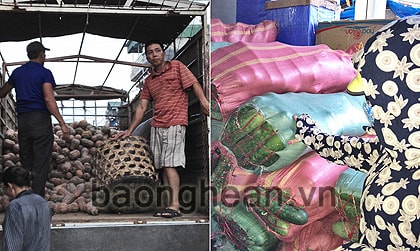
Gourds and pumpkins are believed to originate from Dak Lak.
Mr. Vinh, who specializes in unloading goods for Ms. Hai, said: "Getting goods from suppliers isn't easy; you have to compete fiercely. Sometimes, you've made a deal over the phone for 10-15 tons, but when you arrive, you only get a few tons. You lose a lot of money, don't even think about it. The high price of goods from ships is partly due to the unstable supply."
According to Vinh, traders in Vinh and neighboring districts mainly buy and sell retail at markets and supply vegetables to restaurants and eateries. Some items are also wholesaled to supermarkets, such as potatoes, carrots, onions, and leeks, and these vegetables are often labeled as imported from Da Lat, Dak Lak, etc.
Ms. Hanh, a resident of Hung Dung commune, Vinh City, said: “People are now more familiar with goods originating from China, and sellers don't bother to hide them like before, but many still accept buying them because, in reality, you see Chinese goods everywhere. And our own products aren't necessarily any better; even food like noodles, rice cakes, and sausages are reported to contain harmful chemicals. Vegetables and fruits are probably an exception. When floods come, they inundate entire villages. What can we do?!”
Thanh Nga


