
Chinese agricultural products continue to flood the market.
Despite repeated warnings, Chinese fruits and vegetables continue to flood markets, especially out-of-season produce.
Currently, the issue of Chinese agricultural products imported into Vietnam containing pesticide levels exceeding permissible limits is a major concern for many consumers. Despite numerous warnings, Chinese fruits and vegetables continue to flood markets, especially out-of-season produce.
At Long Bien wholesale market (Hanoi), the largest agricultural market in Northern Vietnam, an average of 200-300 tons of vegetables and fruits are imported daily, including grapes, apples, tangerines, cabbage, tomatoes, carrots, potatoes, and onions. From there, these produce are then distributed throughout Hanoi and neighboring provinces. Chinese agricultural products are mixed and sold alongside Vietnamese agricultural products. Therefore, consumers find it very difficult to distinguish the origin of goods and whether they contain harmful preservatives. Most shoppers rely on experience to differentiate between domestic and Chinese vegetables and fruits, especially out-of-season produce.
Ms. Tran Thu Huong, residing in Thanh Xuan district (Hanoi), stated: “Most of the cabbage, carrots, potatoes, and tomatoes at the market nowadays are from China. My family hasn't bought these vegetables recently because a regular vendor advised against them. As for unfamiliar customers, they still claim they are from Da Lat, but in reality, they are from China.”
In most markets throughout Hanoi, almost every vegetable and fruit stall sells products imported from China. Many consumers are concerned about information regarding Chinese agricultural products containing preservatives and pesticide residues. According to the Ministry of Agriculture and Rural Development, from 2013 to the present, the Plant Protection Department has detected 17 shipments of grapes, lemons, carrots, apples, oranges, and tangerines, totaling approximately 300 tons, that did not meet food safety standards and contained pesticide levels exceeding permissible limits. Upon arrival in Vietnam, these products were all relabeled as Vietnamese by small traders.
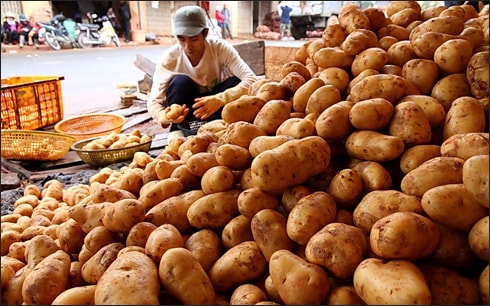 |
| The market is still flooded with agricultural products originating from China. |
Ms. Nguyen Thi Nui, a small trader at Trung Hoa Market in Cau Giay District, who regularly sources goods from wholesale markets and sells tons of vegetables and fruits daily, asserts that items such as carrots, potatoes, tomatoes, onions, cabbage, Chinese cabbage, and white radishes currently sold in markets are all from China. She notes that the supply of vegetables and fruits from Da Lat is usually very limited and their prices are two or three times higher than those from China.
According to the Ministry of Agriculture and Rural Development, shipments containing pesticides exceeding permissible levels are still entering Vietnam because they are cleared through customs before the inspection results are known. Taking advantage of the lenient customs clearance policy, small traders import low-quality, unsafe agricultural products into the country for consumption.
Mr. Huynh Tan Dat, Head of the Food Safety and Environmental Management Department, Plant Protection Department, Ministry of Agriculture and Rural Development, said that most shipments are inspected for origin. Only products from countries registered on the list of countries permitted to export agricultural products or goods of plant origin to Vietnam are allowed to undergo food safety inspection procedures. The Department will conduct inspections of shipments based on their compliance history and import frequency as stipulated in Circular 13, with a maximum inspection rate of 10%, which is consistent with international practice.
To limit shipments containing pesticide residues exceeding permissible levels, authorities need to strengthen strict controls at border crossings and promptly address any violations. Consumers should avoid buying out-of-season or unverified produce and should opt for products harvested during their peak season.
According to VOV.VN


