
Model new rural areas must have model citizens.
(Baonghean) - Kim Lien (Nam Dan) is one of three communes in Nghe An province selected to build a model new rural commune by 2020. The commune Party Committee has identified one of the existing problems and difficulties affecting the current acceleration of development as ideological inertia.
Regarding this issue, Nghe An Newspaper had a dialogue with Mr. Hoang Dinh Tien - Secretary of the Party Committee of Kim Lien commune.
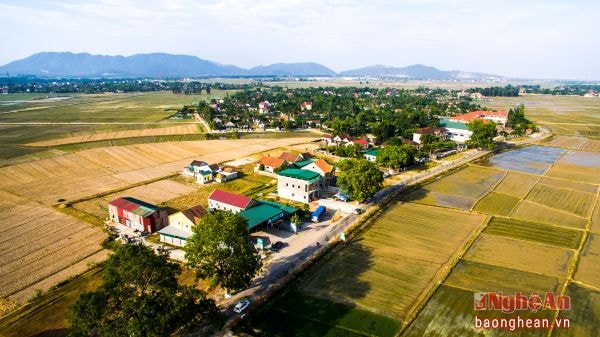 |
| Panoramic view of Kim Lien commune (Nam Dan district). Photo: SM |
PV:After achieving national standards for New Rural Development in 2014, Kim Lien was selected by the Provincial People's Committee to be developed into a model New Rural Development commune by 2020. However, there have been times when the pace of New Rural Development construction seems to have slowed down. Do you think that Kim Lien still hasn't overcome ideological inertia, and that this is a hindrance hindering rapid breakthroughs and strong growth?
Mr. Hoang Dinh Tien:It is true that some officials, Party members, and the general public in Kim Lien still exhibit ideological inertia. Specifically, this manifests as a reluctance to change to new ways of doing business, a failure to adapt quickly to the market mechanism, and a failure to fully utilize their potential and resources.
Some have suggested that Kim Lien still exhibits a sense of dependence and reliance, and I believe this is a frank and responsible observation. It's certainly unpleasant to hear such comments, but we must honestly face the truth and recognize that this inertia in mindset is a major obstacle that needs to be overcome and eliminated.
PV:Can you give some specific examples to illustrate this resistance?
Mr. Hoang Dinh Tien:This is a rather sensitive issue, but it's not difficult to point out. For example, in Kim Lien commune, although everyone knows that "one sao (approximately 1000 square meters) of flowers is equivalent to three sao of rice," the commune has surveyed and planned to convert 3.7 hectares of unproductive rice fields to flower cultivation. However, despite the campaigning and propaganda efforts, only 1 hectare has been converted to flower cultivation so far. This shows that people are hesitant to face difficulties and changes. Furthermore, the leadership has not been decisive enough.
Another example is in Kim Lien commune, where the main transportation system has been largely paved with concrete, with only a few smaller, secondary routes remaining. However, even with only a few routes left to complete, only 4 hamlets (Sen 3, Mau 6, Hoi 2, Hoi 3) have completed 100% of their road upgrades and improvements. Nearly 20 remaining hamlets still seem to be relying on cement support from higher levels or external sources. The percentage of main internal field roads that are paved and easily accessible by motorized vehicles is only 74.9%.
Amidst the picture of a modern and well-developed new rural area, there are still some unsightly and inconsistent aspects. Some restaurants and residential areas still do not ensure proper waste and wastewater treatment according to regulations. Village roads and alleys are not regularly cleaned in some areas. The poverty rate remains at 3.7%. Only 5 out of 25 (20%) village-level cultural centers meet the required standards…
PV:Building a model new rural area certainly requires model citizens. Could you tell us how the Kim Lien Commune Party Committee is addressing this issue?
Mr. Hoang Dinh Tien:The commune is focusing on implementing a project to build the people of Kim Lien into exemplary citizens. The goal is to transform the people of Kim Lien into those who "welcome guests with pleasure and leave satisfied," worthy of being citizens living in the birthplace of the great President Ho Chi Minh. The focus is on building model residential areas in the hamlets of Sen 3, Hong 1, Hong 2, Mau 1, Mau 2, Mau 3, Mau 4, Mau 5, Mau 6, and Hoang Tru 1.
To create a model new rural area, it's essential to have exemplary people. Exemplary behavior in their gait, speech, and cultural conduct, creating a friendly environment, ensuring security and order, and paying attention to landscape and environmental factors.
Kim Lien has a special pride as the birthplace of the beloved President Ho Chi Minh. The name Kim Lien, as well as this place, has become familiar and known throughout the country and internationally. However, without vigilance, it is easy to fall into a state of "resting on one's pride." Therefore, cadres, Party members, and the people of Kim Lien need to be proactive, dynamic, rely primarily on their own strength, dare to think and act, and have a resolute spirit of competing to achieve legitimate wealth.
PV:The key to building a new rural area is improving the quality of life for the people. Modern infrastructure is not sustainable if average income is unstable. So, what solutions are the Party Committee and the government of Kim Lien commune implementing to ensure sustainable rural development?
Mr. Hoang Dinh Tien:Despite continuous efforts, Kim Lien has not yet developed to its full potential, advantages, and the attention of Party committees, authorities, the people, and tourists from all over the world. Five out of 19 criteria remain unfulfilled. Specifically, in 2016, the average income was 35.1 million VND per person per year, while the target for 2020 was 60-70 million VND per person per year.
Therefore, to achieve the set goals, Kim Lien identified three major solutions to create a breakthrough: Firstly, promoting tourism development; secondly, attracting investment resources to unleash potential; and thirdly, implementing a transformation of the production structure.
As a commune with outstanding tourism potential, to exploit this potential, the commune focuses on shifting the crop structure. In the highlands, where rice cultivation is less efficient, it converts to fruit tree cultivation to serve tourists; it plans some land areas to attract businesses to produce handicrafts; and it re-plans some areas to provide opportunities for people to trade in Kim Lien's unique products. Currently, it has developed the Lang Sen sticky rice wine product and is expanding its vegetarian food business.
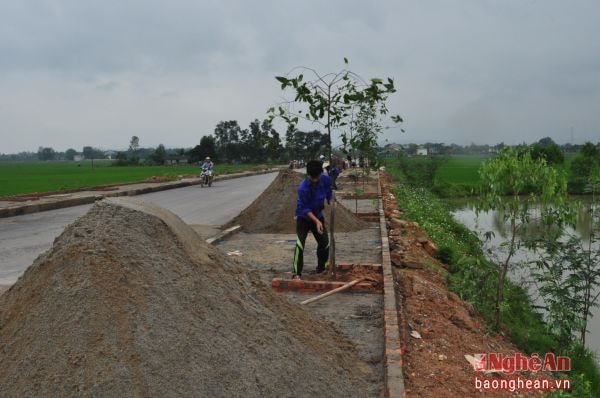 |
| Through the New Rural Development program, many rural roads have been upgraded and expanded (the expanded road in Kim Lien commune). Photo: PV |
Regarding attracting resources, the commune continues to call for and promote investment. The biggest expectation is investment in building a bus station connected to a commercial and shopping center. This includes establishing routes for specialized tourist vehicles (such as electric vehicles) to transport visitors to President Ho Chi Minh's birthplace, Kim Lien village, economic models, and specialty gardens, etc.
Currently, the commune has 397 households engaged in small-scale trading and handicrafts, accounting for approximately 12%. The commune will encourage the creation of joint ventures and partnerships to establish value chains and enhance production and business value.
The commune is currently focusing on directing the transformation of low-yield, upland rice-growing areas into farm-based economic development. To date, Nam Dan has 27 small and medium-sized farms, many of which are integrated farms with average annual revenue exceeding 1 billion VND. Crop conversion in the Dam Sim and Lien Son 1 areas is being implemented through collaboration with the Central Institute of Crop Science to survey soil quality and identify high-value crop varieties. Unproductive orchards in six hamlets are being renovated, retaining only traditional crops such as camellias, Terminalia catappa, oranges, apples, and guavas.
For a long time, the low-lying canal system in Kim Lien has lacked irrigation water for the summer-autumn crop, causing droughts and water shortages for production. Furthermore, being located in a low-lying area, just 200 mm of rainfall causes large areas to be flooded. Of this flooded area, only 66 hectares are suitable for conversion to other crops. Therefore, the commune will focus on attracting investment to build an irrigation system to ensure stable water supply.
The above solutions are not only being promoted to increase people's income, but also contribute to creating breakthroughs in awareness and thinking, eliminating inertia in both perception and action.
PV:Thank you, sir!
Ngo Kien
(Perform)
| RELATED NEWS |
|---|


