
The issue of poverty eradication is a hot topic.
(Baonghean.vn) - On the third working day of the 13th session of the 16th Provincial People's Council, the Director of the Department of Labor, War Invalids and Social Affairs was questioned regarding poverty reduction, labor export, and vocational training. This was the hottest issue at this session.
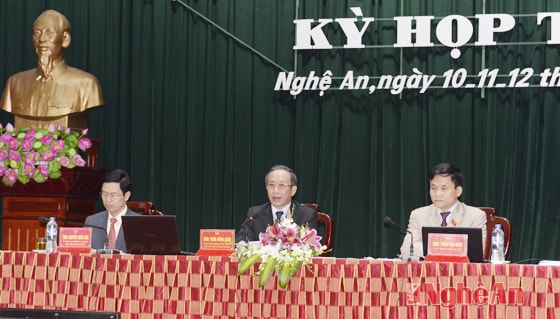 |
| Comrade Tran Hong Chau presided over the question-and-answer session. |
Opening this morning's question-and-answer session was the explanation from the Director of the Department of Labor, War Invalids and Social Affairs, Nguyen Bang Toan, regarding poverty reduction efforts. He noted that while the poverty rate has decreased, it is not yet stable, and the risk of re-poverty and the emergence of new poor households remains high. According to the explanation, besides objective reasons such as the majority of poor and near-poor households relying primarily on agricultural production under harsh natural disaster conditions, subjective factors include a lack of knowledge among many poor households, limiting their access to scientific and technological advancements in production and resulting in low labor productivity. Most poor households are also limited in their ability to plan their businesses, failing to accumulate capital for reinvestment in production, including livestock farming, crop cultivation, and services. Some households still heavily rely on government support and lack the determination to escape poverty. Furthermore, some poor households have members suffering from social ills, drug addiction, and other social problems, making poverty alleviation difficult. The leadership and guidance role of some Party committees, government agencies, and political systems at various levels in organizing and implementing poverty reduction work is still limited; the capacity of some officials working on poverty reduction in some localities is still weak, especially at the commune level.
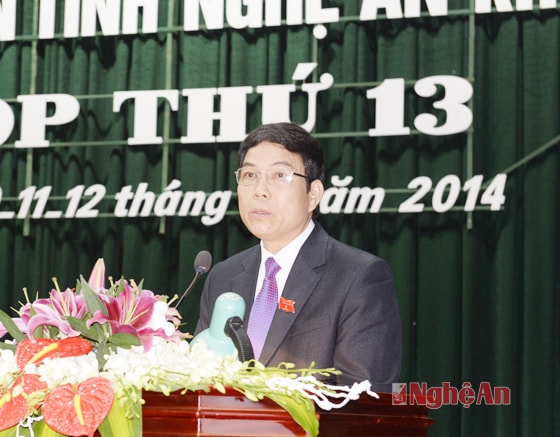 |
| Director of the Department of Labor, War Invalids and Social Affairs, Nguyen Bang Toan, provided explanations and answered questions related to the department's field. |
The Director of the Department of Labor, War Invalids and Social Affairs also explained and acknowledged the shortcomings raised by the Provincial People's Council in some of the issues questioned, namely: the investigation, review, and assessment of poor households showed signs of inaccuracy; state management of vocational training still has many limitations, the quality of training does not meet requirements, does not closely follow the needs of labor recruitment, and vocational training for rural laborers is not highly effective; the situation where some organizations and businesses exploit labor export for fraud and profiteering has not been promptly prevented, causing public resentment. State management of labor export still has many limitations. Mr. Nguyen Bang Toan stated that, with its role and responsibility, the Department of Labor, War Invalids and Social Affairs seriously accepts and takes responsibility for the existing problems and limitations and will resolutely coordinate with all levels and sectors to focus on implementing comprehensive solutions to overcome the shortcomings as soon as possible.
The questioning session by provincial People's Council representatives to the Director of the Department of Labor, War Invalids and Social Affairs was very lively, focusing on the core issues and the department's authority and responsibilities. Twelve representatives directly questioned the Director on 23 related topics. Beginning the session, Representative Phan Văn Tuyên (Yên Thành) questioned: “The issue of resolving the rights of 25 workers in three communes of Yên Thành district, whose rights were not addressed by Cửu Long Investment Joint Stock Company after collecting money from them but failing to send them abroad for work, remains unresolved. What is the responsibility of the Department of Labor, War Invalids and Social Affairs in pursuing and resolving this issue?” Responding to the issue raised by the delegates, Mr. Nguyen Bang Toan acknowledged and clarified: “This matter dates back to 2006 and remains unresolved to this day. The reason is that the company has been dissolved and its operating license revoked, and the case is currently being transferred to the investigative agency for prosecution and trial. However, with the responsibility of the sector, we will continue to actively cooperate with the Ministry of Labor, Invalids and Social Affairs and the Ministry of Public Security to provide information to the delegates and voters as soon as possible.”
Responding to a question from delegate Pham Anh Tuan (Quynh Luu), who requested clarification on how many of the 55,000 Nghe An workers currently working abroad went through official channels, unofficial channels, and how many had to return midway without their rights being protected, the Director of the Department of Labor, War Invalids and Social Affairs stated: “Of the total number of workers going abroad, the majority went through official channels. Regarding specific figures on how many went through unofficial channels and how many returned prematurely, the department will take this into consideration and send a written notification to the delegate later.”
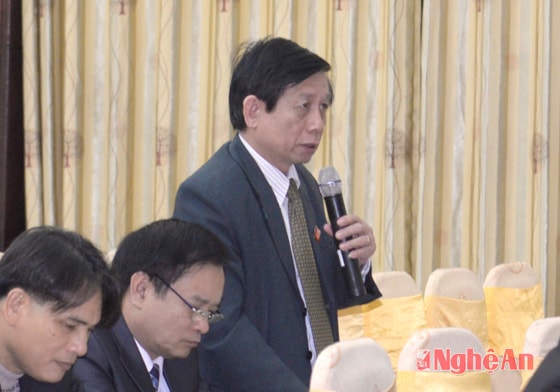
Also related to the management of labor export, delegates Phan Thế Phương (Nghĩa Đàn) and Phan Thị Thanh Hiền (Tân Kỳ) expressed concern about how the industry should be directed to ensure that people have access to information and avoid fraud in labor export. Responding to this issue, Mr. Nguyễn Bằng Toàn stated: To overcome the lack of information among workers, the solution in the coming time is to strengthen propaganda efforts. In the near future, we will coordinate with the provincial radio and television station and Nghệ An Newspaper to specifically publicize reputable labor export companies, the recruitment areas of each company, and require companies to make strong commitments to workers so that when difficulties arise, they are responsible for timely handling. In particular, the control role of the authorities at all levels, especially at the grassroots level, is very important in detecting networks and brokers to correct and remedy the situation, minimizing losses for workers.
Another issue that many delegates questioned was the existing shortcomings and limitations surrounding poverty eradication efforts. Delegate Cụt Thị Nguyệt (Kỳ Sơn district) questioned: “Currently, Kỳ Sơn district has the highest poverty rate in the province, and the district is very concerned but has not yet found a solution. According to your explanation, the solution for the future is to first strengthen propaganda work and raise awareness about poverty reduction, especially to empower the poor themselves to strive to escape poverty, combating the mentality of waiting and relying on support from the State and the community. However, is this solution feasible, and how should propaganda be reformed to achieve effectiveness?”
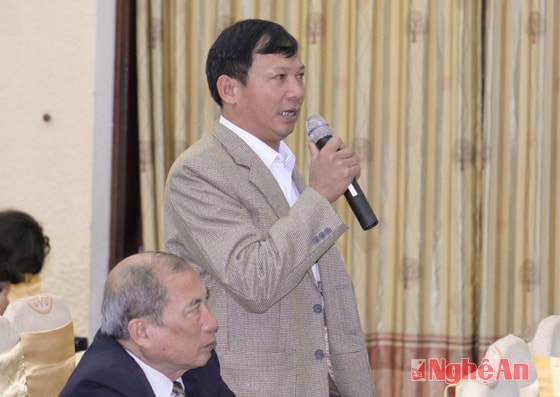 |
| Representative Le Van Tri (Anh Son) questioned the issue of favoritism in the assessment of poor households. |
The Director of the Department of Labor, War Invalids and Social Affairs affirmed: "Everyone wants to escape poverty to take control of their own lives, but some still want to remain on the list of poor households to benefit from state and community support policies. Therefore, we must strengthen propaganda work. Whether the propaganda is practical, effective, and resonates with the people still depends on the role of each village, hamlet, and locality; the role of the Department of Labor, War Invalids and Social Affairs is mainly to guide and coordinate with localities to disseminate information. For households that want to remain on the list of poor households or intentionally falsify information to be included in the list, no one can fight more effectively than directly and face-to-face combat at the village, hamlet, and local levels."
Mr. Nguyen Bang Toan also answered a question from delegate Le Van Tri (Anh Son) regarding measures to overcome favoritism, local parochialism, and clan-based biases that lead to inaccurate poverty assessment, with non-poor households still being included in the poverty list. According to Mr. Toan, the poverty assessment process takes place at the ward and commune level, therefore the role of the commune level is extremely important, and the supervisory role of the district level is also crucial. There is a situation where the list of poor households is compiled only through internal discussions among officials, without transparency and creating unfairness and inaccuracy. Regarding solutions, there is no other way than to strictly follow the four-step process in identifying poor households, including: step 1 is identifying the list of households to be investigated and excluding those that do not need to be investigated (households that are definitely not poor through assessment of their asset status and poor households that are definitely not yet out of poverty); step 2 is conducting an investigation of household income; step 3 is compiling preliminary investigation results and reviewing them; Step 4 involves organizing a public meeting to review and vote on the official list of poor households. In the near future, the department will strengthen training on this four-step process for officials at the block, hamlet, and village levels, thereby creating a transformation in the review process, ensuring greater transparency and accuracy.” Issues related to effective solutions for the situation of some people wanting to be included in the list of poor households; the situation where children with good economic conditions separate their elderly parents to become poor households due to the lack of income to receive state support policies; and whether reviewing poor households once a year is appropriate… were also thoroughly addressed by the Director of the Department of Labor, War Invalids and Social Affairs.
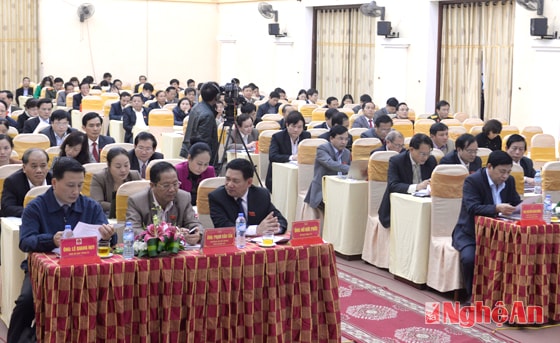 |
| Delegates attending the session |
In addition to the two points mentioned above, the Director of the Department of Labor, War Invalids and Social Affairs also answered questions from delegates Lu Dinh Thi (Que Phong); Le Van Tri (Anh Son); and Do Dinh Quang (Vinh City). The questions focused on clarifying the criteria for allocating vocational training funds to localities based on the annual training targets assigned to each locality, and based on a review and registration of learners' needs. Regarding the standards for evaluating the level and quality of vocational training, these are based on the skill level of the workers, the employers who have received the training, and the vocational training quality accreditation agency. Mr. Nguyen Bang Toan also analyzed and clarified the results and reasons why the quality of training at vocational training institutions and vocational training for farmers has not met expectations...
Concluding the questioning session with the Director of the Department of Labor, War Invalids and Social Affairs, Comrade Tran Hong Chau suggested that the Department should proactively advise the Provincial People's Committee to review regulations, standards, and procedures to accurately assess poor households, avoiding three common trends. Firstly, the pursuit of achievements, especially during the period leading up to the Party Congress, where localities want to meet Congress targets and therefore report inaccurately on the number of poor households; secondly, the dependence and expectation among a segment of the population, leading to a lack of motivation to escape poverty; and thirdly, the lack of objectivity in the assessment of poor households. These three "diseases" are quite prevalent in localities and need to be stopped. Poverty eradication must be carried out comprehensively and through multiple measures, including education to raise the level of public awareness, self-reliance, self-strength, and self-respect of each individual, family, and clan. The Ministry of Labour, Invalids and Social Affairs needs to coordinate with the Ministry of Education and Training to guide students towards vocational training, avoiding the mindset of pursuing university education at all costs, even if they lack the ability, leading to unemployment after graduation. Review and improve the quality of vocational training institutions, focusing on enhancing the quality of vocational teachers – excellent teachers produce excellent students; select training content that is relevant to practice and meets market demands so that graduates can make a living from their learned skills. Resolutely combat the practice of vocational training solely for the purpose of disbursing funds. Vocational training centers should be linked with production facilities, units, and businesses to both improve skills and practical training during the learning process and create jobs after graduation. Training should also focus on ethical knowledge, legal compliance, and labor skills to ensure students have opportunities for sustainable employment in established establishments. Comrade Tran Hong Chau also requested that the Department of Labor, War Invalids and Social Affairs focus on solutions to overcome existing shortcomings and limitations in labor export work, and manage labor export activities more effectively.
MAI HOA


