
Having spent billions of dong on pilot training, pilots can have their licenses revoked at any time.
The tuition fee to become a basic pilot in Vietnam is 1.7 billion VND, with a training period of 22-24 months. However, according to Captain Nguyen Nam Lien, a pilot's license is only valid for 5 years, and pilots can lose their jobs at any time if they fail one of the hundreds of exams.
Two years cost 1.7 billion VND.
In 2012, the Civil Aviation Authority approved the first pilot training school in Vietnam under a socialized model. The school opened in Ho Chi Minh City with a training framework based on European standards. The majority of instructors were foreigners. The pilot trainees were of diverse nationalities, including Vietnamese, as well as students from Canada, India, Australia, Cambodia, and other countries.
|
| Applicants must go through multiple rounds of testing and incur significant costs. |
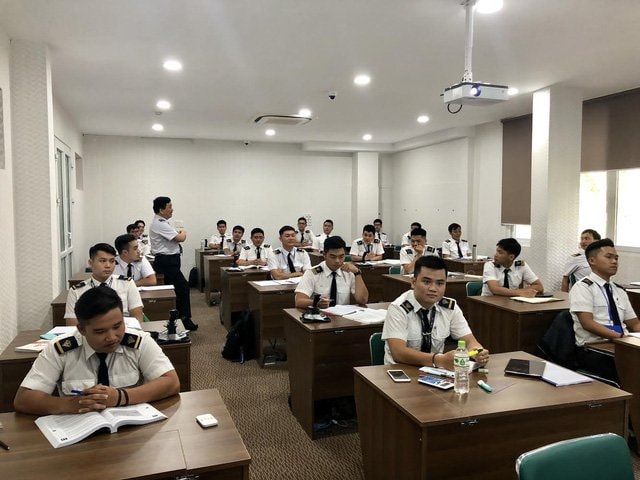
To become a pilot, applicants must pass three rounds of onboard testing and numerous other tests to ensure the most accurate and honest assessment of their knowledge, qualities, and essential skills for becoming a pilot, including information processing abilities, situational awareness, adaptability, and self-confidence. The final test results are analyzed and sent from the UK by an independent body specializing in evaluating pilot candidates. Approximately 40-50% of applicants are selected.
Captain Nguyen Nam Lien, a Boeing 787 flight crew member with 38 years of experience and currently involved in pilot training at a pilot school, stated: With the privatization model, the tuition fee alone for a pilot is 1.7 billion VND, and basic pilot training takes 22-24 months, including a mandatory 3 months of military training. Without privatization, airlines would have to spend 130,000 USD to train one basic pilot abroad, and then an additional 55,000-60,000 USD per two-person crew for pilot type conversion training (800 USD per hour for Boeing 787 SIM flight).
In Vietnam, the basic pilot training program takes place in two phases. Phase 1 lasts for 6 months: Pilot trainees must complete 14 subjects, 783 hours of instruction, 30 hours of examinations, and 3 hours of SIM flight time (cockpit simulator). Trainees must learn about flight principles, aircraft, aviation systems and equipment, human factors, meteorology, air communication, basic navigation, radio navigation, flight planning, flight characteristics, load balance, flight procedures, and aviation law.Phase 2 involves flight training with 155 hours.
|
| Pilot training takes two years and costs nearly 2 billion VND. |
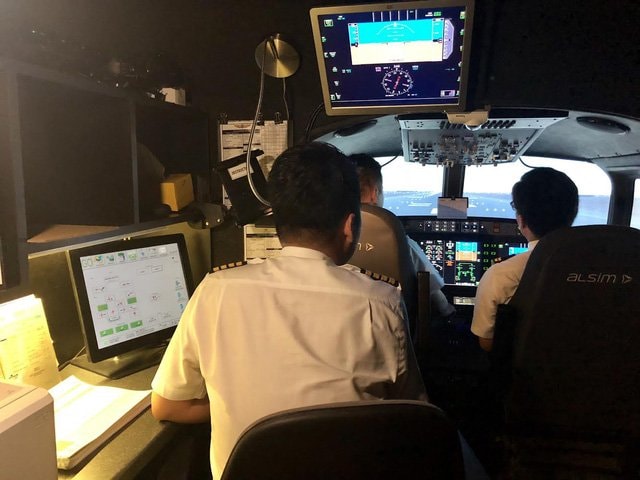
"For a first disciplinary violation, the trainee receives a warning; for a second violation, the trainee must appear before the Disciplinary Council; and for a third violation (especially cheating in exams), the trainee has all their academic results canceled and must start over if they want to pursue a career as a pilot," said instructor pilot Nguyen Nam Lien.
After completing the basic pilot training program, trainees are transferred to SIMs (Specialized Training Centers) to learn how to become operational pilots. Trainees must learn about ground operations, flight crew management, and more. Upon completing SIM flight training, trainees move out to conduct training flights.
Even after graduating, you still have to take exams throughout your life.
Captain Nguyen Nam Lien stated that doctors, engineers, or professionals in any other field receive lifetime licenses upon completion of their studies, but pilots spend nearly 2 billion VND on training only to have their licenses valid for 5 years. Even after becoming a pilot, they must still undergo 8 exams and 2 periodic training sessions on the simulator each year. Failing even once will result in the revocation of their license and they will no longer be considered pilots.
“On a flight, if any unforeseen incident occurs, it threatens the lives of the pilot and nearly 300 other people, along with the $250 million aircraft. To avoid such unfortunate events, pilots must be able to handle situations in the best possible way. That's why pilots have to study and take exams many times a year. If you decide to become a pilot, you receive a license to study and take exams for life,” said Captain Nguyen Nam Lien.
|
| A female pilot trainee and her classmates recently graduated from basic pilot training and are now waiting to begin type conversion training on the simulator. |

The captain, with 38 years of flying experience, shared that the challenging environment makes piloting a very special profession. Anything can affect a pilot, and many risk factors can compromise safety. Pilots must always remember that safety is number one and a prerequisite for any flight.
It is projected that by 2020, Vietnam's aviation industry will need approximately 1,800-2,000 pilots. Socializing pilot training will broaden the selection of pilot candidates, ensure objective quality, eliminate the "request-and-grant" mechanism, and significantly save on the cost of investing in pilot training abroad (approximately 2.5 billion VND).


