
Meritorious Artist and Choreographer Lu Kieu Le: Beauty from Simplicity
(Baonghean) - Having choreographed performances for the SEA Games and Para Games, and having won numerous awards at national and international professional dance festivals, she was also honored with the title of Meritorious Artist at the young age of 28.
The artist couldn't remember how many times her name had been called to the stage to receive an award. For her, awards weren't the deciding factor in honoring an artist; what mattered was whether their works resonated with the public, whether they conveyed the essence of life and the national spirit. The hallmark of each of her dance works is the way she tells the simplest story about life...
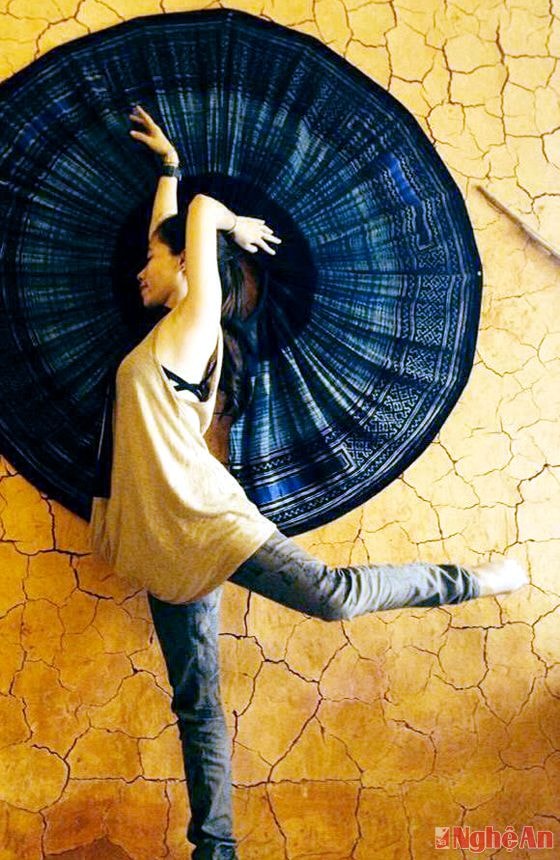 |
| Meritorious Artist - Choreographer Lu Kieu Le |
I met her on a crisp, sunny winter afternoon. At first, I didn't think she was the renowned Meritorious Artist and choreographer, Head of the Dance Department at the Military University of Culture and Arts, Lieutenant Lu Kieu Le. In my imagination, after watching "Three-Leaf Clover," the musical "The Nation Rises Up," or "New Rice," which she directed and which won numerous prestigious awards at national and international professional festivals, I expected the female artist I admired to be incredibly elegant. She appeared before me simply, without makeup, her slender figure clad in a loose-fitting sweater. She said, "My connection with dance is like destiny. Since childhood, I've followed my parents from one stage to another. The language of body language has seeped into me without me even realizing it, and it's hard to explain whether I chose dance or dance chose me..."
Kieu Le was born into a family with a tradition in the arts. Her father was a saxophone player, and her mother was a dancer in the Nghe An Song and Dance Drama Troupe (now the Nghe An National Song and Dance Troupe). In the past, whenever her parents went to rehearsals, Kieu Le and her sisters would follow them, lingering backstage, dancing and singing along. By the time the play premiered, Kieu Le and her sisters had mastered the routines, so the troupe members recognized her early talent. After finishing high school, Kieu Le couldn't resist the allure of dance. In 1989, she applied to join her parents' troupe and, of course, she was accepted.
Two years after joining the troupe, she was sent to train at the Military College of Culture and Arts in dance. It was there that she absorbed the profound values in each dance piece. Each dance performance can be likened to a literary work with its own story, climax, and resolution. Every dance piece must convey its idea and message. Each scene is a literary segment in which the dancer is conveying to the audience what the choreographer wants to say. Sometimes, each dance piece is a painting, and when performed, it helps the audience grasp the essence of the artwork.
She thought that simply conveying ideas wouldn't sustain her passion in the long run, nor would it allow her to fully express what she wanted to share with the audience. Therefore, she decided to study choreography for three more years at the School of Theatre and Film. After seeing her performances during her graduation night, the Board of Directors of the College of Culture and Arts decided to recruit her as a lecturer...
If you've seen "New Rice" and "The Returning Season," choreographed by her, even the most discerning audience and the most seasoned choreographer will be captivated by the flow of sound, rhythm, and body language guided by the dancers from beginning to end. Both works draw their material from the folk songs of the Khơ Mú ethnic group.
She shared: “The Khơ Mú people possess generosity, optimism, and a love for nature. My mother is also Khơ Mú, and through her, I came to love the people, customs, and the land where they live. Perhaps that's why, when I'm given the opportunity to stage performances with folk elements from the mountainous region, it feels like I'm bathing in the streams and springs, freely immersing myself in the cool, refreshing water of the borderlands, where my mother's childhood was nurtured.”
However, saying that contemporary folk art is her strength isn't entirely accurate, because many of her works with a modern feel have been deemed unrivaled by art councils at major festivals. She is always exploring new things, always stylizing the simple things in life, and bringing them to the stage.
The work "Rhythm of Life" has no music; the actors use props to create sound, and they even sing their own labor songs to create music. This surprised the entire art council, and it represents a unique exploration, a modernity within simplicity, and simplicity within modernity, which she brought to the competition and won the All-Army Gold Medal and the National Gold Medal. She believes that the first criterion in her work must be simplicity, and no matter how "extravagant" or technically sophisticated it may be, simplicity must ultimately prevail. Because the goal the artist brings to the audience is a message about the beauty in life. And the most beautiful thing in life is simplicity.
When I asked her if she ever ran out of ideas, she answered without hesitation: "Never." Because in her eyes, life is beautiful, simple, and life has given her endless creative inspiration. As long as life is still moving, she will always have topics and creative inspiration.
She recounted that once, while on a business trip to Sapa, it was late afternoon and very cold. She saw a foreign tourist chatting with a Dao woman carrying a sleeping child on her back. Surprised, she approached and saw the woman diligently giving directions to the tourist, speaking fluent English. That image inspired her to create "Three-Leaf Clover," which won second prize (there was no first prize) at the national young dance talent festival. Beautiful images, such as women wearing raincoats to the rice paddies in the freezing winter, or innocent children and elderly people strolling slowly through bustling city streets, evoke strong emotions in someone like her who gathers simple things from life and transforms them into the art form of dance.
Therefore, she always pondered how to ensure that the dancers also absorbed that essence and incorporated it into the core of their movements and body language. For her, if she wanted dance to reach the public, choreographers and dancers must first equip themselves with a rich cultural background to be able to convey the choreographer's ideas and bring dance closer to the audience. This once again placed a heavy burden on her shoulders in her training work. And each journey that teacher Kieu Le undertakes carries a weight of thoughts but also optimism about a new generation of dancers, who will bring new breaths to Vietnamese dance art, breaths of inheriting and developing the essence of Vietnamese national culture.
When asked about the responsibility of a choreographer in honoring the folk music heritage of Nghe An province, she reflected: "I've thought about this before. As someone from Nghe An, every time I hear the folk songs of the 'vi giam' region, it stirs up nostalgic memories of my childhood, and in the future, I will convey the image of the young men and women of the weaving villages in my dance works." She also believes that although she is not in the field of singing, dance is an art form that allows music to take flight, and there is no reason why 'vi giam' and 'giặm' songs shouldn't soar when the sounds in the dance language are infused with the soul and essence of the ancient weaving villages...
Thanh Nga


