
"Golden bamboo" in the new homeland
(Baonghean) - For the fifth spring, more than 50 Dan Lai households have left their remote, isolated homes in the vast Pù Mát forest. Warm and cozy in their spacious houses, celebrating Tet (Lunar New Year) with the radiant glow of electricity... they have found their "golden bamboo" in their new homeland...
The "golden bamboo" has been found.
On the last day of the year, I went to Thach Ngan, one of the remote communes in the district, with the Secretary of the Con Cuong District Party Committee, Vi Xuan Giap. As we walked, he chatted: “Although the Party and State have shown great concern, providing tens of tons of rice, salt, lamp oil, medicine, clothing, and fabric annually to the Dan Lai people, the terrain where they lived before was extremely rugged, transportation was incredibly difficult, and they still haven't escaped their hunter-gatherer lifestyle. Every year, they clear hundreds of hectares of upstream forest to plant rice, corn, and cassava, and illegally exploit forest products in the Pu Mat primary forest. This vicious cycle of backward living conditions keeps the people of Huoi Khang trapped in poverty.”
The government approved a resettlement project for the Dan Lai people in the core area of Pu Mat National Park, located in Mon Son commune, aiming to preserve and improve the lives of this ethnic group. Initially, the district was concerned about the project's success, as the new resettlement area was surveyed and selected in Ke Gia, Ke Tat, and Pa Ha, in Thach Ngan commune, about 50 km from the buffer zone of Pu Mat National Park. Although also mountainous, it was completely different from their familiar homes of the past. Previous lessons showed that their return to their old villages during the subsidy period was a reality. However, after driving up the now-lowered and widened Kem Noc slope, descending into the valley, one could see nearly 50 stilt houses with bright red tiled roofs, looking like charming villas nestled around the hills, and the Nam Xan stream flowing like a green silk ribbon at the foot of the village. And when we arrived and saw the terraced rice fields and vegetable plots... lush green, herds of buffalo, cows, and goats grazing at the foot of the mountain, and chicks chirping as they searched for food, we began to believe that the Dan Lai people had found a new life!
Mr. Vi Xuan Giap recounted that the Dan Lai people in the relocation project included nearly 200 households, more than 1,000 people, in three villages: Co Phat, Khe Con, and Ban Pung. In early 2001, the government approved the project to relocate the Dan Lai people out of the core area of Pu Mat National Park, with a total investment of 20 billion VND. In September 2002, the district successfully relocated 36 households to Tan Son and Cua Rao villages in Mon Son commune, with each family receiving almost full support. Initially, due to their traditional lifestyle and low consumption habits, their food rations ran out before the end of the month, and many resorted to cutting bamboo, harvesting shoots, and digging up roots in the forest. However, with the persistent guidance of the "three together" (together with the community) officials and organized visits to learn from successful farming models, the people gradually adapted to the new production methods. The relocation of the Dan Lai people was meticulously prepared.
Previously, efforts to persuade the Dan Lai people to resettle were unsuccessful, likely due to a lack of investment capital and a lack of commitment from officials. This time, the district assigned relevant departments to send officials to persuade the villagers, even though it required many trips, was arduous, and quite costly, but it was necessary to persevere. Through persistent persuasion and mobilization, by the end of 2005, the pioneers from Co Phat village, including five Party members such as Party branch secretary La Giang Son, village elder Le Van Tien, village head La Van Vinh... and subsequently many other households also registered to relocate. As a result, 42 households with 193 people voluntarily committed to the district to move to their new residence in Thach Ngan commune.
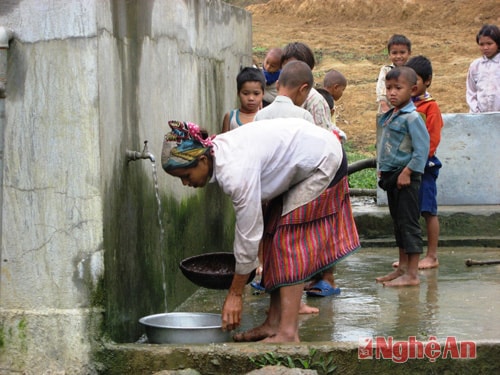 |
| Clean water has arrived in the village. |
On average, each household that moves to the new location is allocated 1,000 to 2,000 square meters of production land and assigned 2 hectares of forest for conservation and protection. In addition, each household receives a solidly built stilt house: households with four members or fewer receive a two-room stilt house with two double beds; households with five or more members receive a three-room house with three double beds and bedding. Each household also has a kitchen and outbuildings... The value of each house is approximately 130 million VND. According to the Chairman of the District People's Committee, Hoang Dinh Tuan, the total average investment per household is nearly 300 million VND. Elder Le Van Tien puffed on his pipe, exhaling smoke, and said: "On the morning of January 23, 2007, 42 Dan Lai households from Co Phat village began moving to their new homes. They have big, beautiful houses, sturdy and well-built, with electricity, television, and water running right up to the stairs, so they no longer have to carry heavy bamboo pipes down to the stream to fetch water. The children have a beautiful school right in the village to learn to read and write. The villagers all have fields and farms, and the officials have shown them new ways to farm. After the new harvest, every house is full of rice, corn, and other crops. The children of the Dan Lai people are much better off than their ancestors. We Dan Lai people cannot express enough gratitude for this!"
Along with the elder Tien, Mr. Le Van Loi contributed to the conversation. After settling down, he and another household jointly invested in seedlings and planted over 40,000 acacia trees on the allocated forest land. Thach Ngan commune also assigned the commune's Youth Union to coordinate with the village's Youth Union to help households plant tens of thousands of trees. In the years since moving to the new village, the Dan Lai people have harvested the most corn and rice, with every house filled with produce. Here, water pipes have been installed, and some households have learned from the Kinh and Thai people to dig ponds to raise fish and ducks. Many households have bought motorbikes and mobile phones to call people far away. Everyone feels healthier and happier here...
I haven't forgotten the past.
Back in his new hometown of Thach Son, the village elder La Van Tien still couldn't forget to tell us the sad story of the Dan Lai people and why they had to climb so high up to the top of "Ong Giang" mountain. Elder Tien recounted that, according to the "pu, nha, y, me" (grandparents, parents) tradition, their territory used to be in Trung Chau, Hoa Quan region (now part of Thanh Chuong district). At that time, there was a wicked and greedy village chief who plundered the villagers' possessions for his own enrichment. One day, the chief ordered the villagers to find "one hundred golden bamboo stalks and a boat with oars" and bring them back, threatening to kill the entire village if they failed. Fearing for their lives, the villagers sent young men to search deep in the forests and treacherous mountains, but they could not find the boat with oars and the hundred golden bamboo stalks. Afraid of being killed, they fled the village.
Day after day, month after month, they traveled upstream along the Giang River. The greed and cruelty of the village chief forced the Dan Lai people to abandon their homeland and flee to this remote, isolated place. The Le family had to change their surname to La... and so their lives in the high mountains and deep valleys continued, "following the tracks of deer to plant rice; following the tracks of tigers to plant corn," like "to ca, to cun, kha lang" (wild boars, monkeys), drinking "dak" (water) from the Tang stream in the morning, and sleeping at night at the top of the Be stream, "wandering at the head of the stream; desolate on the mountain pass...". Their roofs were usually thatched with banana leaves until they turned yellow, revealing the entire sky above, before they would move on to another place. The Dan Lai people previously had no clothes to wear; their only coverings were tree bark. Their main food source was cassava, yam, and roasted or boiled taro, eaten with grilled fish or dipped in honey. At night, they would cut a "chang" (a type of wooden stick) to prop up their foreheads to protect themselves from wild animals.
The name Thach Son village is a combination of the names of two communes, Thach Ngan and Mon Son. This spring marks the fifth time that more than 50 households in Dan Lai have enjoyed a bright, electric-lit Tet holiday. They are truly well-fed, warmly clothed, and happy in their spacious homes. They have found their "golden bamboo" right here on this land. The eyes of the village Party Secretary, La Giang Son, also shone brightly: "Now, the villagers not only know how to plant trees, cultivate rice paddies, grow crops, grow sugarcane, and raise livestock, but they also receive guidance from a task force consisting of officials, including engineers and experts in fields such as agriculture, construction, military, police, and youth union members from the district and Thach Ngan commune, who are stationed in the village. They are guided in organizing production, using plows to cultivate fields, and how to preserve agricultural products... From 42 households, Thach Son village has now increased to 50 households, and some Thai and Kinh households have come here to live harmoniously with the Dan Lai people. It's wonderful!"
Text and photos:Pham Ngan