
Water flowing on Mars - a discovery that will change our understanding of the universe.
The discovery of surface water flowing during the warm season on Mars is a significant breakthrough, raising hopes for humankind about a habitable planet.
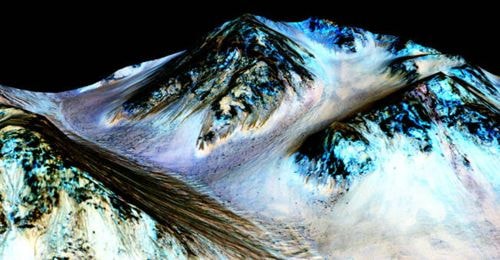 |
| Seasonal water flow on Mars. Photo: NASA |
The US National Aeronautics and Space Administration (NASA) announced yesterday that Mars has streams of saltwater flowing on its surface, raising hopes of finding life on the red planet.
A very long time ago, "ancient Mars was covered by a vast atmosphere, along with an ocean the size of two-thirds of the Northern Hemisphere, about 1,609 kilometers deep," said Jim Green, director of NASA's planetary science division. After an unexplained catastrophe, "the Martian climate changed dramatically, and the water on the surface gradually disappeared."
In 2008, scientists confirmed the existence of frozen water on Mars, including at both poles. However, the latest data from the Mars Reconnaissance Orbiter (MRO) reveals that the surface of the red planet also contains liquid water, creating opportunities for some forms of life to develop. Traces of hydrated salt deposits and eroded slopes are the result of saltwater flowing across the Martian surface during the warm season, then freezing and disappearing during the cold season.
"Mars isn't the barren planet we once thought it was," Green said.
According to Mary Beth Wilhelm of the Ames Research Center (NASA), the discovery of surface water flowing during the warm season on Mars raises hopes for human habitation. Pure water would certainly not be stable in the harsh Martian atmosphere, which is why saltwater is highly likely to exist either frozen or evaporated during the transitions between hot and cold seasons.
Scientists have previously discovered water on the surface of Mars, frozen at its poles. However, they remain uncertain about the origin of this surface water. Wilhelm says she is optimistic that the new data will provide scientists with "a great opportunity to pinpoint the exact source of water on Mars" that humans could use, and even signs of life existing in the salts, liquids, and moisture present in the Martian atmosphere.
"Water on Mars will be a crucial resource in the future for human expeditions to the planet," Wilhelm said.
NASA and other space agencies are struggling to find ways to provide enough water for humans on Mars exploration missions. It costs up to $10,000 in fuel to send 0.45 kg of water into space, so having water readily available in space would save a significant amount of money.
The European Space Agency and NASA are searching for water on asteroids, hoping that one day they may be able to extract water from asteroid crusts and transport it to the Moon or Mars. However, asteroid mining is still many years away from becoming a viable option.
President Barack Obama has called on NASA to send humans into Mars orbit by 2030, in preparation for a Mars landing. An orbit around Mars takes at least three years, so the discovery of liquid water on Mars is a crucial step in the mission to explore the red planet.
NASA is planning to survey asteroids near Mars, hoping to find microscopic life forms. Therefore, it's highly probable they could also be present on Mars – a planet that once had oceans and an atmosphere.
"The existence of liquid water suggests the possibility of life on Mars, and if it exists, we can learn how it survives," said John Grunsfeld, an astronaut on NASA's Science Mission Directorate. "Whether or not extraterrestrial life exists is no longer an abstract question, but a concrete one that humans can now answer."
According to VnExpress


