
The media's low-stakes move.
(Baonghean) - The love affair between French President Francois Hollande and actress Julie Gayet, revealed in the magazine Closer, has become the focus of European media attention and has even spread to the United States. Surprisingly, the French media has been quite indifferent, if not outright disagreeing, with Closer. The French, seemingly accustomed to the complicated love affairs of political figures, have once again demonstrated what they consider "respect for personal freedom" in relation to celebrities.
BBC, CNN, Financial Times, Times, Daily Telegraph... all the prominent British and American newspapers expressed particular interest in the French President's love life, albeit in different ways. While the BBC placed the story at the top of international news headlines for an entire morning, the Financial Times featured a photo of actress Gayet on its front page and commented that the president needed to "eat his croissants in peace." Less sympathetic was the Daily Telegraph, which stated that Hollande was facing a "new crisis," and that with his "record low" approval ratings, a love scandal would be the last thing he needed at this point.
German media maintained a relatively neutral stance in their commentary on the news, reminding readers that affairs involving romantic relationships are not unprecedented in French politics. Nevertheless, a touch of humorous irony was evident through the wordplay on "affare," which is close to the French word for "affaire" but also means "romantic relationship" in German. Germans also expressed surprise at the fact that French political figures unanimously accused the press of violating their privacy without giving any thought to using the scandal for political purposes. Spanish and Italian newspapers such as El Pais, El Mundo, La Vanguardia, and La Stampa focused on the female figure involved, with comments like "a talented and discreet woman." Or a broader perspective: "France, with its tradition of romantic affairs intertwined in history, film, and literature, has always been tolerant of extramarital affairs of its presidents."
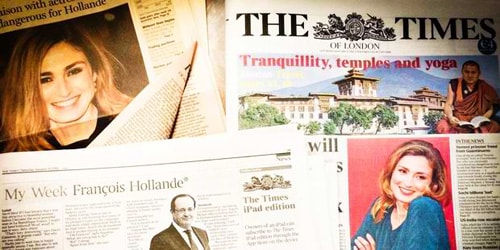 |
| Articles about the incident appeared in The Times and Financial Times on January 11. |
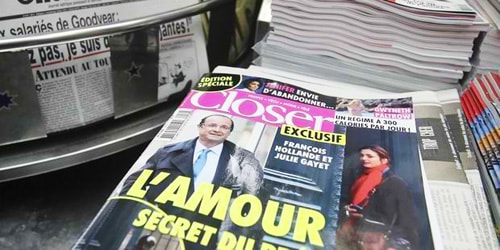 |
| Closer's front page, January 10th |
What are the French media and public saying? It's not easy to find any particular focus on the incident, except that all, or almost all, are pointing the finger at the magazine Closer. What surprised the public wasn't the fact that the president had a secret affair with an actress in an apartment not far from the Elysee Palace, where he was still living with journalist Valerie Trierweiler. Nicolas Sarkozy also had a relationship with singer Carla Bruni for a time before divorcing her and marrying her. Jacques Chirac was also known as a womanizer with many women surrounding him.
Francois Mitterand kept his mistress and illegitimate daughter a secret for a long time before revealing the truth in Paris-Match. But a "sneak attack" like the one Closer just inflicted on Hollande is unprecedented, and for the French, such a serious intrusion into personal privacy is unimaginable. This is not the first time Closer has been criticized for its "nosy" behavior in the private lives of celebrities; in September 2012, the magazine published a series of topless photos of a female member of the British Royal Family during a holiday in France.
Immediately, the British Royal Family filed a lawsuit against Closer magazine, specifically its editor-in-chief Laurence Pieau, publisher Ernesto Mauri, and two photographers. The article has since been removed by Closer at the request of Julie Gayet's lawyer, but President Hollande has stated that he will pursue the matter to the end, not in his capacity as the head of state of France, but as a citizen with the right to privacy.
Contrary to the harsh criticism leveled at Closer by left-wing leaders and opposition party figures like Bruno Leroux and Marine Le Pen, who called it "trash news" and "disgusting," Bruno Le Maire declared in Figaro that "providing information is the role of the press." He further argued that, according to Closer's justification, this information had been circulating for some time among individuals closely connected to the two main characters in the story.
It was a colleague of Julie Gayet who joked about her alleged affair with the president on a television program last September, and that was the opening shot in the media's "plan." However, given the French's familiarity with the complicated love lives of political figures, Hollande's change of mistress (he and Valerie Trierweiler are not married) doesn't seem to be a top public concern. Perhaps Closer miscalculated not just once, but twice: public indifference, and the main character pursuing legal action. This should be a lesson for the French media: don't equate political figures with movie or music stars, and don't assume France is a haven of freedom like America!
Reishi Mushroom


