
Nước Mỹ, đến và cảm nhận
(Baonghean) - During those historic days of April, we took a trip to the United States. Forty years ago, five consecutive US presidents (Delhi, Elsenhowe, John Kennedy, Lyndon, John Sory, Richard Nixon, and Gerald Ford) successively implemented four new war strategies in the Vietnam War. The result was the greatest and most devastating defeat in the more than 200-year history of the United States. A war that left the deepest emotional wound in America: the "Vietnam Syndrome."
(Baonghean) - During those historic days of April, we took a trip to the United States. Forty years ago, five consecutive US presidents (Delhi, Elsenhowe, John Kennedy, Lyndon, John Sory, Richard Nixon, and Gerald Ford) successively implemented four new war strategies in the Vietnam War. The result was the greatest and most devastating defeat in the more than 200-year history of the United States. A war that left the deepest emotional wound in America: the "Vietnam Syndrome."
Since the trip was initially planned to learn about America and Americans after the Vietnam War, and especially to commemorate the 20th anniversary of the normalization of relations between Vietnam and the United States, and thanks to a friend who studied in America and is now an overseas Vietnamese, we were able to visit all the places we needed to go quite smoothly. Our first destination was Washington D.C., where cherry blossoms were in full bloom, showcasing their beauty around Tidal Basin. The number of people flocking to the capital to admire the cherry blossoms and visit historical sites and scenic spots in Washington D.C. was exceptionally high.
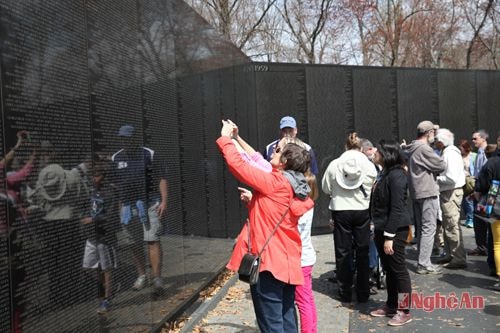 |
| Americans in front of the "Vietnam War Wall". |
Navigating through the endless crowds of cherry blossom festival-goers, we made our way to the "Vietnam War Memorial Wall," also known as the "Vietnam War Memorial," which was inaugurated on September 13, 1982. This monument is located in Washington State Square.
Here, millions of Americans gathered to protest the Vietnam War during the 1960s and 70s. With its V-shaped architecture, measuring 75 meters in length and 3 meters in height, the walls are clad with 72 rare black granite slabs imported from Bangalore, India. The walls are inscribed with the names of 58,285 American soldiers who died or went missing in the Vietnam War.
In front of the wall are two groups of bronze statues, each 2.5 meters tall. One group depicts three American soldiers, and the other shows two women in uniform, supporting a wounded American soldier. Since the wall's completion, approximately 3.7 million people, both domestic and international, have visited annually to pay their respects and search for relatives.
Đến xem bức tường này, chúng tôi bắt gặp rất nhiều hình ảnh người dân Mỹ đang nhón chân, rướn người để chụp ảnh những dòng chữ khắc tên người thân ở phía trên cao, hay một cặp ông bà già với nét mặt đượm buồn, giơ tay chỉ tên em ruột của mình tử trận lúc mới tròn 20 tuổi để cháu nội cùng đi được biết.
Những cựu chiến binh Mỹ cúi đầu, rón rén bước nhẹ nhàng, có người gục đầu vào tường, vài người khác thầm lau nước mắt, để lại bông hoa nhỏ dưới tên một người bạn. Cảm động hơn khi tiến về phía cuối bức tường, nơi chỉ có độ cao 30cm (do cấu trúc bức tường hình chữ V) một nhóm người cao tuổi, tay bám chặt xe lăn, đang nhoài người quỳ xuống để tìm đọc tên người thân, đồng đội ở đây…
Tất cả những hình ảnh ấy đã được kịp thời ghi lại trong ống kính máy ảnh mà chúng tôi mang theo. Khi được tận mắt chứng kiến những cử chỉ, những cảm xúc thể hiện trên khuôn mặt của họ mới hình dung được sự mất mát, đau thương kéo dài của người dân Mỹ sau chiến tranh Việt Nam. Và thầm nghĩ những người đến đây, có dịp tới Việt Nam vào các Nghĩa trang Trường Sơn, Đường 9 ở Quảng Trị, Việt - Lào ở Anh Sơn (Nghệ An) và các đài tưởng niệm liệt sỹ khắp nơi trên đất nước Việt Nam sẽ hiểu thêm sự hy sinh, mất mát của dân tộc mình, mà giới cầm quyền Mỹ thời bấy giờ gây ra còn lớn gấp nhiều lần con số ở nước Mỹ.
Rời Thủ đô Washington sau một ngày nắng dịu, chúng tôi đến Thành phố New York, 1 trong 3 trung tâm thương mại tài chính lớn nhất thế giới (London và Tokyo). Dân số New York chỉ có 8,3 triệu người, nhưng thành phố này hàng năm đón khoảng 47 triệu du khách trong và ngoài nước viếng thăm.
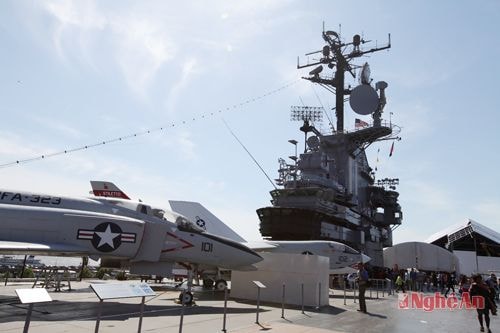 |
| Tham quan hàng không mẫu hạm |
Sau khi tham quan tượng Nữ thần Tự do, một trong những biểu tượng nổi tiếng nhất của Hoa Kỳ, chúng tôi tìm đến Bảo tàng ngoài trời, nơi trưng bày chiếc hàng không mẫu hạm Intrepid, tàu ngầm USS Growler mang số hiệu 577 có trang bị tên lửa hạt nhân và tàu con thoi Enterprise cao 17m, dài 41m, nặng 68 tấn, sau 30 năm làm sứ mệnh lịch sử trên không gian vũ trụ nay NASA quyết định đưa về đây phục vụ khách tham quan.
Tại đây, chúng tôi được vào bên trong tàu ngầm và chiếc hàng không mẫu hạm tham quan phòng radar, phòng điều khiển phóng ngư lôi, đài chỉ huy... Đi lên trên boong tàu chiếc hàng không mẫu hạm xem trưng bày 30 máy bay các loại, trong đó có nhiều chiếc đã trực tiếp tham gia ném bom phá hoại miền Bắc Việt Nam trong những năm 1965 đến 1972 của thế kỷ trước. Qua tài liệu cho biết các phương tiện trưng bày ở đây đều trực tiếp hoặc gián tiếp phục vụ chiến tranh ở Việt Nam.
Giờ đây chiến tranh đã lùi xa, quá khứ đã khép lại, quan hệ Việt Nam và Hoa Kỳ đã bình thường hóa được 20 năm, nhưng người dân Mỹ, đặc biệt là thế hệ trẻ Mỹ luôn nhắc nhở nhau rằng đừng bao giờ tham gia một cuộc chiến phi nghĩa. Tổng thống Mỹ Barack Obama ngày 28/5/2012 khi đến thăm “Bức tường chiến tranh Việt Nam" đã phát biểu: Mỹ không quên bài học từ cuộc chiến Việt Nam, cuộc chiến này là một trong những chương đau thương nhất trong lịch sử nước Mỹ.
Xuân Nhường


