
Sea crab farming - facing market challenges.
(Baonghean) - In areas where shrimp farming was inefficient, farmers in Quynh Luu have introduced commercial sea crab farming, bringing high economic efficiency.
The right choice
In the crab farming area of Hoi Ma, An Hoa commune, many households are concentrating their efforts on cleaning ponds to prepare for the next crab farming season. Directing workers in pond preparation, Mr. Nguyen Xuan Huong from Tan Thang village said: "After years of unsuccessful whiteleg shrimp farming, selecting and introducing sea crab species has proven highly effective." In August 2015, the District Agricultural Extension Station selected Mr. Huong's household as a pilot project for commercial sea crab farming. With a 4,000 m2 pond area, he received 100% support for the cost of the crablings. After 4 months of farming and care, the average yield was 2-3 crabs per kilogram.
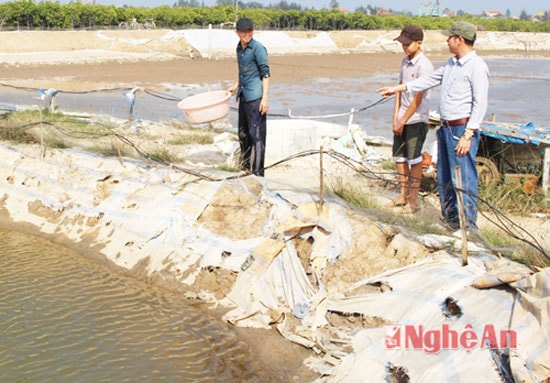 |
| This is the sea crab farming model of Mr. Hoang Van Thang in An Hoa, Quynh Luu. |
“Raising sea crabs isn't difficult, the profit isn't as high as shrimp farming, but it's safer, less prone to disease, and has a survival rate of 60%. In the last farming season, my family harvested nearly 1 ton of commercial crabs, and after deducting expenses, we earned a profit of 150 million VND per pond,” Mr. Huong said excitedly.
In An Hoa commune, 10 hectares of land previously used for shrimp farming have been converted to commercial crab farming. Mr. Nguyen Anh Hung, Head of the District Agricultural Extension Station, stated: “Sea crabs are not only easy to raise but also well-suited to various pond conditions and can be raised using different methods. In areas where sustainable shrimp farming is difficult or lacks the conditions and potential, commercial crab farming is a suitable choice. The economic efficiency has shown that this model is much more effective than other species such as grouper, snapper, and seaweed. In the future, the station will survey more ineffective shrimp farming areas to encourage farmers to switch to crab farming.”
Continue to remove obstacles.
Sea crab farming is a new and effective direction for farmers in Quynh Luu, but it still faces many difficulties. According to many sea crab farmers, the biggest challenge currently is finding a market for their products. Currently, the consumption of sea crabs is limited to small-scale seafood sales in small quantities, and cannot yet be sold on a large scale or exported like shrimp. Therefore, farmers can only harvest and sell at a minimal level.
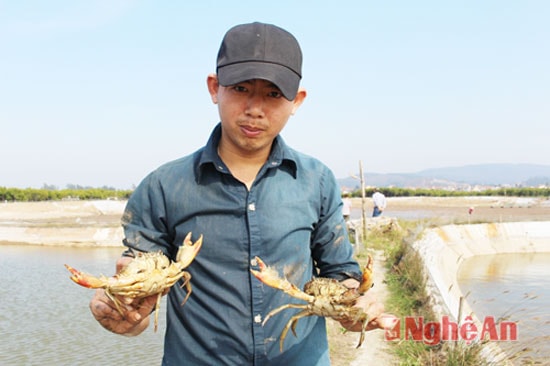 |
| Well-grown crabs can reach 3 crabs per kilogram. |
Another difficulty is that most crab farmers learn the science and techniques themselves to apply to the farming process, as the authorities have not provided professional training. Therefore, economic efficiency will be somewhat limited, and the likelihood of disease outbreaks will be high.
Mr. Nguyen Xuan Dinh, Head of the Agriculture and Rural Development Department of Quynh Luu District, said: "Currently, there are nearly 15 hectares of concentrated crab farming area in the communes of Quynh Luong, Son Hai, An Hoa, etc. Sea crabs are being raised by people as a replacement for whiteleg shrimp. In the future, we will advise the district to support and build a sustainable crab farming model, transferring scientific and technical knowledge. We will also link with a seed production facility in Quynh Luong commune to ensure branded, high-quality crab seeds to help farmers develop sea crab farming sustainably."
To raise crabs efficiently, proper pond preparation and technical procedures are essential. The initial stocking size should be at least 2cm/crab, and the optimal stocking density is 1 crab/m². The crabs' daily diet consists mainly of small fish, and the food must be completely fresh. The pond environment must be clean, free from leftover food that could pollute the water. Regular cleaning of the pond bottom is necessary to remove rotting food, and water changes should be performed according to the tides to maintain a clean environment, stimulate feeding, molting, and promote rapid growth and development. |
Viet Hung
| RELATED NEWS |
|---|


