
Raising pigs and chickens doesn't require cleaning the pens.
No need to clean manure or wash the pens, yet there are no foul odors or toxic gases, and the pigs and chickens grow quickly. This is the technology of raising pigs and chickens on biological bedding that is being applied in the Mekong Delta.
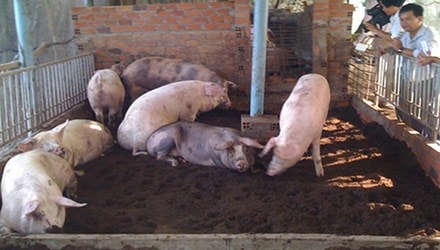 |
| Raising pigs on biological bedding in Tan Chau town, An Giang province. Photo: Thanh Hai |
Biological bedding is made from sawdust (70%) and rice husk (30%) mixed with Balasa N01 microbial preparation. Sawdust can be replaced with sugarcane bagasse. The biological bedding is spread on the earthen floor of the barn; if using an old cement floor, many large holes must be drilled for drainage. Pigs and chickens are introduced into the barn 2-3 days after the biological bedding is spread.
According to Mr. Hua Long Son, an official at the Tan Chau Town Agricultural Extension Station in An Giang province, raising pigs on biological bedding is best done with approximately one pig per 2 square meters. Mr. Son stated that raising pigs on biological bedding saves 60% of labor and 60-80% of electricity and water costs. Because the biological bedding contains beneficial microorganisms, the pigs' ability to digest food is significantly improved. The pork is also tastier compared to pigs raised on cement floors.
According to Mr. Lu Xuan Hoi, Director of the Agricultural Seed Center of Hau Giang province: “Compared to raising pigs on cement floors, pigs raised on biological bedding gain weight 19% faster and require 12% less feed. Total input costs are reduced by 13%.”
Mr. Nguyen Thanh Lam, residing in Hamlet 3, My Tan Commune (Cao Laanh City, Dong Thap Province), has been using biological bedding to raise chickens since 2010. He recounted: “Previously, raising chickens the traditional way without biological bedding required daily cleaning of chicken droppings and frequent replacement of the bedding material, yet it was still very smelly and attracted many flies. This affected my family's health and also impacted our neighbors.”
Since using the biological bedding, environmental problems have been solved, and economic efficiency has increased. According to Mr. Lam, chicken manure decomposes in the coop, reducing odor and mosquitoes. The two main diseases affecting chickens, digestive and respiratory diseases, have also significantly decreased. The bedding helps keep the chickens warm during the rainy season and cool during the dry season, resulting in cleaner chickens with smoother feathers, a 5% reduction in mortality rates, nearly a 10% reduction in feed costs, and faster growth.
According to the Dong Thap Provincial Center for Agricultural and Fisheries Extension, biological bedding contains beneficial microorganisms for livestock and poultry, thus inhibiting and eliminating harmful bacteria. The system of housing using this method is quite simple and requires less labor, allowing one worker to raise 800 pigs, significantly reducing breeding costs. After 2-4 years of use, the bedding can be replaced and used as fertilizer for crops due to its high nutrient content.
In Hau Giang province, there are currently 14 households raising chickens using biological bedding in Phung Hiep district and Vi Thanh city, each raising 250-400 chickens. The Hau Giang Provincial Agricultural and Fisheries Extension Center provides guidance, spreading a 10 cm thick layer of biological bedding, mixing 1 kg of Balasa N01 biological product to cover 30 m2 of the coop floor.
According to Tien Phong


