
Extensive farming of earthworms
Tylohynchus heterochaetus, also known as the "rươi" worm, belongs to the polychaete worm group and lives in the tidal flats of estuaries along the coast of Vietnam. Rươi is a protein-rich and nutritious food source.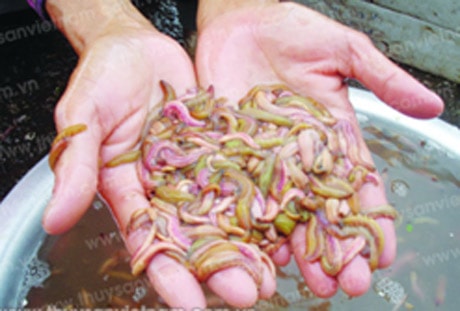
After 6 months, the worms can be harvested.
Choose a location
The ponds used for raising lugworms must be tidal flats or rice paddies with tidal water flowing in and out, and a salinity of 0-10‰.
The minimum area must be 500m2 or more, surrounded by a sturdy embankment, and must be 30-50cm higher than the highest water level in the lagoon.
The pond is located far from sources of pollution from residential areas or industrial zones.
Physicochemical conditions of the aquaculture pond
- Bottom substrate: The bottom mud in the lagoon must be sandy mud (mud accounts for 2/3, sand 1/3).
- Physicochemical factors in the lagoon: oxygen content >4mg/l; pH: 6.5 - 8.5; H2S <0.01mg>
Renovating fish ponds
- This is a crucial factor determining the productivity of the mudworms. Pond renovation should be done at two times before the mudworm breeding season (March and September). Renovating the pond should be done during low tide to avoid turbid water from flowing out, carrying away organic matter (the mudworms' food).
- Drain the pond, catch and eliminate all predators of the lugworm such as fish, shrimp, crabs, and crayfish.
- The pond should be leveled and sloped towards the drain to ensure proper water drainage. A system of small ditches should be designed within the pond to facilitate water supply and drainage. The soil in the pond should be thoroughly plowed and tilled.
- Clear the surrounding bushes and remove excess weeds at the bottom of the pond (sedges, rushes).
- Construction of water supply and drainage canals: The water supply and drainage canals are responsible for supplying and draining water from the lagoon, and also serve as a place for natural breeding and harvesting of mudworms.
For areas smaller than 2,000m2, use round cement pipes with a diameter of 0.5m; for larger areas, square pipes with sluice gates can be constructed to open and close the culverts.
- Check the pH of the pond using litmus paper. If the pH is <6, add more agricultural lime (Ca(OH)2) at a dosage of 7-10%.
- Add composted manure or straw at a rate of 5-6 kg/100m2 to supplement the food source for the worms. Lime and manure should be evenly spread and mixed into the bottom substrate using a mixing machine.
- Creating a habitat for lugworms: After the pond is renovated, some types of soft-stemmed grasses or rice can be planted to create a habitat for lugworms and reduce water temperature on sunny days.
Natural breeding techniques
This is a crucial step in the mudworm farming process, as it determines the productivity of the pond.
When mature, the lugworms migrate from the tidal flats to the estuary with the tides to reproduce. The fertilized eggs develop into larvae that return to the tidal flats with the tides to grow and develop, creating a new life cycle.
Best time to collect the seeds: during the high tide periods of April-May and September-December in the lunar calendar.
Procedure: Open the sluice gate to let water into the pond; the lugworm larvae will follow the water in and burrow into the surface mud at the bottom to live. After the tide recedes for 4-6 hours, drain the water out, always maintaining a water level of 30-40cm in the pond.
This natural breeding process must be carried out throughout the lugworm's breeding season.
Care and management
After collecting the larvae for one month, use a fine-mesh net to sift through the mud on the surface of the pond bottom. You will see the larvae resembling red threads, with a density of 150 individuals/m2 or more, which is considered satisfactory.
During subsequent tides, water must be drawn into and drained from the pond to provide additional food sources for the worms (silt and algae in the water). When drawing in and draining water, nets should be used to prevent predators from entering the pond. On dark days, use lamps to walk around the pond's edge to catch predators that harm the worms.
No chemicals of any kind should be used in the process of raising earthworms. Limit water intake into the pond during periods when polluted water is discharged into the river and during periods of heavy pesticide spraying in the surrounding rice fields.
Harvest
After breeding and raising the worms in the pond for 6 months, they mature and can be harvested. Before the high tide, you can dig the soil under the pond to check the density and maturity of the worms.
Mature lugworms, preparing to reproduce, have females that are light green and males that are milky white. They are larger than normal lugworms, and their bodies are full of reproductive organs, making them very fragile.
During high tide, fill the pond with water. Mature lugworms, stimulated by the tide, will rise to the surface, swim out to the drain to migrate and reproduce, get caught in bottom nets (1-3mm mesh) at the drain opening, and when the water is released, the lugworms will follow the water into the nets. Gently lift the net bags and empty the lugworms into basins for sale or transfer them to refrigerated styrofoam trays to preserve them alive for 5-7 days and allow for long-distance transportation.
According to (Vietnam Fisheries) - LC


