
Pù Quặc "Oasis"
(Baonghean) - Pu Quac 2 - the very name evokes a sense of remoteness, isolation, and something mysterious and enchanting. This remote hamlet in the border commune of Na Ngoi (Ky Son district) is home to more than 50 Mong households, isolated from other villages, leading some to liken it to an "oasis high in the mountains"...
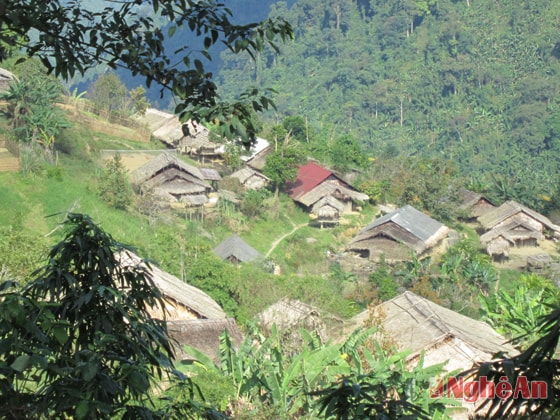 |
| A view of Pù Quặc 2 village. |
There are two routes to Pù Quặc 2. The first starts from Pù Khả village, the center of Na Ngoi commune, following a rugged and treacherous mountain trail, taking about two hours by motorbike. The second starts from Mường Xén town, heading south along National Highway 7A to Khe Nằn village (Chiêu Lưu), then turning onto a trail that leads up to the mountaintop, a path "opened" by the people of Pù Quặc to reach the district center. This route is equally treacherous and also takes about two hours by motorbike. I chose the second route, as it offers some advantages. After showing me the way, an elderly man from Khe Nằn village warned: "It's less than 20 kilometers from here to Pù Quặc 2, but the road is very difficult; I'm afraid you might not be familiar with it..."
It's safe to say that the road to Pù Quặc 2 is typical of the roads leading to remote villages in the high-altitude, border districts. It's narrow, inaccessible, and steep, bordered by mountains and ravines, often shrouded in fog and slippery. After only a short while, my motorbike, accustomed to the long journey, started skidding, the rear wheel spinning wildly like a windmill and emitting a burning smell. This was because Kỳ Sơn was in its dry season, with very little rain, but it was also the time of year when the fog was thick. The fog swept through the valleys and mountain peaks, condensing into droplets like rain scattered across the villages and forests. These droplets fell on the road, forming puddles, then small streams that flowed out, making the road wet, muddy, and slippery.
The higher we climbed, the thicker the fog became, obscuring visibility, and the cold seeped into our skin. Luckily, I only encountered people walking down the mountain; no motorbikes coming from the opposite direction, otherwise it would have been very difficult to handle a potential collision. Having traveled on mountain roads for many years, I've learned that to avoid falling off a motorbike, you need to ride on all fours. This means your two feet must always be firmly planted on the ground; otherwise, you'll easily lose balance due to the slippery and bumpy road. On the way to Pù Quặc 2, I came across a Win 100 motorbike parked by the roadside, its front wheel tied to the seat. Perhaps due to a tire problem and a lack of tools for repair, the owner had to abandon the bike midway. It's likely the motorbike had been parked there for months, as many parts were rusted. At this point, I understood why the old man in Khe Nằn said this road was "extremely treacherous."
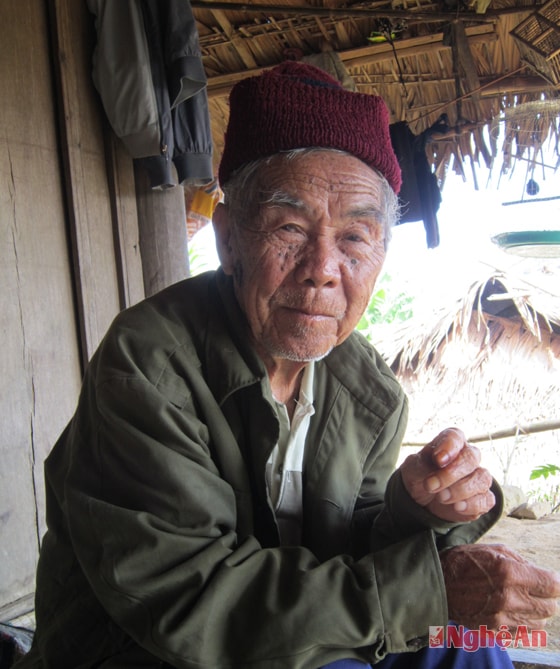 |
| "The old master craftsman" Ha Da Sy. |
My purpose in going to Pù Quặc 2 was to meet Mr. Hạ Đa Sỹ, a famous mouth organ player. I'd heard about him for a long time in Kỳ Sơn; he was over 100 years old, yet still healthy and continued to play the mouth organ as usual. I believed it was true, so today, no matter how difficult the journey, I had to meet him to learn more about this elderly mouth organ player. Upon arriving at Pù Quặc 2, the first thing I did was ask for directions to Mr. Hạ Đa Sỹ's house. The locals enthusiastically guided me. Like the more than 50 houses on this mountaintop, Mr. Đa Sỹ's house was very low, roofed with corrugated iron, with wooden walls. The cold mist seeped through the cracks in the door. He was home alone, sitting by the blazing fire, his eyes half-closed, his face full of wrinkles, his hair white, and wearing a loose cloak.
Although his eyesight and hearing were failing, he still knew that visitors had arrived, and they were strangers, not from Pù Quặc. Sitting opposite Mr. Hạ Đa Sỹ, in the bright firelight, I noticed that his face and appearance suggested he was probably not yet over 100, perhaps even less than 90. I asked, "Have you reached 100 yet?" He replied, "Not yet, still a dozen or so years away, I'm only 83 now!" I asked again, "I heard you make and play the mouth organ very well, can you still make and play it now?" Old Man Đa Sỹ answered, "That was in the past, now I'm old, my eyesight isn't as good, my hands aren't steady enough to make it, and my breath isn't strong enough to play it anymore."
Then he recounted his youth, starting from Deputy Head of the Commune Police to Secretary of the Party Committee of Tay Son Commune. His time was very difficult, especially with criminals often infiltrating the area to incite people to do bad things or relocate. On one hand, he had to spread propaganda and persuade the people to stay and work peacefully in their villages. On the other hand, he had to mobilize people to go into the forest to drive the criminals out of the area. Then there were the trips with the commune and district working groups to persuade the Mong people to eradicate opium cultivation. Some listened immediately, but others were "stubborn," holding flintlock guns and standing at the edge of the fields, challenging him. In such situations, Officer Ha Da Sy had to approach, persuade, and convince them skillfully to prevent any unfortunate incidents. He showed enthusiasm when talking about the Mong flutes he had made himself.
In his youth, he played the bamboo flute beautifully and danced with it gracefully. Girls, whether working in the fields or carrying water down from the mountain, would stop what they were doing and walk at the sound of his flute. Every girl wanted Da Sy to play the flute for them to sing the traditional folk songs, and hoped to be asked to marry him. This young man from the mountains was not only skilled at playing the flute, but also handsome, strong, and a government official. With his talent for making, playing, and dancing with the flute, Ha Da Sy once thought about passing on his skills to future generations. However, partly due to his busy schedule and partly because he hadn't found a worthy successor, old age caught up with him, preventing him from fulfilling his intention. Now, sitting by the fire all day, he cannot help but feel longing and regret—regret for not having had the chance to pass on the secrets of crafting and using his ancestral musical instrument to future generations.
Both the Party Secretary and the village head had gone into the forest early in the morning, so I stopped by the house of Mr. Ha Tho Nenh, a man quite knowledgeable about the village. Mr. Tho Nenh, over 50 years old, short and stout, with a bald head, was quite talkative. He provided basic information about Pu Quac 2: it has over 50 households, has experienced periods of spontaneous migration, and its livelihood mainly depends on slash-and-burn agriculture and raising buffalo and cattle. Some households own more than 20 buffalo and cattle, worth hundreds of millions of dong. However, Pu Quac 2 is still struggling and lacking resources because it is far from the center, the roads are rough and difficult, it is almost isolated during the rainy season, there is no electricity grid, the phone signal is intermittent, and during the dry season there is often a shortage of clean water...
Mr. Ha Tho Nenh further explained that in the Pu Quac region, cypress trees are very rare, so the Mong people there don't roof their houses with cypress wood planks, but mainly with thatch. Recently, thatch has been replaced with corrugated cement. Mr. Tho Nenh also revealed that he has two wives and eight children. His first wife only gave birth to daughters, so he had to find another wife to have a son. Both wives live with him under one roof, in separate rooms, working together every day to build a life. It turns out that on the cloud-covered peak of Pu Quac, there are still customs and ways of life far different from the outside world, perhaps this is also one reason why people call it an "oasis".
Leaving Mr. Ha Tho Nenh's house, we went to the primary school. This is probably the only building in Pu Quac 2 made of cement and bricks. The morning classes were over, and the teachers were preparing lunch. Three teachers from three different regions in the lowlands came to Pu Quac 2 to "plant the seeds of knowledge": Ms. Nguyen Thi Nhung (1980) from Thanh Chuong, Mr. Le Van Cong (1988) from Hung Nguyen, and Mr. Ho Ngoc Hoa (1991) from Do Luong. The young teacher, Mr. Ho Ngoc Hoa, who had only been working in Ky Son for less than four months, showed me the scars on his legs.
Those were the marks of several falls, due to unfamiliarity with the terrain and lack of experience when he first started. One fall even broke his laptop screen, costing him 4 million dong to replace. Then, Mr. Hoa recounted an incident on a slope during a rainstorm, where the road was so slippery it was almost impossible to go down. He came up with a unique "solution": he turned off the engine, deliberately laid the motorbike down, and pushed it down the slope. Because the road was slippery, the motorbike "rolled" all the way to the bottom. He got off, helped the motorbike stand up, and then started the engine to continue his journey.
Towards the end of the afternoon, when the road had dried and was a little less slippery, I decided to descend the mountain to return to Muong Xen. The winding road stretched endlessly along the mountainside towards the banks of the Nam Mo River. On the way back, I met people carrying equipment who were surveying and measuring the road. They said they were building a project to upgrade the Khe Nhan - Pu Quac 2 road so that life on that misty mountaintop would no longer be an "isolated island".
Cong Kien


