
The young boss of Cua land
One day at the end of the year, sitting in the house of Dang Xuan Sy, a house with a modern and imposing architecture, one of the largest in "Cua" commune, Nghia Hoan district (Tan Ky), I listened as he recounted the ups and downs during his 17 years of nurturing his dream of becoming a business owner.
The term "hired driver"
When I first met Sy, he seemed worldly, quick-witted, and spoke decisively. His square face occasionally broke into a bright smile, easily winning people's hearts. Born in 1974 into a quintessential farming family in the land famous for its "Cừa tiles," Dang Xuan Sy graduated from high school and then passed the entrance exam to Nghe An Teacher Training College (in 1992). For other young people, receiving an acceptance letter was a lifelong dream. But for Sy, it was a source of worry and careful consideration at this crucial juncture in his life.
To be honest, it wasn't that Sy disliked teaching, but the teacher's salary at the time wasn't enough to make ends meet! So Sy decided to pursue a different career: learning to drive. His parents knew about it and urged him to continue teaching, but he insisted on following his passion, even though it was hard work and sometimes dangerous. In 1993, Sy started working as a hired driver, transporting goods to Hanoi, Saigon, and other places. Sy confided: "Driving here and there was interesting. At that time, driving was a lucrative profession; truck owners were doing well and paid well. That's why, every time I lay thinking about it, the dream of getting rich kept urging me on."
"Traveling far and wide teaches you a lot," and Sỹ learned a great deal about the transportation business. Quickly adapting to the development of the market economy, he discussed with his parents the idea of buying a truck to start his own business. At that time, his father, who was in the brick and tile manufacturing business, also needed a means of transporting his products. In 1995, his parents pooled their capital and borrowed more money to buy a truck, entrusting it to Sỹ. Every day, Sỹ transported bricks and tiles to various locations within the province and neighboring provinces for sale. As "Cừa tiles" gained a reputation in the market, consumers came directly to his workshop to place orders, and all the products were sold as soon as they were produced. He was one of the people who contributed to building the "Cừa tiles" brand later on.
...to the boss
In 1996, Dang Xuan Sy got married, and his parents built them a small house to live in separately. Sy spent another four years driving, accumulating some capital with the dream of building a tile manufacturing facility. At that time, building a tile factory required at least 200 million dong, a huge sum for a young couple. In 2001, with the support of his parents and the encouragement of friends, including a quote from a driving instructor that Sy remembers vividly: "There's no place as good as your hometown, blessed with excellent clay deposits for brick and tile production. If people know how to invest, it's easy to get rich." So, Sy decided to switch to the Cua tile manufacturing business at the beginning of 2001.
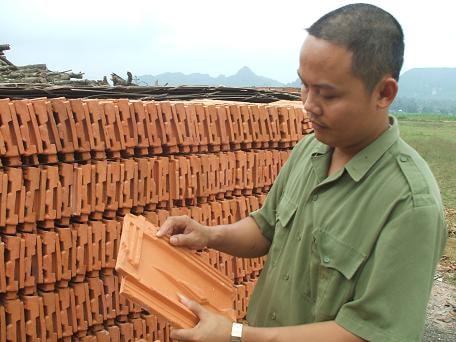 |
Dang Xuan Sy introduces his roof tile product with the unique code SP. |
Compared to the Cua Tile-Making Village Production and Service Cooperative, Sy and his wife were the latest members to join, so the cooperative allocated them the outermost, less advantageous plot of land. Ironically, just as their tile-making facility produced its second batch, prices plummeted, and they couldn't even cover their expenses, leaving Sy and his wife penniless from a fortune of hundreds of millions of dong. Sy laughed, realizing that his dream of getting rich in his hometown had vanished. Many times, the couple discussed leaving their village to work abroad. Knowing Sy's intentions, his parents and siblings strongly opposed it, constantly encouraging him, saying, "In business, ups and downs are normal," and that he should stick with his craft, hoping for a better year.
Following his father's advice, Sy and his wife decided to borrow more capital to invest heavily in tile production. Unexpectedly, in 2002, Cua tiles fetched a good price, and Sy and his wife made a fortune, paying off all the debts incurred from the previous year's losses. Their business prospered, and by the end of 2004, they opened another tile production facility, and in 2006, they added a brick production facility.
Thus, at this point, Sy and his wife own three brick and tile production facilities in Cua. Each year, their facilities produce 400,000 to 450,000 tiles and over 1 million bricks. In addition, Sy and his wife have invested in an excavator and a transport vehicle for their business. Including all three production facilities, their total business assets currently exceed 3 billion VND. They provide regular employment for 25 workers and approximately 40 seasonal workers. Each year, the young business owner earns a profit of 500-600 million VND, contributing around 40 million VND to the state budget annually.
Sitting in the luxury car that Sy and his wife had just bought for over a billion dong, they arrived at his brick and tile factory and saw dozens of workers busily operating on the assembly line. Each person had a specific task, serving two machines: a clay grinding machine and a tile pressing machine. Sy explained: "Although we're using manual machines, to ensure the products are beautiful, we have to find highly skilled workers from as far away as Thanh Hoa and Ha Tay (Hanoi). Therefore, most of the technical work here is done by people from the North; they work enthusiastically and with a high sense of responsibility." Nguyen Van Thanh, the team leader of the tile production team, is small in stature but muscular, with a dark complexion. He said, "I'm from Thanh Hoa, and I've been working here for Sy and his wife for four years. This job is quite hard, and as the team leader, I have to know how to arrange work for each person efficiently to increase productivity. Sy pays us 3 million dong a month, and at the end of the year, the boss even sends gifts home for our families to celebrate Tet and pays for our transportation, so everyone feels secure in their work."
|
|
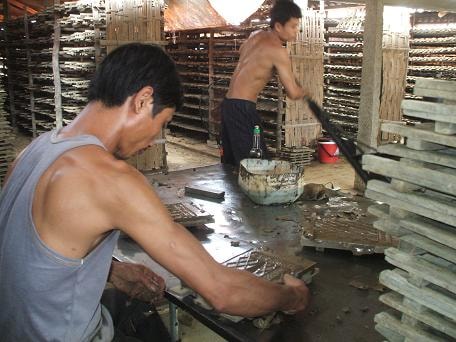
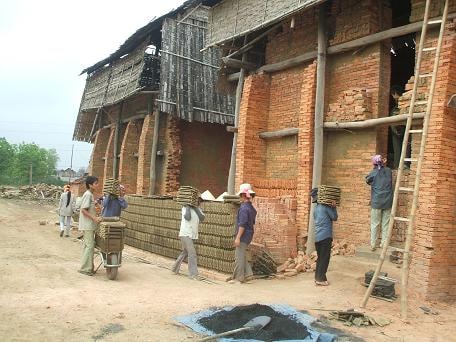
When loading and unloading bricks from the kiln, he has to hire 30 freelance workers, spending 70-80 million VND per month on their salaries. At the end of the year, Cừa tiles are in high demand, so he has to ensure the machinery runs smoothly and motivate the workers to meet customer needs. Sỹ's tiles have a unique designation; besides the common "Cừa tiles" of the craft village cooperative, the other side of each tile is printed with "SP" (the unique designation of Sỹ and his wife, Phương). Previously, the sheds used for drying unbaked tiles were thatched or made of corrugated cement sheets, which was labor-intensive and often unreliable. Now, they've invested in replacing the sheets with translucent plastic. When it rains, they don't need to cover the tiles as before, and the translucent plastic sheets allow sunlight to pass through, eliminating the need to turn the tiles over, resulting in faster drying and saving time. Currently, the cooperative is building tile kilns using the "tall chimney" model to reduce environmental pollution, so all members will collectively invest in building kilns according to this model.
After more than ten years in business, what has Sy learned? After a moment of silence, Sy said: "The most fundamental thing is that whatever profession you pursue, you must thoroughly understand the product you are making. To make my 'Cua tiles' increasingly beautiful and high-quality, I have traveled to Quang Ninh, Hai Phong, and Binh Duong many times to learn their methods, especially the kiln firing techniques and how to use fuel to ensure the tiles have a beautiful color and don't crack. If you use fuel containing oil, such as pine or rubber wood, without knowing the proper method, the tiles will 'spark'. Therefore, I always directly supervise the kiln firing process."
Currently, Sy is investing in building a farm on 4 acres of land he recently leased from the commune. This area was originally a pond where the Cua Tile-Making Village Cooperative had excavated land for production. Sy has invested in excavating the land, building embankments, and creating ponds for fish farming. Sy's plan is to hire more laborers in 2011 to raise fish and create a place for relaxation.
Mr. Ha Van Bien, Vice Chairman of the People's Committee of Nghia Hoan commune, commented: "Sy is a sharp young man who knows how to seize opportunities to assert himself in society. Compared to many young 'millionaires' in Nghia Hoan, Sy is a prime example. In recognition of his achievements, over the years, he has been selected by the commune's Youth Union to report on his achievements in the 'Studying and Following the Moral Example of Ho Chi Minh' youth movement at the district level; the Provincial People's Committee awarded him a Certificate of Merit for his achievements in the emulation movement of excellent labor, production, and business in the period 2006-2010; the Central Farmers' Association also awarded him a Certificate of Merit for outstanding achievements in the emulation movement in the period 2005-2010; and most recently, he was honored to receive a Certificate of Merit from the Prime Minister."
Xuan Hoang



;)