
Mr. Dinh La Thang: Even selling my house would only get me a small portion of the compensation.
"Even if we sold the apartment we're living in, we'd only get a small fraction of the compensation we'd have to pay. I'm willing to work with my family to resolve this once the court rules in our favor."
For the crime of intentionally violating regulations in the case involving the Vietnam National Petroleum Corporation (PVN) and the Vietnam Oil and Gas Construction Corporation (PVC) related to the Thai Binh 2 Thermal Power Plant project, defendant Dinh La Thang was sentenced by the first-instance court to 13 years in prison and ordered to pay 30 billion VND in compensation.
In this afternoon's appeal hearing (May 9th), defendant Dinh La Thang affirmed that he maintains his appeal regarding the assessment of his charges and civil liability, arguing that the lower court's assessment did not accurately reflect the scope of his responsibility.
|
| Defendant Dinh La Thang: I feel deeply saddened by what happened, so I cannot write about my achievements to ask for a reduced sentence. |
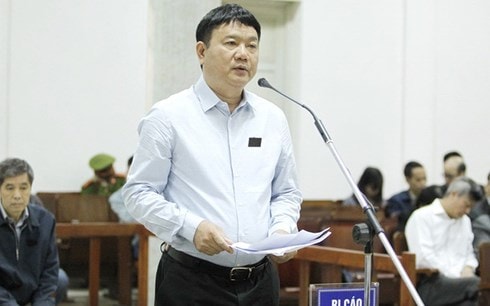
In response to the prosecutor's question about whether he was appealing for a reduced sentence or claiming innocence, defendant Dinh La Thang did not assert his innocence or wrongdoing, but maintained that he did not commit the crime of intentionally acting against the law. Mr. Thang stated that he lacked responsibility and accepted responsibility as the head of the organization.
"I am at fault and irresponsible, and I hope the court will consider my case objectively. Neither I nor the group's leaders ever knew something was wrong and still did it; we never intentionally acted illegally for personal gain, but always for the purpose of building and developing the group," said Mr. Dinh La Thang.
When asked about mitigating circumstances, defendant Dinh La Thang stated that he did not disclose his personal achievements because he felt distressed and uneasy about the incident occurring in the unit he headed.
"Over the past few nights, I haven't been able to sleep within these four walls. I can't bring myself to write down my achievements to ask for a reduced sentence, but I still ask the panel of judges to consider my case," Mr. Thang replied.
Citing mitigating circumstances, including voluntary compensation, the representative of the Procuratorate noted that at this time, defendant Dinh La Thang and his family have not yet rectified the civil aspects of the case, while the appeal hearing for the case involving the loss of 800 billion VND in capital investment in Oceanbank is also about to take place and is related to the defendant.
However, defendant Dinh La Thang once again emphasized his request for the appellate court to reconsider the basis for calculating the value of the damages and the scope of responsibility and authority of the Chairman of the Board of Directors in causing the damages.
"I accept responsibility, but only within my authority and responsibilities. I own an apartment, and even if I sold it, I would only get a small fraction of the compensation I have to pay. When the higher court rules correctly, I and my family will do our best to mitigate the consequences," defendant Dinh La Thang replied to the representative of the Procuratorate.
Also at today's trial, citing the conclusions of the meeting on March 31, 2011, chaired by Mr. Dinh La Thang, which stated that PVC was being selected as the general contractor for the first time, the panel of judges asked on what basis PVC was deemed to have experience as a general contractor for the selection. In response, defendant Dinh La Thang stated that, after assessment, PVC was deemed to have sufficient capacity and experience, having completed many large projects. Based on the assessment and proposal, the General Director reported to the Board of Directors for approval, allowing PVC to be the general contractor for the Thai Binh 2 Thermal Power Plant project.
Following the defendant's testimony that he was unaware of the errors in EPC contract 33, the panel of judges questioned: "This contract is very important for a key national project, yet you didn't know its contents?" In response, Mr. Dinh La Thang stated that it was the responsibility of the investor; if even the General Director didn't know, then the Board of Directors wouldn't either. He added that when the investor was transferred to PVN, he wasn't allowed to review contract 4194 because the General Director signed it and was responsible for it.


