
2014 Cars: Don't even dream of price reductions, despite the overwhelming demand.
With imported cars seeing price reductions, domestic car manufacturers must also lower their prices to compete. Currently, domestic car companies are still making high profits; without price cuts, they will struggle to survive.
Will cars imported from ASEAN countries dominate the market?
From January 1, 2014, import tax rates on completely assembled cars from the ASEAN region into Vietnam were reduced to 50%. However, the prices of imported cars from the region to Vietnam have not decreased. For example, the prices of two small car models, the Toyota Yaris and Mitsubishi Mirage, remain the same as in 2013.
Discussing this issue, businesses stated that most imported car models from ASEAN that have not yet seen price reductions are inventory from 2013. New imported cars have not yet arrived, with some models awaiting the release of the 2014 version, thus delaying import. They believe that prices will certainly decrease in the future when more imported cars arrive.
According to business calculations, simply reducing the import tax rate on completely assembled vehicles to 50% would allow many imported models to compete on equal footing with domestically assembled vehicles.
Meanwhile, Yoshihisa Maruta, General Director of Toyota Vietnam, stated that domestically assembled cars could not be discounted in 2014 because the factors necessary for price reductions were absent.
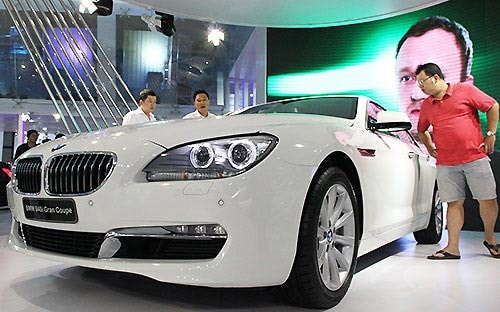 |
| More foreign car brands will continue to enter the Vietnamese market through the import and distribution of fully assembled vehicles. |
.
This has led many to worry that domestic car manufacturers will face difficulties against imported vehicles. Even in 2013, imported cars were considered to have prevailed over domestic cars, despite high import taxes on completely built vehicles and the lingering gloom in the automotive market. Specifically, while the Vietnamese automotive market grew by 19% in 2013 compared to 2012, domestic car sales increased by only 18%, while imported car sales increased by 23%.
The Vietnam Automobile Manufacturers Association (VAMA) forecast for the Vietnamese automobile market in 2014 remains extremely pessimistic, with a low growth rate of around 9% and total sales of 120,000 vehicles of all types, including domestically assembled and imported vehicles.
The reduction in import tax rates on completely built vehicles is causing many businesses to worry about the fate of domestically manufactured and assembled vehicles, similar to what happened with pickup trucks previously. In 2012, when Vietnam reduced the tax on pickup trucks originating from ASEAN countries to 15%, all domestic assemblers of this type of vehicle ceased operations for an extended period and switched to importing completely built vehicles from Thailand.
According to forecasts by the European Chamber of Commerce in Vietnam (EuroCham), the domestic automotive assembly industry is likely to achieve only 3% annual growth from 2014-2018 due to increasingly fierce competition from imported vehicles from ASEAN countries and countries that are members of the Economic Cooperation Agreement such as Japan, South Korea, and China.
In 2013, a number of new car brands officially opened dealerships for imported vehicles in Vietnam, including Rolls-Royce, Bentley, Lexus, Infiniti, MG Car, and many more. In addition, many new imported models were also brought in by domestic manufacturers and assemblers.
In 2014, many more foreign car brands will continue to enter the Vietnamese market through the import and distribution of completely built vehicles.
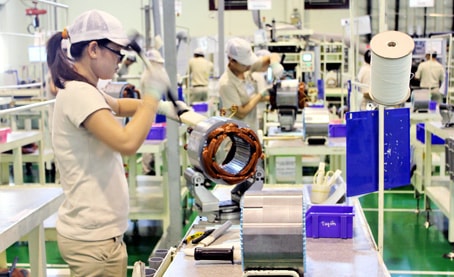 |
| The underdeveloped supporting industries in Vietnam are one of the reasons why the automotive industry is lagging behind. |
In fact, the cost of producing cars in Vietnam is about 20% higher than in the ASEAN region because most assembly lines operate at less than 50% capacity and incur high costs.
However, some argue that domestically produced cars could compete with imported cars if prices were significantly reduced. According to Mr. Bui Ngoc Huyen, General Director of Xuan Kien Automobile Joint Stock Company, most foreign-invested automobile companies in Vietnam are well-known names worldwide. As major brands, their brand value is considered quite high. Customers typically pay around 10% of the car's selling price for the brand value.
Furthermore, for major brands, spare parts are also priced very high, 1.5 to 3 times higher than normal. Mr. Huyen gave an example: a set of 16-inch cast aluminum alloy rims for 195-size tires imported from China to Vietnam costs 600,000 VND/piece, while ordering them from a Japanese FDI company that manufactures them in Vietnam costs 800,000 VND/piece. Yet, major car brands are selling them for 3 million VND/piece.
Many other spare parts are also in a similar situation, and it must be said that they are making high profits. If FDI enterprises are willing to lower domestic car prices and focus on a few models to increase production, along with limiting the import of completely built vehicles for distribution, then domestic cars can still compete well with imported cars, Mr. Huyen commented.
However, according to forecasts, a downward trend in prices for domestically produced cars in 2014 is unavoidable, as the economy remains difficult and purchasing power is weak, forcing price reductions to stimulate consumer demand. Furthermore, price cuts are necessary to compete with new imported models. In addition, many domestic assembly companies significantly reduce the prices of older models before launching newer ones.
Many people hope that lower car prices, along with reduced registration fees, will make the 2014 automotive market more vibrant, contrary to overly pessimistic forecasts.
According to vietnamnet


