
Cars made in Vietnam: Who makes them, and with whom?
Many goals and ambitions have been set for Vietnam's automotive industry, but who will implement them remains unclear, and time is running out. Everyone is still waiting for specific and clear policies.
Time is running out, and we still have to wait.
The strategy and development plan for Vietnam's automotive industry for the next 10 and 20 years was approved by the Prime Minister in late July and early August 2014.
Many goals and ambitions have been set for Vietnam's automotive industry, but the question remains: who will take on this responsibility? To date, there is no clear answer. Certainly, the development of the automotive industry must rely on businesses, but these businesses themselves are struggling and unsure how to proceed.
A number of well-known FDI automotive companies with strong financial resources, powerful brands, technological know-how, and sufficient production capacity have stated that they have not yet decided whether to invest in automobile manufacturing in Vietnam. They are all awaiting specific policies from the government.
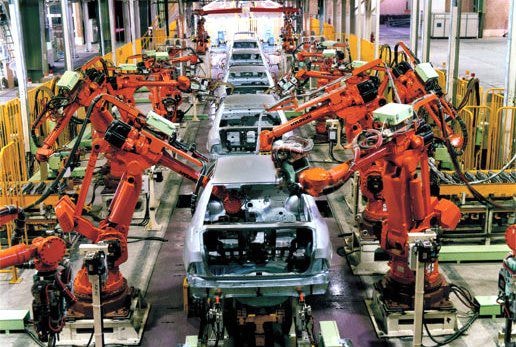 |
| Many automotive manufacturing projects are currently on hold, awaiting more specific policies. |
With 100% domestic capital, Xuan Kien Automobile Joint Stock Company (Vinaxuki) has invested heavily in automobile production in recent years, from mold making, stamping of body parts, plasma cutting equipment, welding, and modern painting... producing various types of car frames, including passenger cars with fewer than 9 seats, with a localization rate of over 40%. However, this company is facing difficulties due to a lack of capital and has not been able to bring any noteworthy car models to the market, including trucks, and is having to sell scrap metal to pay employee salaries.
Besides trucks and buses, Truong Hai Group also assembles a range of passenger car brands such as Mazda, Kia, Peugeot, etc. In addition to its modern vehicle assembly lines, Truong Hai has invested in the production of some components, but mainly simple products such as windshields, seats, and front bumpers.
This company's most prominent project was the production of engines using technology transferred from the South Korean Hyundai Group, but it ended in early 2014. The reason: the committed technology transfer period had expired, and the factory had not yet been built. A new automotive engine production project is currently under negotiation with Hyundai, with hopes of restarting in 2016 and producing Euro 4 standard engines instead of the previous Euro 2. However, success depends on Hyundai's approval, and nothing is certain yet.
Hyundai Thanh Cong has just completed the first phase of its automobile factory investment, totaling $80 million, including an automated vehicle frame welding line with a capacity of 40,000 vehicles per year. Hyundai Thanh Cong announced plans to proceed with the second phase, which will include a body stamping workshop and the production of some electronic components, using technology transferred from Hyundai Korea. The goal is to achieve a 40% localization rate, thus benefiting from preferential treatment when exporting vehicles to Southeast Asian countries. However, the body stamping project requires significant capital investment and a large production volume; otherwise, it will be difficult to succeed, and the start date remains unclear.
Mazda, a foreign investor, also plans to establish a joint venture with Truong Hai to invest in an automobile manufacturing plant with a localization rate of 40% by 2018, but is still awaiting specific policies from the Government.
While FDI enterprises are not making clear decisions, domestic enterprises face many problems such as lack of capital, technology, experience, and weak brands, while automobile production requires large investments in research and development, prototyping, etc., and time cannot wait.
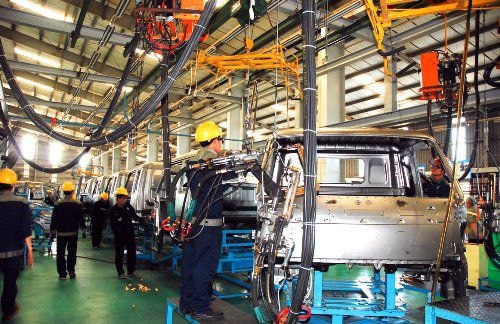 |
| Vietnam's automotive industry: When will this dream become a reality? |
The opportunity is gone.
According to the Ministry of Industry and Trade, there will be no further amendments to the special consumption tax policy for automobiles, as the Law amending and supplementing several articles of the Law on Special Consumption Tax has just been passed by the National Assembly and will take effect from January 1, 2016. Every three years, the Government will review and issue a roadmap for reducing the special consumption tax on this item. Previously, at a Government meeting, the Ministries also agreed to maintain the current roadmap for automobile import tax as committed under the AFTA accession agreement.
Specifically, in 2015, the import tax rate on completely assembled cars from the ASEAN region to Vietnam remained at 50%, decreasing to 40% in 2016, 30% in 2017, and finally to 0% in 2018.
According to the general assessment of experts, the advantage will belong to completely imported vehicles, due to the sharp reduction in import tax rates and the fact that imported vehicles also enjoy the same special consumption tax rate as domestically produced vehicles. Therefore, Vietnamese automobile businesses are at risk of not surviving in the near future.
Mr. Duong Dinh Giam, Director of the Institute of Industrial Strategy and Policy (Ministry of Industry and Trade), said: “When developing the Automotive Strategy and Planning, we expected that policies – specifically the special consumption tax – would be reduced and implemented from the beginning of 2015. This would allow the automotive market to rapidly expand and give businesses time to increase production, thereby boosting domestic investment. However, with this revised special consumption tax law, no further amendments are permitted; waiting three years is too slow.”
Businesses hope that authorities will erect technical barriers to protect domestically produced cars. However, an engineer from Toyota Vietnam argues that this is ineffective because car-exporting countries in the region have higher technical capabilities than Vietnam, making it difficult to implement. Other barriers, such as tightening import vehicle inspections, limiting imports to only two seaports, and requiring dealers selling imported cars to deposit funds, only create difficulties and cannot prevent imports, as domestically produced cars are 20% more expensive than imported cars.
The goal of automotive industry development is to boost and increase the localization rate. To achieve this, supporting industries must be developed. Conversely, to develop supporting industries, it is first necessary to maintain the existence of automotive assembly enterprises. Without assembly, there can be no component production. If automotive enterprises cease to exist, the automotive industry will also decline.
According to Vietnamnet


