
Thai cars enter the top 10, Vietnam awaits policy changes.
Thailand's automotive industry is aiming to be among the world's top 10, while Vietnam is still debating and unable to enact a development policy.
According to several sources, the German automotive group Volkswagen is undertaking a major investment plan in Southeast Asia. Recently, Volkswagen submitted an application to build a car manufacturing plant in Thailand, under a government support program.
Investors are leaving Vietnam.
Thailand has a tax exemption program for automotive manufacturers that invest $200 million or more and achieve a production output of 100,000 vehicles after four years of official production operations starting in 2019. Therefore, it is highly likely that Volkswagen will invest more than $200 million to qualify for the tax exemption.
Volkswagen's "eastward" strategy has been in preparation for a long time. In 2008, Volkswagen revealed that Vietnam would be one of the Southeast Asian countries targeted for establishing a "base of operations." However, to date, there has been no sign of this becoming a reality.
According to Mr. Bui Ngoc Huyen, General Director of Vinaxuki, until 2010, representatives from Volkswagen Asia visited and worked with Vinaxuki to explore investment in automobile production in Vietnam. But now they have stopped too.
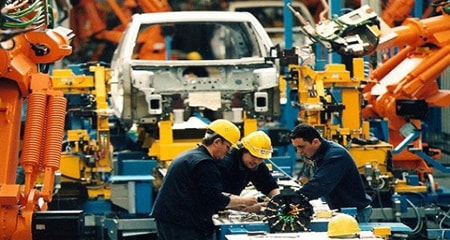 |
| While Thailand's automotive industry is aiming to be among the world's top 10, Vietnam is still debating and unable to enact a development policy. |
Perhaps Volkswagen has already moved its "base" to Indonesia, because in August 2013, the Indonesian Minister of Industry confirmed that Volkswagen would complete its car manufacturing plant in the country by 2017 with an investment of up to $260 million.
While major automotive corporations have no intention of investing in Vietnam, a large project that had just begun has been halted. This is the Chu Lai - Truong Hai engine manufacturing and assembly plant, with an investment of $185.5 million.
Initially, the parties envisioned a joint venture between Hyundai (South Korea) and Truong Hai, with the foreign partner holding a 51% stake. A memorandum of cooperation was signed in Hanoi in August 2011.
However, in the second contract signed later in South Korea, the project was left solely as investment by Truong Hai, while Hyundai only transferred the manufacturing technology.
However, in early 2014, Hyundai announced a temporary suspension, citing the expiration of the technology transfer agreement between the two parties and the project's prolonged duration, which was impacting the group's production and business plans in the Southeast Asian market.
According to Mr. Tran Ba Duong, Chairman of Truong Hai Group, due to the overload at Hyundai's engine factory in South Korea, Hyundai intended to establish an engine manufacturing plant in Vietnam to supply the Southeast Asian market. Hyundai partnered with Truong Hai Group, planning to launch the project in 2011, when the market was very favorable. The project was also included in the State's key mechanical engineering program and received preferential loans. However, the lengthy loan application process delayed the project's implementation.
According to the plan, phase 1 of the factory will be completed by the end of 2012 and will begin producing Euro 2 and 3 standard engines. After 5 years, it will upgrade to Euro 4 and 5 standards as stipulated by the Government.
However, due to delays, production didn't begin until 2015, leaving only two years for the transition, which was insufficient. Truong Hai also requested the government to allow the project to continue producing Euro 2 and 3 engines until the end of 2018, but the government only agreed in December 2013. With no time left, Hyundai decided to temporarily suspend production.
This project will be reviewed again in 2016. However, by 2016, will Hyundai still be interested in this project, or will they move to another Southeast Asian country with more favorable conditions?
The prospects for component manufacturing are uncertain.
To date, Indonesia, Thailand, and Malaysia are developing their component manufacturing industries very strongly thanks to incentives from their respective governments.
According to market research firm Frost & Sullivan, annual growth in automotive component manufacturing in the three aforementioned countries reached 12.9% during the 2010-2017 period. Meanwhile, opportunities for Vietnamese component businesses are increasingly dim due to their small scale and the imminent opening of the market to imported vehicles.
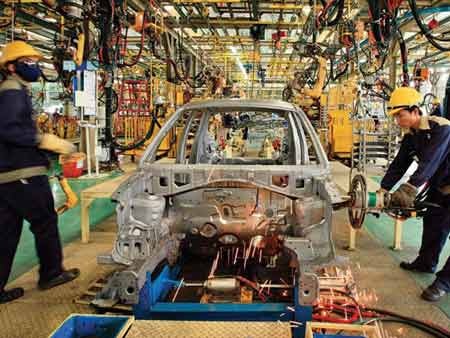 |
| The prospects for Vietnamese component manufacturers are currently quite bleak. |
According to Mr. Bui Ngoc Huyen, in early 2014, a delegation of 30 German businesses came to explore the possibility of investing in component manufacturing in Vietnam. However, upon seeing that current policies offered no incentives for manufacturers and that new policies had not yet been issued, they left without a return date.
Vietnam wants to participate in the regional and global automotive component supply chain, but so far has not implemented any effective policies to attract manufacturers.
In early 2011, the Government also issued Decision 12/2011 on policies for developing several supporting industries, including the automotive sector. However, to date, no enterprise or project has applied for incentives under this decision, because it is both too general and difficult to meet the standards and procedures which are too complex.
Meanwhile, the Vietnam Automobile Industry Development Plan to 2020, with a vision to 2030, recently drafted by the Ministry of Industry and Trade, also proposed several preferential policies for businesses investing in automobile and component manufacturing, but it has not been issued for nearly two years and remains only a draft.
While we were busy with the draft regulations, Thailand was already inventing new, more fuel-efficient, and cheaper vehicles, and not forgetting its export plans. In 2013, Thailand's car production reached 2.5 million units, and it is striving to be among the top 10 largest car-producing countries in the world, aiming for 3 million vehicles by 2015.
According to vietnamnet


