
PAPI Nghe An 2014: Soon to change color on the public administration map
(Baonghean.vn) - From 2011 to the present, the annual Provincial Public Administration Performance Index (PAPI) has become familiar to the public, the press, and especially to local government agencies.For this indicator, based on the 2014 results, Nghe An is in the middle range.
As the designers of PAPI explain, PAPI is built on the philosophy of viewing citizens as "users" (or "customers") of public authorities (or "service providers"), who have the capacity to monitor and evaluate the effectiveness of local governance and public administration.
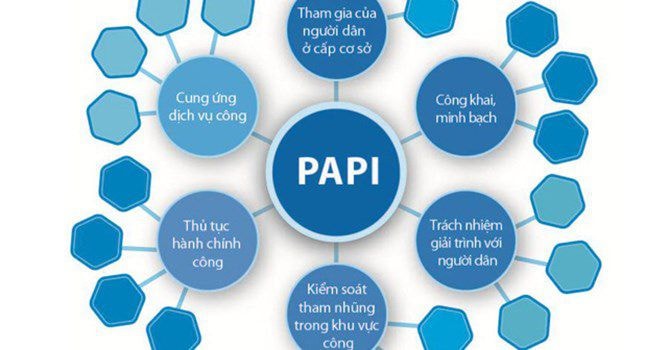 |
Based on observations, understanding, and experiences of "customers" regarding the "products" of the entire "production" process of local government agencies, PAPI provides an objective indicator system that contributes to evaluating the effectiveness of provincial-level governance and public administration, creating motivation for leaders at all levels in localities to continuously improve the effectiveness of government management.
Green Nghe An
Recently, the 2014 PAPI (Provincial Aptitude Test) results were released. In addition to the national indicators, there are noteworthy parameters for the local governments of each province/city, including Nghe An. The authors of the PAPI report indicated the ranking of the provinces using different colors. Provinces with high rankings are shown in dark green, those with average to above-average rankings in green, those with lower-average rankings in dark yellow, and those at the bottom in light yellow. Nghe An, throughout the years, including 2014, is shown in green, indicating an average to above-average ranking.
Nghe An's PAPI 2014 The 2014 survey results show that Nghe An is in the middle of the ranking, with average scores in most component indicators. Specifically, regarding public service delivery, Nghe An scored 6.7 points, while the highest score was 7.86; regarding public administrative procedures, the corresponding scores were 7.03 compared to 7.31; control of corruption in the public sector was 5.54 compared to 7.29; accountability to the people was 6.12 points compared to 6.54; transparency and openness was 6.12 compared to 6.73; and citizen participation at the grassroots level was 4.99 compared to the highest score of 5.77. |
In Nghe An's scores, it is noteworthy that the control of corruption in the public sector lags far behind the leading localities. Here, people not only see little improvement in the effectiveness of corruption control but also an increase in negative phenomena across several indicators in this area. According to people's assessments, "nepotism" in the recruitment of personnel into the public sector and the phenomenon of harassment and bribery by government officials still persist.
The index of citizen participation at the grassroots level reflects the situation nationwide, with relatively low scores. The quality of mobilizing citizens to participate in political life and local development tends to decline relatively sharply, with the "opportunity to participate" index showing the largest decrease in score. Indices on accountability, transparency, and the "right to know" about state policies are not low, but also not high, reflecting the general trend nationwide. Only the index on public administrative procedures seems promising with 7.03 points, but compared to other provinces, Nghe An only ranks in the above-average group. Considering the process, these indices for Nghe An have hardly changed much over the past four years, and some are even lower than in 2013, including public administrative procedures which scored quite highly in 2014.
What do I need to do to change it to dark blue?
To improve its ranking and enhance the effectiveness of public administration reform, Nghe An can learn from the experience of an increasing number of provinces and cities that view the PAPI Index as a tool to monitor and supervise the performance of all levels of government. By the end of 2014, at least 16 provinces and cities nationwide had issued directives or action plans to improve the PAPI Index, aiming to leverage strengths and address weaknesses in local governance and public administration. In addition, more than 30 provinces and cities organized in-depth analytical workshops on the PAPI Index and issued necessary directives and measures to improve areas of weakness. Some localities (e.g., Thanh Hoa, Thai Nguyen, and Long An) have used PAPI results as an indicator of local governance effectiveness in their efforts to attract investment.
For each specific issue, policymakers in Nghe An need to implement measures to promote citizen participation by creating conditions for people's voices and aspirations to be heard, and by establishing mechanisms for them to actively participate in grassroots political life. In the recommendations of the 2014 PAPI report, it is noteworthy that localities do not need to invest significant budgets to improve existing shortcomings in this area. The important thing is for local authorities at all levels to create conditions for people to actively participate in political life and to build and refine policies from the grassroots level, while complying with state regulations on local elections.
Local governments can enhance transparency by seeking reliable ways to share information with citizens of diverse demographics. Electronic portals at the provincial and district levels, public bulletin boards at People's Committees/wards/townships, and newsletters or loudspeakers at the village/neighborhood level remain effective tools for disseminating information transparently to the public, helping citizens exercise their right to know.
As analyzed, with low corruption control scores, it is even more necessary to continue implementing measures to prevent corruption. Surveys conducted over the years show that localities in the low-scoring group, such as Nghe An, can learn from provinces/cities with higher public ratings in ensuring fair recruitment; monitoring and minimizing the acceptance of money outside of regulations when providing public services; preventing officials and civil servants from abusing their positions and authority for personal gain through extortion when processing administrative procedures for citizens; using public funds for personal purposes; and accepting bribes in the recruitment of personnel into the public sector. At the same time, citizens also need to be more proactive in reporting acts of harassment and extortion by officials and civil servants to help reduce corruption and harassment.
The scores for public service delivery in Nghe An are not high, with public primary education services receiving lower user satisfaction ratings compared to the other three services. Therefore, all levels of government and the education sector need to pay more attention to investing in public primary education services, especially in two aspects: human resources and the interaction between service providers and the people.
With its human potential, Nghe An should have been among the top-ranked provinces in public administration reform. The crucial question is how determined the provincial government at all levels has been in its efforts to promote reform, transforming its position on the national public administration map from green to dark green.
Nguyen Duc Lam


