
Peru: 150 mummies belonging to an unknown civilization found in the desert.
A team of archaeologists from several universities in Poland, Peru, and Colombia has just discovered 150 mummies in the Atacama Desert, belonging to a previously unknown culture that may have existed nearly 500 years before the Tiwanaku and Inca civilizations.
The bodies found were naturally mummified through burial in sand without the use of any stone structures. The bodies were wrapped in linen, reed mats, or fishing nets. Radiocarbon dating revealed that the oldest mummy lived around the 4th century AD, while the youngest lived in the 7th century AD.
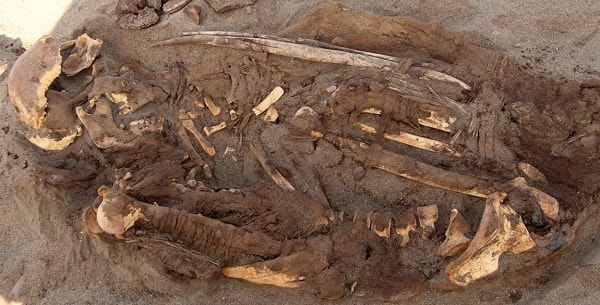 |
| A newly unearthed mummy in Atacama (Source: IBTimes) |
According to IBTimes UK, these mummies most likely belong to the Tiwanaku civilization, which existed from approximately 500 to 1000 AD. This civilization covered a vast area, almost encompassing present-day Peru and Chile.
Under the Tambo Project, the research team has been excavating the Tambo River delta area in the northern Atacama Desert since 2008. The first mummies were found there in 2012, but it wasn't until March 2014 that the team made major discoveries.
Besides the mummies buried in individual tombs, scientists also found many burial artifacts including weapons such as bows and arrows with obsidian tips, and maces with stone or bronze tips.
The tombs were also decorated with various embroidery tools, jewelry made from tumbaga (a gold and copper alloy), copper, thorny willow branches attached to the ears of the deceased, and relatively intact pottery.
According to Professor Józef Szykulski, the project's research team leader from Wrocław University, the mummies belonged to previously unstudied individuals, and the bows buried with them are a particularly interesting discovery. They were not only weapons but also served as symbols of power. This suggests that those buried in the Tambo River delta were nobles or members of the upper echelons of society.
"The bows found in Peru are particularly rare and belong to an earlier era. However, we have seen bows in areas further south, such as Chile, and further east, in the Amazonia. However, further research is needed on this matter," Szykulski told IBTimes UK.
In one of the tombs, archaeologists even found the remains of a llama. This means the animal had been brought to the area earlier than previously thought.
"Funerals accompanied by camels were quite common in pre-Columbian cultures," Szykulski said. "We gathered a lot of information about what equipment was used, such as baskets and fishing nets, what occupations the people had, their agriculture and fishing practices, how they dressed, what jewelry they liked to wear, and even how they styled their hair."
Polish archaeologists will return to Peru this October to continue their excavations. Work will take place both at the burial site where they found the mummies and at an adjacent location where several tombs believed to belong to the Tiwanaku civilization have been discovered.
It has long been believed that the Tiwanaku people did not venture as far as the Tambo River delta. The discovery of these tombs will help to enhance our understanding of pre-Columbian civilizations in Peru.
According to VNA


