
Breaking the ice in Australia-China relations: It's not that simple!
(Baonghean) - Australian Trade Minister Simon Birmingham recently visited China and attended the China International Import Expo (CIIE).
 |
| Breaking the ice in relations between Australia and China is no easy task. (Illustrative image) |
Strategic contradictions
The relationship between Australia and China is considered to be at its lowest point in years, as Canberra grapples with Beijing's increasingly assertive policies across the Indo-Pacific region.
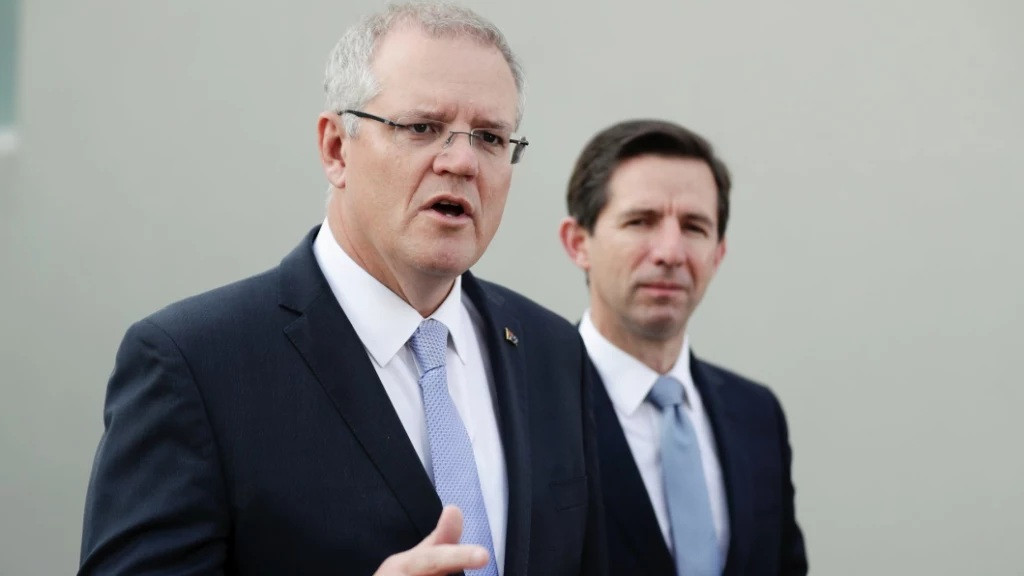 |
| Australian Trade Minister Simon Birmingham (right) and his trip to improve relations with China, in line with Prime Minister Scott Morrison's (left) policy. Photo: Sydney Morning Herald |
Intense verbal clashes between the two sides have been ongoing since late last year, concerning a range of issues, and truly erupted when Senator Concetta Fierravanti-Wells published an article heavily criticizing China for attempting to lure poor island nations neighboring Australia with preferential loans to increase its influence. Fierravanti-Wells even called this a "debt trap" tactic by Beijing, arguing that these poor countries would have difficulty repaying the loans.
Not easily dismissed, China completely rejected the article and heavily criticized its author, Senator Fierravanti-Wells. Beijing loudly asserted that China wants to help Pacific nations "without any political motives," and that any attempt to hinder these goals will fail.
Not only are numerous bilateral conflicts emerging, but as a close ally of the US, Australia naturally sides with the US on many issues to counter China.
Balanced choice
Despite strategic tensions and conflicts, both the old and new Australian administrations know that a quarter of their trade is with China. Meanwhile, in reality, however reluctantly, Australia is inadvertently caught in the middle of a geopolitical struggle between the two giants, the United States and China. Both are vying for the other's position as the leading power in the Indo-Pacific region. And Australia itself has its own geopolitical ambitions.
Therefore, behind the surface verbal clashes, Australia is still trying to maintain a balanced strategy to avoid impacting its economic interests as well as national security...
 |
| A greater US military presence in Australia pushes back against the threat from China but also puts Canberra in a difficult position in balancing its trilateral relationship with the US and China. Photo: Reuters |
For Australia's new Prime Minister, Scott Morrison, while serving as Treasurer, had some policies and views that were against Chinese businesses and individuals. However, overall, Morrison advocated for close economic cooperation with China, given the significant potential between the two sides. Upon his election as Prime Minister, the Chinese Ministry of Foreign Affairs also congratulated Morrison and affirmed that China's policy regarding its relationship with Australia has always been "consistent and clear."
In response to China's goodwill, in recent statements regarding relations between China and its ally the US, Australian Prime Minister Morrison has clearly demonstrated a balanced stance between the two sides, without taking sides with Washington. Looking back to early October, Prime Minister Scott Morrison affirmed that Australia would maintain a calm attitude amidst escalating tensions between the US and China in the South China Sea.
Prime Minister Morrison also affirmed, “Australia’s job is to work with all parties to reduce uncertainty, and that is what Australia is doing.” He added that, “Australia has close ties with both the US and China, so he is committed to working to achieve the most strategically beneficial results for the country.” He further stated that Australian Trade Minister Simon Birmingham’s visit to China is part of a strategy to improve relations with Beijing.
While the goal of achieving balance is considered, realizing it is clearly not simple and sometimes beyond Australia's control. According to observers, the escalating US-China trade war is negatively impacting the global economy, including Australia. Meanwhile, the US under President Donald Trump is clearly not pleased with a neutral ally like Australia.
It will all depend on Prime Minister Scott Morrison's ability to balance diplomacy. But perhaps this effort is also being distracted by Morrison himself preparing to face a very tough general election in Australia next year.


